
Why move to Northumberland? Because sometimes moving home is less about finding more rooms and more about creating more room in your life.
Northumberland gives people several very different ways to do that.
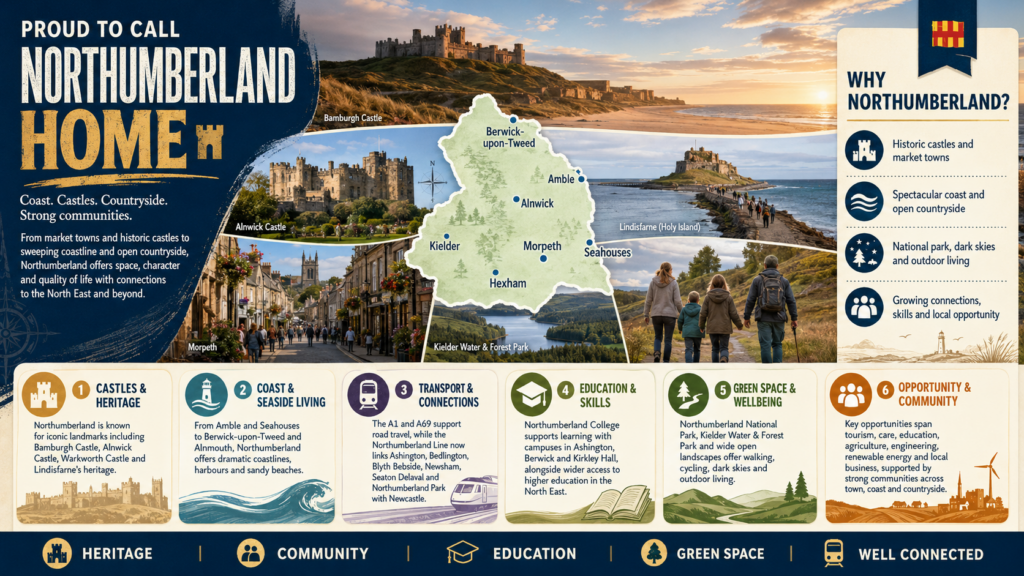
You can live near the North Sea in places such as Alnmouth, Amble, Bamburgh or Seahouses. You can choose a market town such as Morpeth, Hexham or Alnwick. For closer access to Newcastle, look towards Ponteland and the south-east of the county, or move inland to Rothbury, Wooler, the Tyne Valley, and the landscapes around Northumberland National Park.
The county can feel remote in one place and well connected in another.
That is why the useful question is not simply whether Northumberland is a good place to live.
It is which part of Northumberland supports the life you want to lead once you move.
When the decision becomes financial, you can explore Mortgage Brokers in Northumberland and compare advisers across the county.
From Market Towns to the North Sea: Choosing Your Part of Northumberland
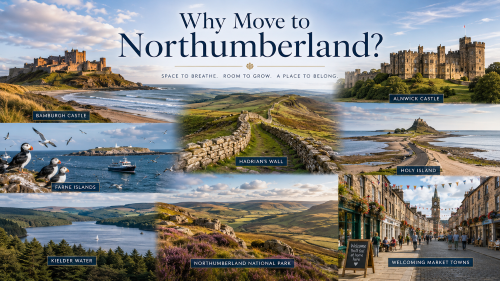
Northumberland does not offer one single way to live.
Morpeth combines an established town centre, schools, rail links and access towards Newcastle.
Hexham has a different character, with a historic centre and access to the Tyne Valley and countryside west of the county.
Alnwick combines heritage, local services and access towards the coast.
Ponteland sits much closer to Newcastle and Newcastle International Airport, which can make it attractive to households whose work remains centred on Tyneside.
Further north, Berwick-upon-Tweed offers a coastal border-town setting, with rail links north to Edinburgh and south to Newcastle and London.
The county’s smaller communities provide another choice entirely.
Rothbury, Wooler, Corbridge, Seahouses, Bamburgh, Alnmouth, and villages across the Tyne Valley, Coquetdale, and the national park area can appeal to people who value landscape, space, or a quieter setting more.
This means two people asking why move to Northumberland may have completely different priorities.
One may need access to Newcastle.
Another may want the coast.
Someone else may want a village where the nearest city matters far less than the countryside outside the front door.
That range is one of Northumberland’s defining advantages.
Northumberland Housing: Price Is Only the Beginning
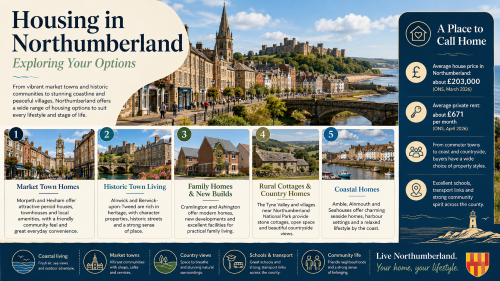
Housing in Northumberland varies substantially by property type and location.
The Office for National Statistics recorded an average house price in Northumberland of £213,000 in July 2026, up 7.3% over the year. It was the highest average house price among North East local-authority areas at that point.
Property type created a sizeable difference:
- detached homes averaged £373,000;
- semi-detached homes averaged £205,000;
- terraced homes averaged £172,000;
- flats and maisonettes averaged £106,000.
First-time buyers paid an average of £175,000, while mortgage buyers paid £217,000 on average.
Those figures provide useful context, but Northumberland varies too much for a single county average to explain an individual purchase.
A buyer might be comparing:
- a newer family home around Cramlington;
- a period property in Morpeth;
- a coastal home near Amble or Seahouses;
- a stone cottage around Rothbury;
- a larger rural property outside Hexham;
- a high-value home near Ponteland;
- a traditional property close to Alnwick;
- a first home in one of the south-east Northumberland towns.
The property itself can matter as much as the postcode.
Older construction, listed status, larger plots, outbuildings, private access, rural location, coastal exposure or unusual building materials may all affect valuation or lender criteria.
That is why a county with comparatively accessible headline prices can still produce complex mortgage cases.
Education, Distance and Daily Family Life
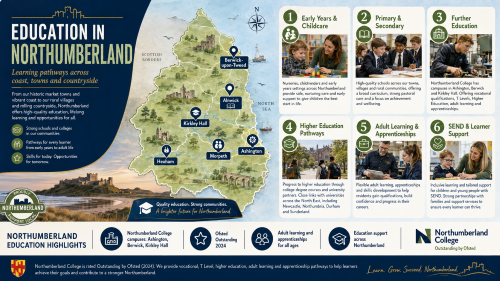
For families, education can influence not only where they move but how the household works afterwards.
Northumberland includes state schools, academies, further education and independent education options. The practical question is often not simply which school a family prefers, but how far away it is and how the daily journey fits with work and childcare.
That matters more in a county with large rural areas.
Northumberland County Council’s school transport policy makes clear that eligibility depends on factors including age, distance, the nearest suitable school and whether a walking route is considered available and safe. Families choosing a school outside the relevant priority arrangements may need to organise transport themselves.
Before choosing an area, it can therefore help to consider:
- school journey times;
- available bus or rail routes;
- after-school arrangements;
- childcare;
- whether both parents commute;
- fuel and transport costs;
- school fees where applicable;
- how education expenditure affects wider affordability.
For households planning independent education, Education Finance may be relevant alongside the mortgage decision.
A property that looks affordable in isolation may feel different once transport, childcare and education costs are added.
Work Is Changing the Geography of Northumberland
Not everybody moving to Northumberland is leaving work behind.
The county has employment across healthcare, retail, transport, manufacturing, tourism, utilities, energy and other sectors. Northumberland County Council’s latest economic reporting also identifies advanced manufacturing, digital and AI, life sciences and pharmaceuticals, and offshore renewable energy as strategically important sectors.
The visitor economy is also significant. Council reporting puts Northumberland’s visitor economy at around £1.58 billion in 2025, with 11.13 million visitors recorded in the latest performance reporting.
This produces different types of mortgage applicants.
Some borrowers will have a straightforward salary.
Others may have:
- seasonal earnings;
- overtime;
- self-employed income;
- company-director income;
- retained profits;
- income from tourism businesses;
- agricultural or land-based income;
- multiple sources of earnings.
That can make lender choice important.
A borrower with strong annual earnings may still find that lenders interpret those earnings differently depending on how predictable, evidenced and sustainable the income is.
For someone relocating for a job, a business, or a change in working pattern, the mortgage should be considered alongside how that income is structured.
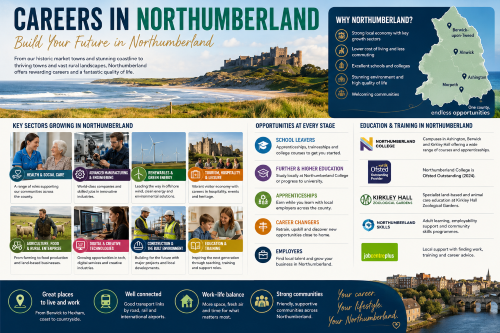
The Northumberland Line Has Changed Commuting Choices
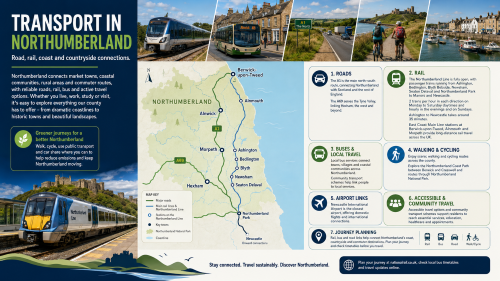
Transport has become a more important part of the relocation discussion in south-east Northumberland.
The reopened Northumberland Line restored passenger rail services between Ashington and Newcastle, improving connections for communities along the route. The final new station at Bedlington opened in March 2026, completing the planned six-station scheme.
In 2026, Northumberland County Council reported that the line had already carried well over one million passenger journeys.
That matters for people comparing places such as:
- Ashington;
- Bedlington;
- Blyth-area communities;
- Seaton Delaval;
- Cramlington;
- locations with onward access to Newcastle.
Elsewhere, rail links from Morpeth, Alnmouth and Berwick-upon-Tweed connect to the East Coast Main Line.
Road journeys remain important, particularly in more rural parts of the county where public transport options can be more limited.
Anyone considering moving to Northumberland should therefore look beyond headline journey times.
Consider:
- how often you need to commute;
- station access;
- parking;
- school journeys;
- winter driving;
- fuel costs;
- hybrid working;
- how far daily services are from the property.
A rural home may provide more space, but convenience has a value too.
Coast, Dark Skies and Space Become Part of Everyday Life
Northumberland’s landscape isn’t just something people visit on weekends.
For residents, it can become part of ordinary life.
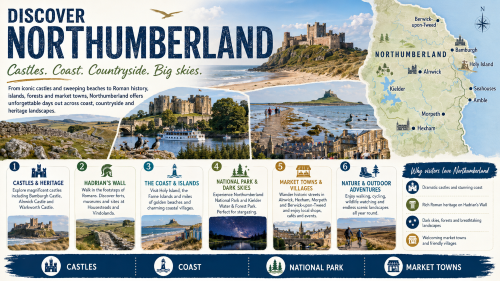
The Northumberland Coast National Landscape stretches along around 40 miles of protected coastline between Berwick-upon-Tweed and Amble, with beaches, dunes, wildlife sites and historic landmarks.
Northumberland National Park covers more than 400 square miles and includes the Cheviot Hills, sections of Hadrian’s Wall and access towards Kielder. In 2026, the park marked its 70th anniversary.
The area is also notable after dark.
Northumberland National Park and most of Kielder Water & Forest Park form an International Dark Sky Park. The National Park describes the area as having some of England’s most pristine dark skies.
For someone moving from a large town or city, these differences can change daily life considerably.
Weekends may involve:
- walking;
- cycling;
- beaches;
- castles;
- wildlife;
- stargazing;
- coastal villages;
- market towns;
- national park landscapes.
These things do not appear in a mortgage calculation.
Yet after the move, they may be some of the reasons the location feels worthwhile.
Food, Heritage and Local Identity Matter More After You Move
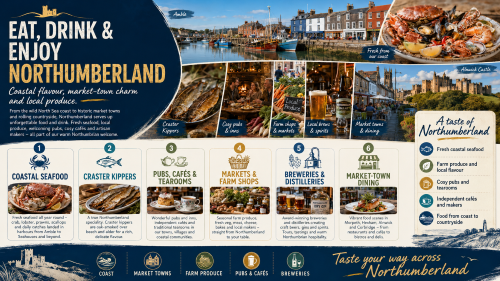
Northumberland has a strong local identity shaped by its coast, farms, market towns and history.
Coastal communities such as Craster, Amble, Seahouses and Berwick-upon-Tweed provide seafood, pubs and independent businesses.
Inland, towns such as Morpeth, Hexham, Alnwick and Corbridge offer cafés, restaurants, markets and traditional town centres.
The county’s landmarks are equally distinctive.
Northumberland is associated with:
- Bamburgh Castle;
- Alnwick Castle;
- Hadrian’s Wall;
- Lindisfarne;
- Dunstanburgh Castle;
- the Farne Islands;
- Kielder;
- Northumberland National Park.
The Northumberland coast also contains more than 30 miles of beaches, according to Visit Northumberland.
These may sound like visitor attractions before someone moves.
Afterwards, they become part of the wider lifestyle around the home.
That distinction matters.
When deciding to relocate, consider not only the property you can buy, but what life around it will actually offer.
Moving to Northumberland Means Thinking About the Property as Well as the Mortgage
Mortgage planning becomes more useful when it begins before a buyer commits emotionally to a property.
Northumberland’s housing includes homes that can fall outside straightforward suburban lending assumptions.
A lender may need to consider:
- property construction;
- age and condition;
- acreage;
- outbuildings;
- private roads;
- access rights;
- listed status;
- coastal location;
- flood information;
- rural valuation evidence;
- commercial or agricultural use nearby.
That does not mean these properties cannot be mortgaged.
It means the lender’s criteria need to fit the property.
A conventional house in Cramlington may produce a very different underwriting process from a stone cottage near the Cheviots or a coastal home close to Bamburgh.
If you are comparing several areas, Find a Mortgage Adviser by Location can help you identify advisers covering the places you are considering.
The important question is not simply:
“Can I afford this house?”
It is also:
“Does the property, borrowing and wider cost of living still make sense together?”

Higher-Value Homes Exist, but Northumberland Is Not One HNW Market

Northumberland should not be labelled as uniformly high-value.
The ONS county average of £213,000 shows why that would be misleading.
However, certain areas can have higher property values and require more substantial borrowing.
Examples can include:
- Ponteland;
- Darras Hall;
- parts of Morpeth;
- Corbridge;
- selected Tyne Valley villages;
- Alnmouth;
- Bamburgh;
- sought-after rural and coastal homes.
Detached homes across Northumberland averaged £373,000 in July 2026, considerably above the county-wide figure.
The borrower may also have a more complex financial profile, including:
- dividends;
- retained profits;
- bonuses;
- investment income;
- partnership drawings;
- rental income;
- business ownership;
- income from several assets or companies.
In these circumstances, proximity should not be the only factor when choosing an adviser.
Experience with High Net Worth Mortgage Brokers may be relevant where the borrowing requirement, property value or income structure falls outside standard lender assessment.
Specialist advice is not simply about access to larger loans. It is understanding how a lender will interpret the entire financial picture.
Later-Life Moves Can Have Different Priorities
Not every move is driven by a growing family or a new job.
Northumberland can also appeal to people whose priorities are changing later in life.
Someone may be:
- downsizing;
- leaving a larger urban home;
- moving closer to family;
- relocating towards the coast;
- looking for a quieter market town;
- moving after retirement;
- reducing monthly household costs;
- thinking about how property wealth fits into later-life finances.
Places such as Hexham, Morpeth, Alnwick, Corbridge and coastal communities can appeal for very different reasons depending on lifestyle, services and family connections.
The financial questions can change too.
Someone approaching retirement may need to consider whether:
- an existing mortgage should be repaid;
- pension income will support new borrowing;
- downsizing releases enough capital;
- the new property will remain suitable over time;
- housing wealth should remain untouched;
- later-life borrowing needs to be considered.
Equity release should be treated as a separate specialist decision rather than an extension of a standard residential mortgage.
Where relevant, homeowners can explore Equity Release Advisers in Northumberland. The current Northumberland equity release page also reflects the county’s property diversity, including coastal, rural and detached homes.

Why Northumberland Can Suit Different Stages of Life
One reason why moving to Northumberland remains a useful question is that the answer may change with age, work and family circumstances.
A first-time buyer may concentrate on Cramlington, Ashington, Bedlington or other areas where their budget stretches differently.
A commuter may prioritise Morpeth, Ponteland, or locations that benefit from the Northumberland Line.
A family may focus on schools, outdoor space and access to Newcastle.
Someone working remotely may value a larger home or rural setting more than proximity to a station.
A higher-income household may compare Ponteland, Darras Hall, Corbridge or selected coastal locations.
Someone approaching retirement may care more about community, healthcare access, shops, walking routes or proximity to family.
The county does not provide one answer.
That is its strength.
A good move should still make sense when the excitement of the property search has disappeared and ordinary life has taken over.
People who found this page helpful also explored these related topics:
Mortgage Broker in Wooler: Expert Mortgage Advice for NE71
Mortgage Broker in Seahouses: Start With the Right Questions
Rothbury Mortgage Advice: Start With the Full Picture
Prudhoe Mortgage Advice: Make Every Decision Count
Mortgage Broker in Ponteland NE20: Confidence Before Commitment
Newbiggin-by-the-Sea Mortgage Advice: Make Your Advice Count
Neighbouring Counties
FAQs: Why Move to Northumberland?
Is Northumberland suitable if I still need to work in Newcastle?
It depends on where you choose to live and how often you travel. Morpeth and parts of south-east Northumberland have established connections towards Newcastle, while the reopened Northumberland Line now provides passenger rail services between Ashington and Newcastle through several communities. Rural and northern parts of the county can involve much longer journeys, so compare actual door-to-door travel rather than county distance alone.
Does Northumberland offer better value than other parts of England?
Property prices are lower than in many southern English counties, but Northumberland should not be treated as uniformly inexpensive. The average house price was £213,000 in July 2026, while detached homes averaged £373,000. Coastal, rural and higher-value locations can sit well above local averages.
What should I consider before buying a rural home in Northumberland?
Look beyond the asking price. Consider construction, access, land, outbuildings, drainage, utilities, broadband, nearby services and how easily a lender can value the property. Some homes may also sit on private roads or have unusual boundaries. The relevant issues depend on the individual property, not simply on it being rural.
Are coastal homes in Northumberland different to mortgage?
Not automatically, but the lender and valuer may consider the specific location, condition, construction, exposure, insurance and comparable sales. A conventional house in Amble may raise different questions from an older or more isolated home closer to the protected coastline. The property should be discussed with an adviser before lender selection.
What are the main areas to consider for families moving to Northumberland?
That depends on work, school and lifestyle priorities. Morpeth, Cramlington, Ponteland, Hexham, and Alnwick can each appeal for different reasons, while smaller communities may offer more space or access to the countryside. Families should compare school journeys, commuting, childcare, local services, and housing costs rather than choosing an area based on reputation alone.
Is Northumberland practical for retirement?
It suits people looking for market-town, coastal, or rural living, but practical access matters. Consider healthcare, shops, public transport, family connections and how manageable the property will remain over time. Downsizing, an existing mortgage and retirement income may also change the financial side of the move.