
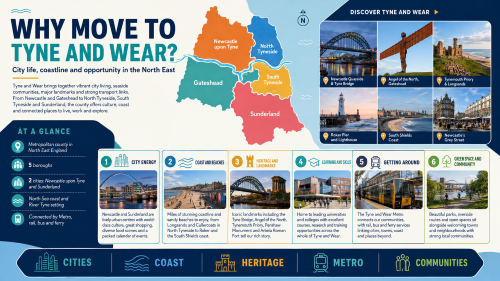
Why move to Tyne and Wear? Because where you live shapes far more than the view from your window. It influences how you travel, where you work, what your home costs, how you spend weekends and what choices remain open later in life.
Tyne and Wear brings several very different lifestyles together.
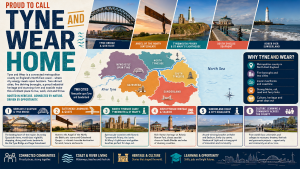
Newcastle upon Tyne offers city living, universities, employment and culture. Gateshead sits immediately across the River Tyne, with established neighbourhoods and major leisure and cultural destinations. Sunderland combines an urban centre with a coastline around Roker and Seaburn. North Tyneside includes communities such as Tynemouth, Whitley Bay, North Shields and Wallsend, while South Tyneside includes South Shields, Hebburn and Jarrow.
That variety gives people a genuine choice between city, coast, suburb and riverside living without leaving the wider Tyne and Wear area.
The useful question is not simply whether Tyne and Wear is a good place to live. It is which part best supports the life you expect to lead after you move.
When your property search becomes a financial decision, you can explore Mortgage Brokers in Tyne and Wear and compare advisers covering the region.
City Streets, Coastline and Communities: Different Ways to Live
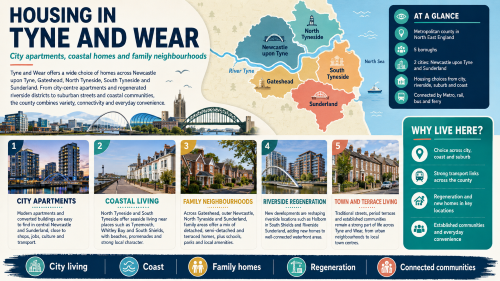
Tyne and Wear has no single residential identity.
Newcastle upon Tyne suits people who want employment, nightlife, universities, shopping, and rail connections close to home. Areas such as Jesmond, Gosforth, Heaton and Ouseburn each offer a different mix of housing and everyday life.
Across the river, Gateshead offers everything from established residential streets to newer developments, with access to Newcastle city centre.
Further east, the character changes.
Tynemouth, Whitley Bay and Cullercoats offer coastal living with access to the Metro. North Shields combines traditional neighbourhoods, regeneration, and connections to Fish Quay.
South of the Tyne, South Shields has its own coastline and town centre, while Hebburn and Jarrow provide residential locations with Metro access towards Newcastle and Sunderland.
Sunderland adds another city centre, university, employment base and coastline.
That range is one of the strongest answers to why move to Tyne and Wear. One household may want to walk to a Metro station. Another may prioritise the beach. Another may need access to Newcastle, Sunderland or a major employment site.
The right location depends on how those priorities fit together.
Tyne and Wear Housing: Five Areas, Very Different Numbers
Housing costs vary noticeably across Tyne and Wear, so a single regional average would hide more than it explains.
The latest ONS figures for July 2026 recorded average house prices of:
- £208,000 in Newcastle upon Tyne
- £206,000 in North Tyneside
- £162,000 in South Tyneside
- £156,000 in Gateshead
- £147,000 in Sunderland
The difference becomes just as relevant for first-time buyers. Average first-time buyer prices were £182,000 in Newcastle, £179,000 in North Tyneside, £146,000 in South Tyneside, £141,000 in Gateshead and £131,000 in Sunderland.
Those figures help explain why two people moving to Tyne and Wear with the same budget may end up considering very different homes.
A buyer could be comparing:
- a city apartment in Newcastle;
- a Victorian terrace in Heaton;
- a family home in Gosforth;
- a coastal property in Tynemouth or Whitley Bay;
- a suburban home in Gateshead;
- a terraced or semi-detached home in Sunderland;
- a property near the coast in South Shields.
Property type matters as well as location.
City-centre flats can raise questions around lease terms and service charges. Older terraces may require closer consideration of condition or construction. Coastal homes can raise different valuation or insurance questions. New-build developments may have lender-specific criteria.
The numbers therefore start the conversation. They do not replace an assessment of the individual property.
Education Can Shape More Than the School Run

Education can play a significant part in deciding where to live in Tyne and Wear.
Newcastle has a strong higher-education presence, including Newcastle University and Northumbria University. Sunderland also has its own university, while further education and technical training are available across the wider area.
Families looking at independent education also have genuine local options.
The Royal Grammar School Newcastle is an independent co-educational day school in Jesmond for pupils aged 7 to 18. Its 2026–27 fees are published at £17,537 for the Junior School and £20,817 for the Senior School, including VAT.
Dame Allan’s Schools also operate in Newcastle, with junior and senior sites within the city.
For families, however, the decision should extend beyond choosing a school.
It is worth considering:
- journey times;
- transport arrangements;
- childcare;
- school fees;
- whether parents commute in different directions;
- how education costs affect disposable income;
- whether a move changes other household commitments.
If independent education is part of the longer-term plan, Education Finance may be relevant.
A property and the life built around it are rarely separate financial decisions.
Tyne and Wear’s Economy Gives People Reasons to Move Towards It
Not everyone living in Tyne and Wear is travelling elsewhere for work.
The wider North East economy supports activity across advanced manufacturing, clean energy, creative industries, artificial intelligence, defence, digital industries and professional services. These areas are identified within the North East Combined Authority’s current growth priorities.
Within Tyne and Wear itself, employment patterns differ by location.
Newcastle supports substantial employment in professional services, digital industries, healthcare, education, finance and the public sector.
Sunderland has long-standing links with advanced manufacturing and automotive production, alongside education, healthcare, digital industries and port-related activity.
Gateshead contributes through retail, culture, logistics, public services and business activity.
North and South Tyneside has strong links to marine industries, offshore activity, healthcare, education, ports, and local services.
That variety can also produce different mortgage applications.
Some movers have straightforward salaried income. Others may receive:
- overtime;
- shift allowances;
- bonuses;
- commission;
- contractor income;
- company-director income;
- dividends;
- retained company profits;
- income from more than one job or business.
For someone relocating for work, the mortgage question may therefore depend as much on how income is earned and evidenced as on the home’s price.

Metro, Rail and Road Connections Change the Shape of the Region
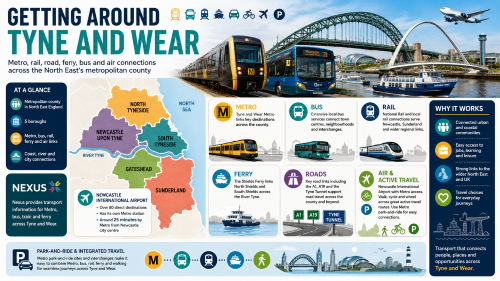
Transport is one of the most distinctive practical reasons for living in Tyne and Wear.
The Tyne and Wear Metro connects Newcastle city centre with Gateshead, Sunderland, Newcastle International Airport, North Tyneside and South Tyneside.
Its network includes locations such as:
- Jesmond;
- South Gosforth;
- Wallsend;
- North Shields;
- Tynemouth;
- Whitley Bay;
- Gateshead;
- Heworth;
- Jarrow;
- South Shields;
- Seaburn;
- Sunderland.
The official network map also shows interchange points with rail, buses and the Shields Ferry.
That connectivity can change what feels like a realistic home search.
Someone working in central Newcastle may not need to live in Newcastle itself. A home in North Tyneside, Gateshead or South Tyneside may still offer a workable daily journey.
Road connections include the A1, A19, A184, and A194, linking parts of Tyne and Wear with Northumberland, County Durham, and the wider North East.
However, commuting should still be assessed as part of everyday life.
Consider:
- walking time to the station;
- frequency of services;
- ticket costs;
- parking;
- school runs;
- shift patterns;
- road congestion;
- hybrid working;
- how often the journey will actually be made.
A cheaper home doesn’t automatically mean a cheaper lifestyle if travel eats up the difference.
Landmarks, Coast and Culture Give Tyne and Wear Its Identity
Tyne and Wear has a strong visual and cultural identity.
The Tyne Bridge connects Newcastle and Gateshead and remains one of the North East’s best-known landmarks.
Gateshead adds the Angel of the North, BALTIC Centre for Contemporary Art and The Glasshouse.
Along the coast, Tynemouth Priory and Castle, King Edward’s Bay, Cullercoats and Whitley Bay create a very different environment from the urban core.
Sunderland offers Roker Pier, Roker Beach, and Seaburn, while South Shields has its own seafront, parks, and coastal heritage.
Sport also shapes the region’s character, particularly through Newcastle United and Sunderland AFC.
For residents, however, attractions matter less as a visitor checklist and more because they shape weekends, social life and the sense of place around a home.
That is another reason why move to Tyne and Wear can have more than one answer.
The region lets you live near a major city, a coastline, established cultural venues, and substantial green space without having to choose between them.

Food, Culture and the Places That Become Part of Everyday Life
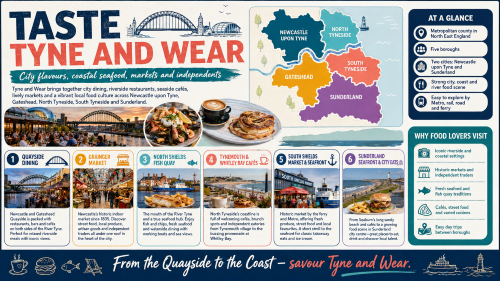
People rarely choose where to live based on house-price data alone.
Newcastle has a broad mix of restaurants, cafés, pubs, music venues, theatres and nightlife.
The Quayside connects Newcastle and Gateshead through one of the region’s most recognisable urban settings.
Ouseburn has developed its own mix of independent venues, food, music and creative spaces.
Further east, the character changes again.
Tynemouth offers independent restaurants, cafés and coastal dining, while North Shields Fish Quay remains strongly associated with seafood and its working harbour.
Whitley Bay has a growing mix of cafés, bars and restaurants around the town and seafront.
Sunderland’s Roker and Seaburn areas offer coastal dining and leisure options, while South Shields combines seafront attractions with a town centre shaped by several communities and food traditions.
These things can look secondary when comparing mortgage payments.
After you move, they often become part of your weekly routine and determine whether a location actually feels right.
Mortgage Planning Should Move With the Property Search
Looking for a home is more useful when you plan your mortgage at the same time.
Tyne and Wear has relatively accessible housing in some locations and higher-value pockets in others. The required amount, deposit, property type, and income structure can therefore change significantly over a short distance.
A mortgage decision may involve:
- deposit size;
- loan-to-value;
- lender affordability;
- monthly payments;
- credit history;
- mortgage term;
- valuation;
- construction type;
- leasehold considerations;
- existing borrowing.
Someone buying a Newcastle city-centre flat may encounter different lender questions from someone buying a detached property in Gosforth.
A coastal home in Tynemouth may need to be assessed differently from a newer property in Washington.
A traditional terrace in Gateshead or Sunderland can create a different mortgage case again.
If you are comparing several parts of the region, Find a Mortgage Adviser by Location can help you identify advisers covering the places you are considering.
The better question is not simply:
“How much can I borrow?”
It is:
“How much can I borrow while still leaving enough room for the life I want after I move?”
That distinction matters when housing, travel, childcare, education, and other household costs are all changing at once.

Higher-Value Homes and More Complex Borrowing in Tyne and Wear

Tyne and Wear should not be described as a high-net-worth region as a whole.
However, some neighbourhoods and property types sit well above the local averages.
In July 2026, detached homes averaged £397,000 in Newcastle upon Tyne and £382,000 in North Tyneside.
Individual homes in areas such as Jesmond, Gosforth, Tynemouth and parts of Whitley Bay can sit substantially above those averages.
Larger borrowing can also coincide with more complicated income.
Applicants may receive:
- annual bonuses;
- partnership income;
- dividends;
- retained company profits;
- investment income;
- rental income;
- income from several businesses;
- substantial savings or investments.
This is where geography should not be mistaken for financial status.
A high-value home does not automatically make somebody a high-net-worth mortgage customer, and living in an expensive postcode does not make a mortgage application straightforward.
Where substantial assets, complex income or larger borrowing requirements are involved, High Net Worth Mortgage Brokers may provide a more relevant adviser search.
The need for specialist experience should be driven by the case, not the postcode.
When Moving Becomes Part of a Later-Life Plan
Not every move is about gaining another bedroom or reducing the commute.
Some people considering why move to Tyne and Wear may be thinking about retirement, downsizing or living closer to family.
Priorities can change.
A homeowner may want:
- a smaller property;
- lower household running costs;
- access to the coast;
- easier public transport;
- fewer stairs;
- proximity to children or grandchildren;
- access to healthcare and local services;
- to understand how housing wealth fits into retirement.
Coastal communities such as Whitley Bay, Tynemouth and South Shields may appeal for different reasons from central Newcastle or Sunderland.
The financial questions can also change.
Someone approaching retirement may need to consider pension income, an existing mortgage, downsizing proceeds, or whether to keep borrowing into later life.
Equity release is not simply another version of a residential mortgage. It is a specialist decision that can affect inheritance, means-tested benefits and future financial choices.
Where relevant, homeowners can explore Equity Release Advisers in Tyne and Wear. The current Connect Lifetime page also explains that property value, age, existing borrowing and the amount required can influence the options available.

Tyne and Wear Can Make Sense at Different Stages of Life
The reasons for moving often change with age and circumstances.
A graduate may choose Newcastle for work, universities, and social life.
A first-time buyer may compare Gateshead, Sunderland, Jarrow or parts of Newcastle depending on budget and transport.
A family may look towards Gosforth, North Tyneside, Washington or established suburban communities.
Someone working in central Newcastle may prioritise Metro access over city-centre living.
A coastal move may make Tynemouth, Whitley Bay, Cullercoats or South Shields more attractive.
Someone approaching retirement may place greater emphasis on transport, local services and access to the coast.
The county does not offer one ideal lifestyle.
Its strength is that city, suburban, riverside and coastal living sit within the same connected area.
A successful move should therefore work beyond completion day.
It should still make sense if employment changes, children get older, commuting patterns alter or financial priorities shift.
Browse Our Advisers in Tyne and Wear
Once you know where you would like to live, the next question is whether the mortgage fits both the property and the circumstances behind the move.
Connect Experts lets users compare advisers by location, experience, and other preferences.
The existing Tyne and Wear directory features advisers across the region and notes that mortgage cases may differ by housing type, borrower circumstances, and local valuation patterns.
Choose an adviser based on the decision you need to make, rather than simply selecting the nearest postcode.
Connect Experts is a mortgage adviser directory and matching platform. It does not provide mortgage advice directly. Advice is provided by the adviser or firm you choose.




People who found this page helpful also explored these related topics:

Mortgage Broker in Whitley Bay: Premium Mortgage Advice!

Mortgage Broker in Longbenton: Trusted Mortgage Advice

Mortgage Broker in Jarrow: Clear Advice for NE32 Clients

Mortgage Broker in Wallsend: UK Trusted Advice

Mortgage Broker in South Shields

Mortgage Broker in Gateshead: Trusted Advice for Clients
Neighbouring Counties
FAQs: Why Move to Tyne and Wear?
Is Tyne and Wear a good choice if I want city life without living far from the coast?
It can be. Newcastle, Gateshead, and Sunderland are major urban centres, while Tynemouth, Whitley Bay, Cullercoats, South Shields, Roker, and Seaburn offer coastal living. The Metro connects many of these locations, so you can combine city access with a home closer to the coast.
Where are first-time buyer prices lower across Tyne and Wear?
The Lincolnshire Wolds, villages around Louth and Horncastle, the Market Rasen area, and many communities across central and southern Lincolnshire offer a distinctly rural character. Rural living offers space and countryside access, but buyers should also consider road travel, broadband, private drainage, property maintenance, and access to local services.
Which Tyne and Wear areas suit someone who relies on public transport?
The Metro is particularly useful for households that want to reduce reliance on a car. It links central Newcastle with Gateshead, North Tyneside, South Tyneside, Sunderland and Newcastle International Airport. Choosing a home close to a station can materially change the daily commute, although service frequency, ticket costs and the full door-to-door journey should still be compared.
Does Tyne and Wear offer independent education?
Yes. Newcastle has established independent schools, including the Royal Grammar School Newcastle and Dame Allan’s Schools. Families considering independent education should factor fees, travel, childcare, and broader household commitments into long-term housing and mortgage planning.
Are coastal homes in North Tyneside automatically more difficult to mortgage?
No. A coastal location does not automatically make a property unsuitable for mainstream lending. However, individual homes may need closer consideration depending on construction, condition, lease terms, insurance, exposure and valuation. The property itself should be assessed rather than making assumptions from the postcode alone.
What should I compare before deciding where to live in Tyne and Wear?
Compare more than the purchase price. Consider commuting, Metro access, schools, childcare, property type, service charges where relevant, access to employment, coastal versus urban living and the amount of borrowing that leaves sufficient room for other household costs. A lower-priced home may not be the better financial choice if it significantly increases travel or other regular expenditure.