
Why move to Herefordshire? Sometimes the right move isn’t about getting closer to everything. It is about deciding which things you are happy to have more space between.
Herefordshire offers that choice.
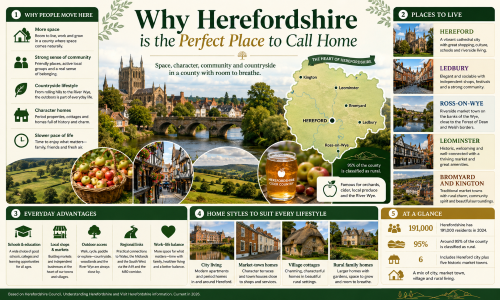
This largely rural county on the Welsh border is shaped by the River Wye, orchards, farmland, wooded valleys, historic market towns, and distinctive black-and-white villages. Hereford provides the county’s main urban centre, while Ledbury, Leominster, Ross-on-Wye, Bromyard and Kington offer very different versions of smaller-town life.
For some people, the appeal is space. For others, it is scenery, community, a character property, or the chance to live where the countryside is part of everyday life rather than something you visit on weekends.
That variety is what makes Herefordshire worth considering.
The more useful question is not simply whether Herefordshire is a good place to live. It is which part of the county fits the life you want after the move.
When that decision also involves borrowing, you can explore Mortgage Brokers in Herefordshire and compare advisers serving different parts of the county.
Market Town, Village or Open Country: Different Ways to Live in Herefordshire
Herefordshire should not be judged through one town alone.
Hereford is the county’s main city and provides the broadest concentration of shops, healthcare, education, employment and transport services. Yet much of the character of the county comes from its smaller towns and rural communities.
Ledbury combines a historic centre with access towards the Malvern Hills.
Ross-on-Wye overlooks the River Wye and provides access towards the Wye Valley.
Leominster is closely associated with north Herefordshire’s black-and-white villages, including communities such as Weobley, Pembridge and Eardisland.
Bromyard has a traditional market-town character, while Kington sits towards the Welsh border and is strongly associated with walking and the surrounding countryside.
This creates very different decisions for someone asking why move to Herefordshire.
One household may want to be within easy reach of Hereford. Another may want a market town with shops and local services. Someone else may prioritise land, views, village life or access to the Wye Valley.
Herefordshire lets you make those choices within the same county, but the practical differences can be significant.
Herefordshire Homes: Character, Space and Different Price Points
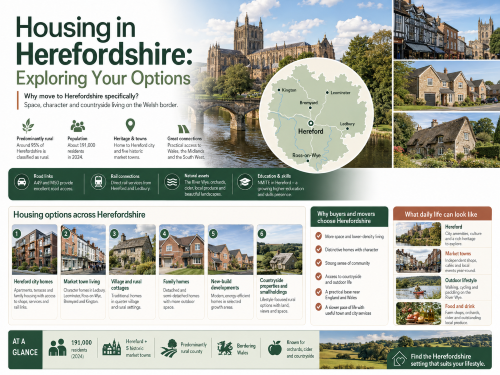
Housing is one of the strongest reasons people consider Herefordshire.
The county includes:
- city terraces and flats;
- period townhouses;
- timber-framed properties;
- cottages;
- converted barns;
- farmhouses;
- detached family homes;
- village properties;
- listed buildings;
- homes with acreage or outbuildings.
The latest ONS figures show that the average house price in Herefordshire was £290,000 in July 2026. First-time buyers paid an average of £224,000, while mortgage buyers paid an average of £282,000.
Property type makes a substantial difference:
- Detached homes: £446,000
- Semi-detached homes: £279,000
- Terraced homes: £210,000
- Flats and maisonettes: £127,000
These figures are county averages, not valuations for individual properties.
That distinction matters in Herefordshire because property characteristics can vary unusually.
A modern home on the edge of Hereford may present relatively conventional lender questions.
A listed cottage, converted barn, property with private drainage or rural house with land may require closer consideration of construction, access, valuation, resaleability and lender criteria.
For buyers entering the market for the first time, first-time buyer mortgage guidance can also help explain how deposits, affordability and the application process fit together.
Education Can Become Part of the Location Decision
For families, choosing a house and an education route can be closely linked.
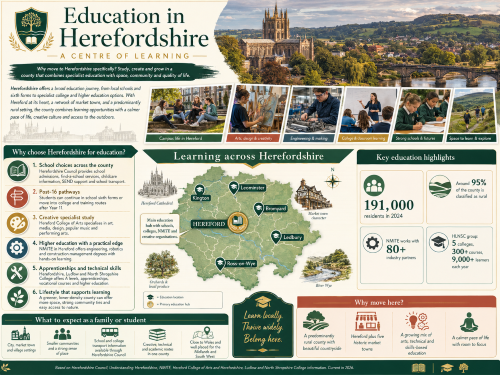
Herefordshire offers maintained primary and secondary schools, academies, sixth forms, further education and independent education.
Herefordshire Council lists 79 primary schools across the county and publishes separate information on catchment areas and admissions arrangements.
Further and specialist education is also available through institutions such as Herefordshire and Ludlow College, Hereford College of Arts and NMITE.
Independent education is another consideration. Hereford Cathedral School is an independent co-educational school serving pupils through senior school and sixth form.
For a family considering moving to Herefordshire, education involves more than school reputation.
Practical considerations may include:
- catchment areas;
- rural school transport;
- journey times;
- childcare;
- whether both parents commute;
- independent-school fees;
- changes to household expenditure after moving.
The county’s rural geography makes travel especially important. A school that appears relatively close on a map may still create a substantial daily journey.
Families considering independent education alongside their wider finances can also explore Education Finance.
Herefordshire's Economy Blends Rural Industries with Newer Specialisms
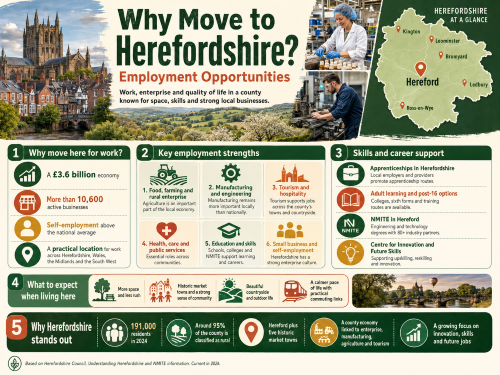
Not everyone moving to Herefordshire is travelling elsewhere for work.
The county has a distinctive economy built around agriculture, food production, tourism, public services, manufacturing, education and a growing number of specialist industries.
Farming remains highly visible across Herefordshire. Orchards, livestock, arable land, and food producers shape both the local economy and the county’s identity.
Hereford also supports employment through healthcare, education, retail, professional services and public-sector organisations.
In addition, Herefordshire Council identifies economic development, housing and growth, transport and infrastructure as important parts of its wider economy and environment work.
The Hereford Enterprise Zone and Skylon Park have also strengthened the county’s links with areas such as advanced manufacturing, defence, security, and technology.
This can create varied income profiles among mortgage applicants.
Some people have conventional salaries.
Others may rely on:
- self-employed income;
- farming income;
- company profits;
- dividends;
- consultancy work;
- seasonal income;
- several businesses;
- more than one income source.
For someone relocating because of employment or business opportunities, the mortgage decision can depend as much on how income is earned as on the price of the property being purchased.
Mortgage Planning When Moving to Herefordshire
A property search is more effective when you consider your mortgage at the same time.
Herefordshire’s varied housing stock means lender requirements may differ significantly from one property to another.
A mortgage application can be influenced by:
- deposit size;
- loan-to-value;
- affordability;
- existing commitments;
- income structure;
- property construction;
- access arrangements;
- private drainage;
- acreage;
- outbuildings;
- agricultural restrictions;
- listed status;
- valuation.
Someone purchasing a relatively modern house in Hereford may face different underwriting questions from someone buying a stone cottage near Kington or a converted rural property outside Ledbury.
That is why location alone should not determine adviser choice.
If you are comparing several parts of the county, Find a Mortgage Adviser by Location can help you identify advisers who cover the places you are considering.
A useful question is not simply:
How much can I borrow?
It is also:
How much borrowing still leaves enough room for the life I want to have there?
That matters especially when the move changes travel, education, heating, maintenance, or other household costs.

Larger Rural Homes and More Complex Borrowing

Herefordshire is not uniformly a high-net-worth county, and it should not be presented that way.
However, higher-value rural homes, substantial detached properties, farms, period houses, and homes with land can require larger loans.
ONS data shows that detached homes averaged £446,000 in July 2026, substantially above the county-wide average.
The borrowing can also become more complex where income comes from:
- company profits;
- farming or land-based businesses;
- investments;
- dividends;
- partnership income;
- several companies;
- retained profits;
- multiple properties.
In these situations, proximity may matter less than experience with larger or less conventional cases.
High Net Worth Mortgage Brokers may be relevant when property value, borrowing requirements, or income structure fall outside straightforward lender criteria.
The important point is not to label whole areas as high-net-worth.
The goal is to recognise when an individual property or applicant requires a more specialist approach.
Later-Life Moves Can Change What Matters Most
Not everyone asking why move to Herefordshire is looking for a larger house.
Some people may be:
- downsizing;
- leaving a larger city;
- moving closer to family;
- reducing household costs;
- relocating after retirement;
- seeking a smaller market town;
- looking for countryside without complete isolation;
- considering how housing wealth fits into retirement planning.
Herefordshire’s villages, market towns and rural settings may appeal to people whose priorities have changed over time.
However, rural living can also raise practical questions about transport, healthcare access, property maintenance, and distance from services.
Financial priorities can change too.
Someone approaching retirement may need to think about:
- whether an existing mortgage should be repaid;
- how pension income affects affordability;
- whether downsizing releases enough capital;
- future property maintenance;
- whether family may need support;
- how housing wealth fits into long-term planning.
Equity release should be treated as a separate specialist decision rather than simply another mortgage option.
Homeowners considering later-life borrowing can explore Equity Release Advisers in Herefordshire.

Getting Around Herefordshire Requires a Different Kind of Planning
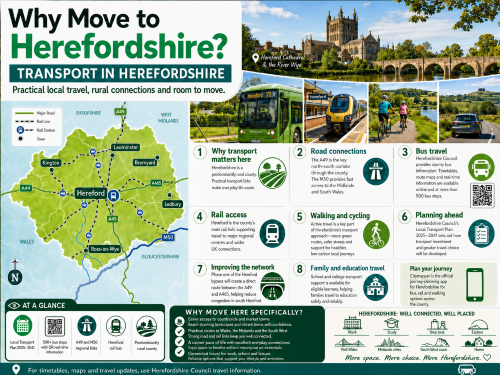
Transport is one of the areas where Herefordshire differs most clearly from more urban counties.
Rail services operate from Hereford, Leominster, Ledbury and Colwall.
Herefordshire Council lists routes including:
- Hereford, Leominster and Shrewsbury towards Manchester;
- Hereford towards Cardiff;
- Hereford, Ledbury and Colwall towards Worcester and London Paddington;
- Hereford, Ledbury and Colwall towards Birmingham.
Road travel remains particularly important.
The A49 forms a major north-south route through the county. The A40, A44 and A465 also connect different areas, while the M50 provides motorway access towards the south-east of the county.
That makes a property’s location especially important.
Someone living near a rail station may have a very different daily routine from someone several miles into the countryside.
Before moving, consider:
- distance to work;
- school journeys;
- station access;
- bus availability;
- parking;
- fuel costs;
- hybrid working;
- access to shops and healthcare;
- how often longer journeys are required.
A beautiful rural home can still be the right choice.
The important thing is understanding what the location means on an ordinary Tuesday morning, not only what it feels like during a weekend viewing.
Food, Markets and Everyday Life Have a Strong Local Identity
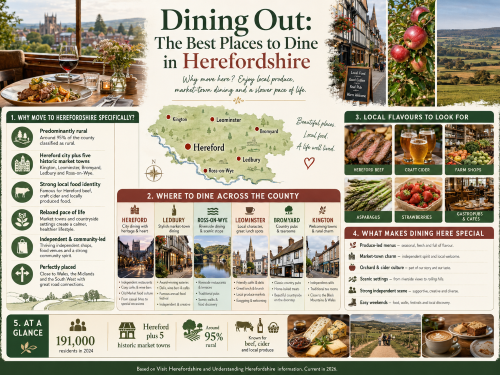
Herefordshire has one of the clearest food identities of any English county.
Orchards, cider, beef, farming, and local produce are closely tied to both the landscape and the local economy.
Herefordshire has restaurants, cafés, pubs, markets and independent businesses.
Ledbury, Leominster, Ross-on-Wye, Bromyard and Kington each offer their own mix of local cafés, pubs, shops and hospitality.
The wider countryside adds:
- farm shops;
- rural pubs;
- local markets;
- food festivals;
- cider producers;
- vineyards;
- independent growers and makers.
This matters because moving to Herefordshire is ultimately as much a lifestyle question as a housing question.
The mortgage may determine whether the property can be purchased.
Everyday life determines whether the move feels worthwhile afterwards.
Heritage, Landscapes and Places to Explore
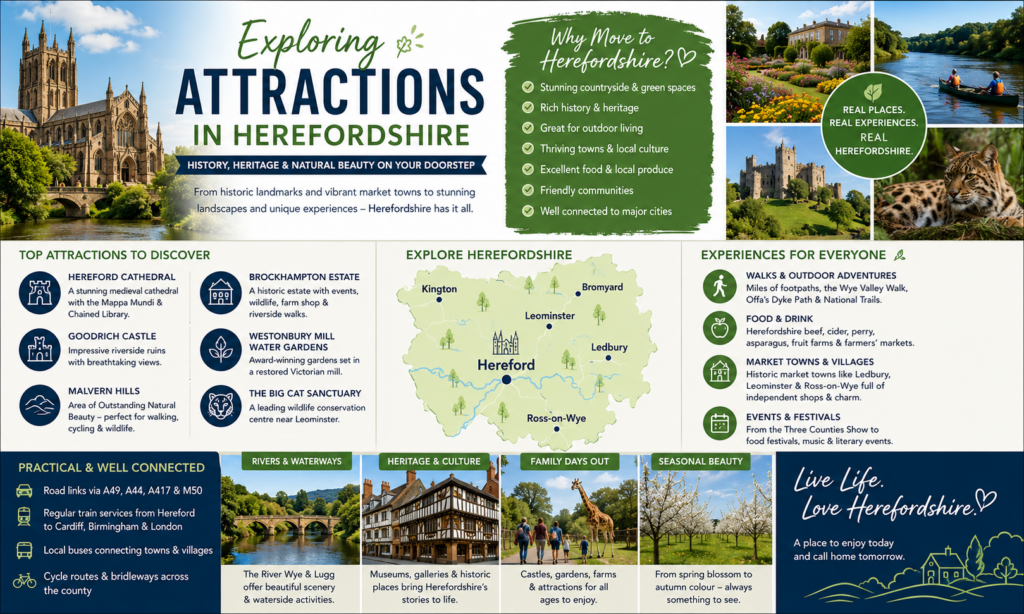
Herefordshire’s strongest attractions are closely tied to its history and landscape.
Hereford Cathedral is home to the medieval Mappa Mundi and Chained Library and has served as a centre of worship for more than 1,300 years.
The Wye Valley provides walking, cycling and water-based activities along one of the county’s most distinctive landscapes.
Ross-on-Wye sits above the River Wye and is closely associated with the early development of British tourism.
North Herefordshire’s Black and White Villages Trail links timber-framed villages including Weobley, Pembridge and Eardisland.
Other places and landscapes include:
- Symonds Yat;
- Goodrich Castle;
- the Golden Valley;
- the Black Mountains;
- Eastnor Castle;
- Bromyard Downs;
- the Malvern Hills on the county’s eastern edge;
- riverside walks around Hereford;
- orchards, woodland and rural footpaths.
Visit Herefordshire’s city and market town guide provides further information for anyone comparing different areas.
These attractions are not merely visitor destinations.
For residents, they become part of weekends, exercise, family time, and daily life.
Why Herefordshire Can Suit More Than One Stage of Life
One reason why move to Herefordshire remains a useful question is that the answer can change over time.
A first-time buyer may focus on Hereford or Leominster because of housing choice and everyday services.
A family may prioritise school access, space and village life.
A self-employed person may value a rural setting while working partly from home.
Someone running a land-based or food business may see practical value in the county’s agricultural economy.
A later-life mover may prefer a market town that combines local services with countryside access.
The county offers more than one lifestyle.
Its strength is the choice between city, market-town, village and rural living.
A good move should therefore work beyond completion day.
It should still make sense as work patterns change, children get older, or financial priorities shift.
Browse Mortgage Advisers Covering Herefordshire
Once you have narrowed down where you want to live, the next question is whether your mortgage fits both the property and the circumstances behind the move.
Connect Experts lets users compare mortgage advisers by location and other preferences.
The current Mortgage Brokers in Herefordshire county page includes locations across the county such as Breinton, Bartestree, Colwall Stone, Clehonger, Ewyas Harold, Hereford, Kingstone, Kington, Ledbury, Leominster, Ross-on-Wye and Weobley.
Use Find a Mortgage Adviser to compare advisers based on the mortgage decision you need to make rather than simply choosing the closest postcode.
Connect Experts is a mortgage adviser directory and matching platform. It does not provide mortgage advice directly. Mortgage advice is provided by the adviser or firm you choose.
People who found this page helpful also explored these related topics:
Mortgage Broker in Breinton: Expert Advice That Fits

Mortgage Broker in Hope Mansell: Straightforward Advice

Mortgage Broker in Leddington: The Advice You Need
Mortgage Broker in Sollers Hope: Expert Home Loan Advice

Mortgage Broker in Ewyas Harold: Confident Mortgage Advice
Mortgage Broker in Clehonger: Reassuring Expert Advice
Neighbouring Counties
FAQs: Why Move to Herefordshire?
Is Herefordshire suitable if I want rural living without being completely isolated?
It can be. Hereford provides the county’s main concentration of services, while towns such as Ledbury, Leominster, Ross-on-Wye, Bromyard and Kington offer smaller communities with everyday amenities. The practical balance depends on distance to work, schools, healthcare, and transport, so compare individual locations carefully.
Are older and rural properties harder to mortgage in Herefordshire?
Not necessarily, but some properties may require closer lender assessment. Listed buildings, converted barns, homes with land, private drainage, unusual construction or restricted access can affect valuation and lender criteria. It is useful to discuss the property type before choosing a lender.
What should I know about house prices before moving to Herefordshire?
The average Herefordshire house price was £290,000 in July 2026, but property type creates significant differences. Detached homes averaged £446,000, while terraced homes averaged £210,000. A county average should therefore be treated as context rather than an indication of what a particular town or property will cost.
Does living in rural Herefordshire mean relying on a car?
In many areas, yes. Hereford, Leominster, Ledbury and Colwall have rail services, but more rural villages can have fewer public transport options. Buyers should check school journeys, work travel, shopping, healthcare and station access before deciding whether a location is practical.
Which parts of Herefordshire suit people who want access to walking and countryside?
The Wye Valley around Ross-on-Wye is ideal for walking, cycling, and river activities. Kington provides access towards the hills and the Welsh border, while Ledbury sits near the Malvern Hills. North Herefordshire also offers the Black and White Villages Trail, which runs through rural villages and farmland.
What should I compare before deciding where to live in Herefordshire?
Compare more than the property price. Consider travel time, school access, broadband, local services, property maintenance, flood information (where relevant), heating, private drainage, and how much borrowing leaves room for wider household costs. In a rural county, the practical details of location can matter as much as the house itself.