
Why move to Buckinghamshire? Because where you live shapes more than the journey to work. It shapes your space, the schools your family can consider, the opportunities around you, and the kind of life you return to at the end of each day.
Buckinghamshire sits close to London but has its own distinct identity. Aylesbury and High Wycombe provide major town centres, while Beaconsfield, Amersham, Gerrards Cross, Marlow and Chesham offer very different residential settings. Beyond them sit Chiltern villages, open countryside and smaller communities where the pace can feel far removed from the capital.
For some movers, Buckinghamshire is about access to London. For others, it is about finding more space, choosing a particular school, living closer to the countryside, or moving nearer to employment centres within the county.
The key question, therefore, is not simply why move to Buckinghamshire, but which part of the county best reflects the life you are planning.
When that lifestyle decision becomes a property decision, you can explore Mortgage Brokers in Buckinghamshire and compare advisers who cover different areas of the county.
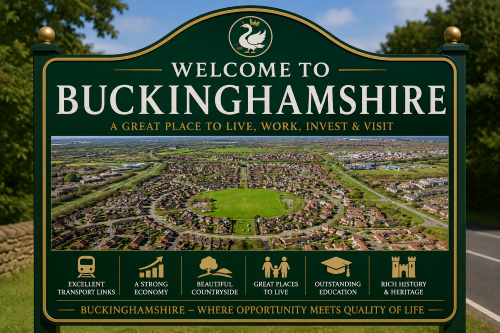
What to Expect When Living in Buckinghamshire
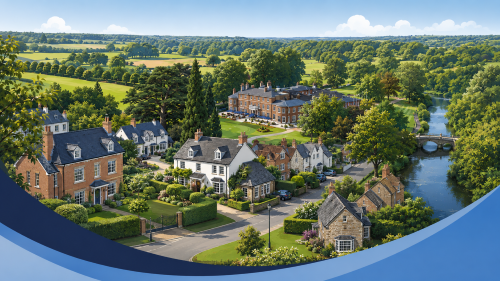
Buckinghamshire offers a striking mix of established towns, commuter communities, rural villages and higher-value residential areas.
Aylesbury offers the county town experience, with established neighbourhoods, new housing, and access to Oxford, Milton Keynes, and London.
High Wycombe is one of the county’s larger commercial centres, combining town living with access to the Chiltern Hills.
Further south, Beaconsfield, Gerrards Cross and Amersham are closely associated with commuting to London and higher-value housing.
Marlow offers a Thames-side setting, while Chesham combines a market-town character with Metropolitan line access.
Elsewhere, places such as Princes Risborough, Wendover and Great Missenden appeal to people looking for smaller-town or village surroundings without losing access to larger employment centres.
This variety matters.
Someone moving from London may prioritise space and rail access. A family may put education first. A business owner may need access to Heathrow, the M40 or wider commercial centres. Someone approaching retirement may value countryside, community, and access to services more.
Buckinghamshire works because it offers more than one version of suburban life.
Housing in Buckinghamshire: Price, Space and Property Choice
Buckinghamshire is a comparatively high-value housing market.
The Office for National Statistics reported an average house price of £480,000 in July 2026, compared with £381,000 across the South East. First-time buyers in Buckinghamshire paid an average of £355,000, while home movers paid £599,000.
Property type also makes a substantial difference:
- Detached homes averaged £859,000
- Semi-detached homes averaged £472,000
- Terraced homes averaged £378,000
- Flats and maisonettes averaged £235,000
These are county averages rather than valuations of individual properties. Streets, school catchments, station access, plot size, construction and condition can all change local values considerably.
This is particularly relevant in areas such as Beaconsfield, Gerrards Cross, Amersham and Marlow, where larger mortgages and deposits can come into play.
For buyers working with more complex income, substantial assets, bonuses, dividends or larger borrowing requirements, experience with High Net Worth Mortgage Brokers may be relevant.
Higher property values do not automatically make someone a high-net-worth borrower. What matters is the scale and structure of the finance required.
For current county-level data, the ONS Buckinghamshire housing data provides the latest house-price and rental figures.

Education in Buckinghamshire: A Genuine Part of the Moving Decision

Education can influence where a family chooses to live in Buckinghamshire more than in many counties.
Buckinghamshire retains a selective secondary-school system. The council confirms the county has 13 grammar schools, and children qualify through the Secondary Transfer Test.
That means school planning can affect:
- where a family chooses to live;
- travel distances;
- school preferences;
- transport arrangements;
- household expenditure;
- the timing of a move.
There is also a wide independent-school sector in and around Buckinghamshire, with preparatory and senior-school choices across locations including High Wycombe, Gerrards Cross, Chesham and the wider county. Buckinghamshire Council’s Secondary Transfer Test information lists several independent preparatory schools as partner schools.
For families considering fee-paying education, they should ideally consider the property budget and education budget together rather than as separate decisions.
Where school fees form part of longer-term household planning, Education Finance explains possible borrowing routes and the affordability considerations involved.
School choice may influence where you live, but regular education costs can also shape how much you feel comfortable borrowing.
Why Move to Buckinghamshire for Employment?
Buckinghamshire is not simply a county people leave each morning to work in London.
It has several distinctive employment clusters.
Buckinghamshire Council’s Economic Growth Plan identifies strengths in:
- film and high-end television;
- advanced manufacturing;
- digital and technology;
- life sciences;
- space technology;
- high-performance engineering.
Pinewood Studios is one of Buckinghamshire’s best-known employment assets, while Beaconsfield is home to the National Film and Television School. Westcott has developed as a centre for space and propulsion technology, and the county also has established life-sciences and MedTech activity.
The council’s 2025 to 2035 Economic Growth Plan focuses on growing high-value sectors, including space, creative industries, high-performance technology, and life sciences.
This creates opportunities for:
- technology specialists;
- engineers;
- film and television professionals;
- healthcare workers;
- researchers;
- entrepreneurs;
- contractors;
- company directors;
- professional-services workers.
That mix of employment can also create less conventional mortgage applications.
Someone receiving bonuses, dividends, contract income, or retained company profits may need a lender whose affordability criteria reflect how that income is actually earned.

Mortgage Planning Should Sit Alongside the Move
Where you choose to live in Buckinghamshire and how you finance the move are closely connected.
The latest ONS figures show why. In July 2026, the average house price in Buckinghamshire was £480,000, while first-time buyers paid an average of £355,000. Homes bought with a mortgage averaged £475,000.
Those figures are county averages, but the financial decision can vary significantly between locations such as Aylesbury, High Wycombe, Marlow, Beaconsfield, Amersham, Gerrards Cross and the villages around the Chilterns.
A move may affect:
- the deposit required;
- loan-to-value;
- monthly repayments;
- commuting costs;
- school or childcare expenditure;
- the type of property being financed;
- the lender criteria that apply.
The property itself also matters.
A town-centre apartment in High Wycombe may involve leasehold and service-charge considerations. A period home in Amersham or Great Missenden may raise different valuation questions. A larger rural property around the Chilterns could involve land, outbuildings or private access.
If you are comparing several areas, Find a Mortgage Adviser by Location can help narrow the search to advisers covering the places you are considering.
The important question isn’t simply how much you can borrow.
It is whether that level of borrowing still leaves enough room for the life you want to create in Buckinghamshire.

Higher-Value Homes Are a Genuine Part of Buckinghamshire

Buckinghamshire is not high-net-worth everywhere, but higher-value property is a significant feature in parts of the county.
ONS data recorded the average price of a detached home at £859,000 in July 2026, compared with an overall Buckinghamshire average of £480,000. Home movers paid an average of £599,000. Office for National Statistics
Higher-value markets can be found around areas such as:
- Beaconsfield;
- Gerrards Cross;
- Marlow;
- Amersham;
- Chalfont St Peter;
- Chalfont St Giles;
- parts of Great Missenden;
- selected Chiltern villages.
The mortgage requirement can also become more complex as property values rise.
Borrowers may receive income through:
- bonuses;
- dividends;
- retained company profits;
- partnership drawings;
- investment income;
- share awards;
- several businesses or income sources.
In these circumstances, choosing an adviser purely because they are nearby may not be enough.
Experience with High Net Worth Mortgage Brokers may be relevant when the property value, borrowing requirement, or income structure needs a more specialist lender assessment.
That experience is not simply about access to larger mortgages. It is understanding how lenders assess a financial position that may not fit neatly into a standard salary calculation.
Later-Life Moves and Equity Release in Buckinghamshire
A move to Buckinghamshire can also form part of a later-life decision.
Some homeowners may be looking to downsize, move closer to family, reduce an existing mortgage or use part of the value held in their property to support retirement plans.
Equity release is one possible route for eligible homeowners, but it is a specialist financial decision.
It can affect:
- inheritance;
- future borrowing;
- entitlement to means-tested benefits;
- the amount of equity remaining in the property;
- options available later in life.
Homeowners considering this type of borrowing can explore Equity Release Advisers in Buckinghamshire for specialist information and advice.
Equity release will not be suitable for everyone, so it should be considered alongside alternatives such as downsizing, remortgaging or using other assets.

Exploring Attractions in Buckinghamshire
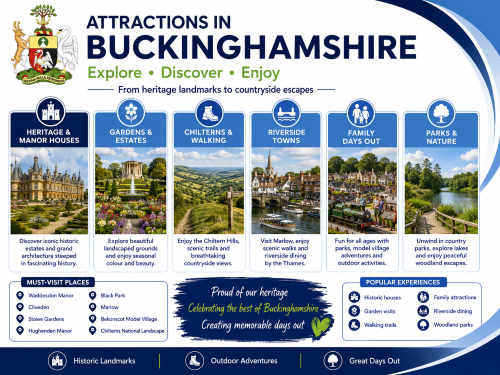
Buckinghamshire has a strong mix of heritage, countryside, family attractions, walking routes, gardens, country parks, and riverside towns.
Waddesdon Manor is one of the county’s best-known attractions. The Chilterns National Landscape describes it as a French Renaissance-style chateau near Aylesbury, built in the 1870s by Baron Ferdinand de Rothschild, with gardens, trails, an aviary, exhibitions, a restaurant, and shops.
The Chilterns also provide outdoor attractions throughout the county, including chalk hills, historic market towns, walking routes, cycling routes, pubs, restaurants, local produce, and places to stay.
Country parks such as Black Park, Langley Park, Denham Country Park, and Thorney Country Park provide walking, cycling, family activities, nature, woodland, lakes, cafés, trails, and picnic spaces.
Other popular Buckinghamshire attractions include Stowe Gardens, Hughenden Manor, Cliveden, Bekonscot Model Village, Marlow’s riverside walks, the Roald Dahl connections around Great Missenden, and the Chiltern villages that give the county much of its character.
Why Move to Buckinghamshire for Transport and Commuting?
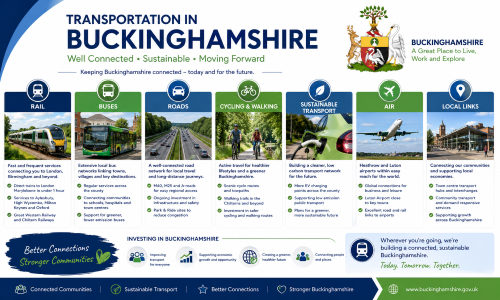
Buckinghamshire’s position between London, Oxfordshire, Berkshire, Bedfordshire and the Midlands gives the county practical transport advantages.
Rail connections are particularly important in the county’s south and centre.
Locations such as High Wycombe, Beaconsfield, Gerrards Cross, Amersham, Aylesbury, Wendover and Princes Risborough offer different rail or Underground connections towards London.
Road access also influences where people choose to live.
The M40 provides an important route towards London, Oxford and the Midlands, while the M25 is accessible from southern parts of the county. The A41 and A413 support movement through Aylesbury and surrounding areas.
Heathrow Airport is also relatively accessible from southern Buckinghamshire.
For many movers, however, the most useful calculation is not simply the fastest train time.
Consider the whole routine:
- distance to the station;
- parking costs;
- season-ticket costs;
- school journeys;
- hybrid working;
- motorway access;
- how often commuting is actually required.
A property further from London may offer more space, but that space’s value depends on what the journey adds to everyday life.
Dining Out: Places to Dine in Buckinghamshire

Buckinghamshire has a strong dining culture, shaped by country pubs, historic inns, farm shops, cafés, restaurants, riverside dining, and local produce.
The Chilterns National Landscape describes the wider Chilterns as having pubs, vineyards, breweries, markets, local produce, historic market towns, tucked-away villages, farmland, chalk-fed streams, and ancient woods. It also notes that the Chilterns were once known as the “larder of London”.
For Sunday lunch and dining out, Marlow, Beaconsfield, Amersham, Great Missenden, Aylesbury, Wendover, Buckingham, and High Wycombe offer a range of pubs, restaurants, cafés, and family-friendly venues. Marlow is especially well known for dining, and The Hand & Flowers claims to be the first pub with two Michelin stars.
Residents can also enjoy farm shops and local produce. The Chilterns National Landscape highlights local food through pubs, restaurants, farmers’ markets, farm shops, foodie tours, and independent shops that support market town and village character.
Whether you want a village pub, a family meal, a riverside restaurant, a country café, or a special occasion venue, Buckinghamshire offers plenty of choice.
Buckinghamshire Can Suit Different Stages of Life
One reason why move to Buckinghamshire remains such a useful question is that the answer may change as life changes.
A first-time buyer may focus on Aylesbury, High Wycombe or other areas where their budget gives them more choice.
A young family may place greater importance on schools, green space and practical journeys between home, work and childcare.
A professional may choose Beaconsfield, Amersham, Gerrards Cross or High Wycombe because access towards London is central to the decision.
Someone building a business or working in Buckinghamshire’s technology, creative, or professional sectors may prioritise access to employment centres over a London commute.
A buyer looking for a larger or higher-value home may consider Marlow, Beaconsfield or Chiltern villages.
Someone approaching retirement may prefer a smaller market town or village where everyday services matter more than proximity to an office.
Buckinghamshire does not provide one single lifestyle.
Its strength is the ability to move between larger towns, commuter locations, market towns, and countryside while staying connected to London, Oxford, the Thames Valley, and the wider South East.
A good move should therefore work beyond completion day.
It should still make sense when careers change, children grow older, commuting patterns shift, or retirement becomes more important than the journey to work.
Check Our Advisers in Buckinghamshire
Once you have narrowed down where you want to live, the next question is whether your mortgage fits the property and the circumstances behind the move.
Connect Experts lets you choose mortgage advisers by location and other relevant preferences.
Compare advisers based on the decision you need to make rather than simply choosing the closest postcode.
Connect Experts is a mortgage adviser directory and matching platform. It does not provide mortgage advice directly. Mortgage advice is provided by the adviser or firm you choose.





People who found this page helpful also explored these related topics:

Mortgage Broker in Flackwell Heath HP10 – Find an Adviser

Mortgage Broker in Great Missenden HP16 – Find an Adviser

Mortgage Broker in Gerrards Cross SL9 – Find an Adviser

Mortgage Broker in Bourne End SL8 – Find an Adviser

Mortgage Broker in Hazlemere HP15 – Find an Adviser

Mortgage Broker in Princes Risborough HP27
Neighbouring Counties
FAQs: Why Move to Buckinghamshire?
Is Buckinghamshire mainly a commuter county?
No. Commuting to London is important in parts of Buckinghamshire, particularly around Beaconsfield, Gerrards Cross, Amersham and High Wycombe, but the county also has major employment activity. Film and television, space technology, advanced engineering, digital industries, and life sciences are key local growth sectors.
What should families know about Buckinghamshire schools before moving?
Buckinghamshire operates a selective secondary-school system alongside upper and all-ability schools. The county has 13 grammar schools, and eligibility for grammar-school consideration normally follows the Secondary Transfer Test process. Families should therefore research admissions, travel and school preferences before choosing a property solely because it is close to a particular school.
Is Buckinghamshire expensive for first-time buyers?
Buckinghamshire is more expensive than many UK areas. First-time buyers paid an average of £355,000 in July 2026, compared with an overall Buckinghamshire average of £480,000. Individual locations and property types can differ substantially, so use county averages for context rather than as a guide to a specific purchase.
Which Buckinghamshire areas may suit buyers wanting countryside and rail access?
Areas around Wendover, Princes Risborough, Great Missenden, Amersham and parts of the Chilterns can combine countryside access with rail connections. The best choice depends on your commuting frequency, housing budget, station access, and the type of community you prefer.
Does moving further out of central London always mean lower housing costs?
No. Outer London can offer lower prices in some areas, but this is not universal. Property type, borough, transport links, school demand and local housing supply can all affect values. Travel costs and journey times should also be considered alongside the mortgage.
Does a more expensive Buckinghamshire property require a specialist mortgage broker?
Not automatically. A higher property value alone doesn’t make you a mortgage specialist. However, larger borrowing, complex income, bonuses, company profits, investment income or substantial assets can require lenders with different underwriting criteria. In those circumstances, experience with larger or more complex mortgages may be useful.