
Why move to Kent? Because where you live can influence far more than the view from your window. It can change how you work, how long you travel, where your children go to school, what kind of home you can afford, and how you spend your time after work.
Kent offers several very different versions of that life.
You could choose a London-facing commuter town such as Sevenoaks or Dartford, historic city living in Canterbury, a central location around Maidstone, a high-speed rail connection from Ashford, or a coastal setting in Whitstable, Deal, Broadstairs or Folkestone.
Further inland, villages, orchards, farmland, and the Kent Downs create a different pace.
That variety is one of Kent’s greatest strengths. The real question is not simply whether Kent is right for you. It is which part of Kent lets your work, housing costs, and everyday life fit together most naturally.
When that decision starts becoming a mortgage question, you can explore Mortgage Advisers in Kent and compare advisers covering different parts of the county.

Coast, Countryside, City or Commuter Town: Kent Gives You Choice
Kent is often called the Garden of England, but the county is much more varied than that description suggests.
Canterbury offers historic city living, universities, established residential areas, and access to the east Kent coast.
Maidstone sits more centrally and combines employment, transport and suburban housing.
Sevenoaks, Tonbridge and Tunbridge Wells attract households looking for established towns within reach of London.
Dartford and Gravesend can appeal to buyers who want access towards London, North Kent and the wider Thames Gateway. To the east, Ashford combines rail connections with extensive newer development and access towards both London and the coast.
Then there is coastal Kent.
Whitstable, Herne Bay, Margate, Broadstairs, Ramsgate, Deal, Dover and Folkestone each offer a different kind of seaside living.
One household may want a station within walking distance.
Another may prefer a larger home in a village. Someone else may value the sea more than the commute.
Kent gives buyers several ways to make that choice.
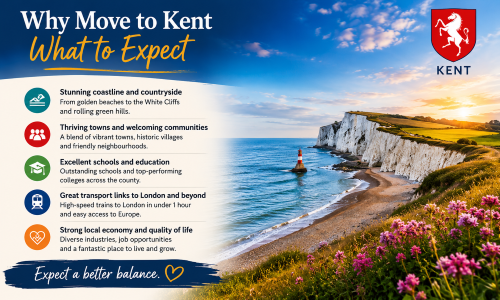
Housing in Kent: One County, Very Different Property Markets

One of the most important reasons to research why move to Kent is that property prices vary considerably depending on location.
The latest ONS data shows that the average house price in Sevenoaks was £539,000 in July 2026, while first-time buyers paid an average of £408,000. Detached properties averaged just over £1 million.
In Tunbridge Wells, the average was £456,000, with first-time buyers paying £351,000.
By comparison, the average house price in Maidstone was £353,000, while Thanet recorded £270,000 in July 2026.
View current local house-price data from the Office for National Statistics.
Those differences show why a single Kent average tells only part of the story.
A buyer might be comparing:
- a commuter home in Sevenoaks;
- a Victorian property in Tunbridge Wells;
- a family home around Maidstone;
- a modern development near Ashford;
- a period property in Canterbury;
- a coastal home in Thanet;
- a village property in the Kent Downs.
Property type can matter as much as location.
Listed buildings, converted properties, leasehold flats, new builds, coastal homes, and rural properties can all raise different questions about valuation, construction, insurance, or lender criteria.
The county may be one place on the map, but it is not one housing market.
Education Can Shape Where a Family Chooses to Live
For many families, the decision to move to Kent begins with housing but quickly becomes an education decision too.
Kent has a distinctive school system that includes grammar schools as well as academies, faith schools, comprehensive schools, colleges and independent education.
Kent County Council confirms that grammar-school applications involve the Kent Test, while individual schools may use different admissions and oversubscription criteria.
Families therefore need to think beyond the school name alone.
Useful questions include:
- Does the property fall within the relevant admissions area?
- Is a grammar-school application part of the plan?
- What will the daily school journey involve?
- Will childcare costs change?
- Are school fees part of the household budget?
- Could moving alter one or both parents’ commute?
If independent education is part of the plan, regular school fees can affect disposable income and overall affordability.
For households considering those costs alongside a mortgage, Education Finance may form part of the wider financial planning conversation.
A home may be a family’s largest purchase, but where children spend their weekdays can influence that decision just as strongly.

Employment in Kent Is Broader Than Commuting to London

Kent should not be treated as just a place to live while working elsewhere.
The county has a substantial employment base.
Kent County Council reports that construction accounts for the largest proportion of businesses in Kent, while professional, scientific and technical firms also make up a significant share. Wholesale and retail, health and social work, and education employ many people.
Other important sectors include:
- logistics and transport;
- ports and freight;
- tourism and hospitality;
- food and drink production;
- manufacturing;
- healthcare;
- education;
- professional services;
- life sciences;
- creative industries.
Different parts of the county support different types of work.
Dover and Folkestone have strong transport and cross-Channel connections.
Ashford is important for logistics, transport and business activity.
Canterbury supports education, healthcare, tourism and professional services.
Maidstone has a broad commercial and public-sector economy.
That matters for mortgage planning because not everyone has a simple basic salary.
Some applicants may receive:
- bonuses;
- overtime;
- commission;
- company-director income;
- dividends;
- retained profits;
- contract income;
- income from several sources.
Where income is less straightforward, lender selection can become just as important as the property itself.
Mortgage Considerations When Moving to Kent
Once a location search becomes a property search, the financial questions become more specific.
Kent’s wide price range means mortgage requirements can differ substantially between households.
A buyer in Sevenoaks may face very different deposit and borrowing requirements than a buyer in Thanet.
Likewise, a Victorian terrace in Tunbridge Wells may create different lender questions from a new-build home near Ashford or a coastal flat in Folkestone.
Mortgage planning may need to consider:
- deposit size;
- loan-to-value;
- affordability;
- property valuation;
- leasehold terms;
- existing borrowing;
- commuting costs;
- school costs;
- income structure;
- lender criteria.
If you are still comparing towns and areas, Find a Mortgage Adviser by Location can help you identify advisers covering the part of Kent you are considering.
The most useful question is not always:
“What is the maximum I can borrow?”
It may be:
“What mortgage leaves enough room for the life I am moving to Kent to have?”
That distinction matters.

Higher-Value Homes and Complex Income in Kent

Kent should not be presented as one uniformly high-value county.
However, certain areas clearly sit at the higher end of the market.
The ONS recorded an average house price of £539,000 in Sevenoaks in July 2026, while detached properties averaged £1,012,000. In Tunbridge Wells, detached homes averaged £870,000.
Higher-value borrowing can also coincide with more complex income.
This may include:
- bonuses;
- investment income;
- dividends;
- partnership income;
- retained company profits;
- restricted shares;
- several income sources.
In those circumstances, the nearest adviser may not necessarily be the most suitable adviser.
Experience with High Net Worth Mortgage Brokers may be relevant where the property value, borrowing requirement, assets or income structure fall outside straightforward lender criteria.
This is particularly relevant around higher-value areas such as Sevenoaks, Tunbridge Wells and some established villages in west Kent.
Later-Life Moves Can Make Kent Attractive for Different Reasons
Not everyone asks why move to Kent because of work, schools or commuting.
Some people may be:
- downsizing;
- moving closer to family;
- changing lifestyle after retirement;
- leaving London;
- looking for a coastal town;
- seeking a smaller community;
- planning around retirement income.
Kent provides several possible settings for that stage of life.
Moving to a coastal town like Deal, Broadstairs, or Whitstable can feel very different from relocating to a village, market town, or established area around Tunbridge Wells.
For older homeowners, the financial questions may also change.
They may include:
- whether to sell and downsize;
- how retirement income affects mortgage affordability;
- whether an existing mortgage needs to be repaid;
- how much capital to retain after moving;
- whether property wealth should play a role in later-life planning.
If you’re considering equity release, treat it as a separate specialist decision rather than a standard residential mortgage.
Homeowners can explore Equity Release Advisers in Kent where later-life borrowing is relevant.

Hampshire Can Work Well for Commuters

Location can shape quality of life long after moving day.
Hampshire has strong road and rail connections and sits within reach of London and the wider South East. Visit Hampshire describes the county as about an hour from London in some areas, with access by rail, road, coach, and ferry.
Rail routes connect towns including:
- Winchester
- Basingstoke
- Fleet
- Farnborough
- Eastleigh
- Southampton
- Portsmouth
The M3 provides an important route north towards London, while the M27 connects many southern Hampshire communities.
Southampton Airport also offers direct air links, while Portsmouth and Southampton provide ferry connections and major transport infrastructure.
For many households, this creates an important compromise.
Living closer to London may reduce commuting time but increase housing costs. Moving further into Hampshire may provide more space or a different lifestyle, while still preserving workable connections.
That trade-off is personal. A longer commute may be acceptable if it brings a larger home, outdoor space, a preferred school or a quieter setting.
Food, Culture and Everyday Life Matter After Completion Day
A mortgage application eventually ends.
Daily life does not.
Kent has long-standing links to agriculture, orchards, brewing, vineyards, and food production, while its cities, towns, and coastline support restaurants, cafés, pubs, markets, and cultural venues.
Canterbury provides theatres, museums and a strong historic centre.
Margate has galleries and creative businesses.
Tunbridge Wells and Sevenoaks have established town centres.
Whitstable and Deal have strong coastal food identities.
Rural Kent adds farm shops, vineyards and local producers. These may seem like small details compared with mortgage rates or house prices.
Yet they often determine whether somewhere feels like home after the boxes are unpacked. A successful move is not only about what you can buy.
It is about whether you want to live your ordinary Tuesdays there too.

Exploring Attractions in Kent

Kent has many well-known attractions. These help the county attract visitors and support local pride.
Visit Kent lists major attractions such as the White Cliffs of Dover, Leeds Castle, Hever Castle, Canterbury Cathedral, the Historic Dockyard Chatham, Dreamland Margate and Port Lympne.
The Kent Downs also support walking, cycling and countryside days out. Coastal towns offer beaches, harbours and seafronts. Historic cities and towns add culture, shopping and architecture.
This makes Kent useful for families, retirees, remote workers and anyone who wants more from their local area.
Kent’s Countryside Is Part of Everyday Life, Not Just a Weekend Destination
Kent’s identity also comes from what sits between its towns.
The Kent Downs, the Weald, orchards, vineyards, and agricultural land create a setting very different from the county’s commuter belt and coast.
For some movers, countryside access is the main attraction.
Village living can offer:
- more space;
- quieter surroundings;
- access to walking and cycling;
- stronger links with smaller communities;
- larger or more individual properties.
But rural living can involve practical compromises.
A property may rely more heavily on a car.
Broadband availability can matter for working from home.
Older properties may have non-standard construction, private drainage, larger plots or outbuildings.
A rural home can therefore be attractive for lifestyle reasons while also requiring more careful mortgage and valuation assessment.
The best location isn’t always the one with the fewest compromises. It is the place where the compromises are ones you are comfortable living with.

Browse Our Advisers in Kent
Once you have narrowed down where you want to live, the next question is whether your mortgage fits the property and the circumstances behind the move.
Connect Experts lets you choose mortgage advisers by location and other relevant preferences.
Compare advisers based on the decision you need to make rather than simply choosing the closest postcode.
Connect Experts is a mortgage adviser directory and matching platform. It does not provide mortgage advice directly. Mortgage advice is provided by the adviser or firm you choose.





People who found this page helpful also explored these related topics:

Whissendine Mortgage Advice: The Right Path to Your Next Move

Mortgage Broker in Uppingham: Seek Expert Advice Before You Buy

South Luffenham Mortgage Advice: Look Beyond the Rate

Ryhall Mortgage Advice: Make the Right Move with Confidence

Mortgage Advice in Oakham: Look Beyond the Purchase Price

Manton Mortgage Advice: Expert Mortgage Broker Help – LE15
Neighbouring Counties
FAQs: Why Move to Kent?
Is Kent a practical place to live if I still work in London?
It depends on where you choose to live and how often you need to travel. Areas such as Sevenoaks, Tonbridge, Dartford and Ashford have established rail connections towards London. The practical decision should consider ticket costs, station access, commuting frequency, and housing costs, not just journey time.
Where in Kent are property prices highest?
Property prices vary considerably. ONS data for July 2026 shows an average price of £539,000 in Sevenoaks and £456,000 in Tunbridge Wells, compared with £353,000 in Maidstone and £270,000 in Thanet. Individual towns and property types can differ significantly from local-authority averages.
What should families check before moving to Kent for schools?
Families should check each school’s admissions criteria, distance rules, school journeys, and whether the Kent Test applies to a grammar-school application. Admissions rules can vary by school, so a property address alone should not be assumed to guarantee a place.
Does buying near the Kent coast create different mortgage considerations?
Sometimes. Coastal properties may raise additional questions about construction, insurance, flood information, leasehold arrangements, or valuation. This doesn’t automatically make them unsuitable for lending, but it can make the property more important when choosing a lender.
Which part of Kent suits someone who wants countryside without being completely remote?
That depends on work, transport and budget. Areas around the Kent Downs, the Weald, and villages outside towns such as Maidstone, Sevenoaks, Canterbury, and Ashford offer countryside access while staying connected to larger centres. Buyers should compare road access, rail stations, broadband and local services before choosing.