
Why move to Surrey? Because choosing where to live is really a decision about how close you want different parts of your life to be.
For some people, Surrey means remaining within reach of London while creating more space between work and home. For others, it means the Surrey Hills, established towns, independent schools, village life or being close to both Heathrow and Gatwick.
Guildford and Woking offer major town centres and rail connections. Epsom, Reigate and Redhill combine established communities with access towards London. Farnham and Dorking bring a stronger market-town character, while Weybridge, Cobham and other parts of Elmbridge sit within some of the South East’s higher-value residential markets.
Then there is the countryside. Box Hill, Leith Hill, the North Downs, and the wider Surrey Hills create a setting that can feel remarkably removed from London, even as the capital remains close.
That variety is what makes Why Move to Surrey a more interesting question than it first appears.
The real decision is not whether Surrey is attractive. It is which part of Surrey fits the life you want to build there.
When the move becomes a financial decision, you can explore Mortgage Brokers in Surrey and compare advisers across the county.

From Commuter Towns to the Surrey Hills: Different Ways to Live

Surrey does not offer one version of suburban life.
Guildford combines a historic centre, university, shops, employment and rail connections with access to surrounding countryside.
Woking has a different rhythm, with strong rail connectivity and substantial modern development.
Epsom combines town living with Epsom Downs, while Reigate and Dorking provide established centres close to the North Downs and Surrey Hills.
To the west, Farnham has a market-town identity with countryside beyond it. Camberley has access towards the M3 corridor, while Staines-upon-Thames offers connections towards Heathrow and west London.
Then there are locations such as Cobham, Weybridge and Esher, where larger properties, proximity to London and established residential areas can create very different housing budgets.
The county also contains smaller villages and rural communities where transport, property condition, and access to services may matter more.
Someone asking why move to Surrey may therefore be looking for one of several things:
- a workable London commute;
- more space than an inner-London property allows;
- access to countryside;
- a larger family home;
- independent education;
- a higher-value residential area;
- a market-town lifestyle;
- proximity to Heathrow or Gatwick.
Those priorities can all lead to Surrey, but rarely to the same postcode.
Surrey Housing: A County of Very Different Price Points
The Surrey housing market shouldn’t be reduced to a single county-wide figure.
Current ONS data demonstrates how significant the variation can be.
In July 2026, the average house price in Elmbridge was £748,000. This was the highest average among South East local authorities. First-time buyers paid an average of £501,000, while mortgage buyers paid an average of £770,000.
In comparison:
- Guildford: average house price £533,000;
- Surrey Heath: £458,000;
- Woking: £440,000.
That gap matters.
The same household budget can lead to very different property choices depending on where someone searches.
A buyer might be comparing:
- an apartment in Woking;
- a Victorian or Edwardian home in Guildford;
- a family house around Epsom;
- a commuter property in Redhill;
- a cottage around Dorking or Farnham;
- a larger detached property in Weybridge or Cobham;
- a home close to the Surrey Hills.
Property characteristics matter too.
Leasehold flats, converted properties, listed buildings, homes on private roads, high-value houses, new developments, and rural properties can all raise different valuation and lender-criteria questions.
For a buyer, the useful question is not simply, “What does a Surrey home cost?”
It is:
“What does the type of Surrey home I want cost in the part of the county that works for my life?”
You can review current local authority data through the Office for National Statistics housing price service.

Education Can Shape a Surrey Move Long Before Completion Day

For some families, the property search begins with education rather than property.
Surrey has a substantial mix of state and independent education. Surrey-i reports 204,097 pupils in Surrey schools in 2024/25, with around 19.8% attending independent schools. The dataset includes 112 independent schools.
Higher education also shapes Surrey’s identity.
The University of Surrey is based in Guildford, while Royal Holloway, University of London has its campus in Egham.
Independent schools are spread across the county, including long-established institutions in areas such as Godalming, Guildford, Epsom, and surrounding communities.
For families, however, school reputation should not be considered in isolation.
A move can change:
- school journey times;
- childcare;
- commuting arrangements;
- school fees;
- transport expenditure;
- after-school logistics;
- household disposable income.
This matters because education costs and mortgage commitments compete for the same household income.
If independent schooling is part of a longer-term family plan, Education Finance explains how school fees, property equity, and borrowing may interact.
A house and an education plan can look like separate decisions.
For many families, they are not financially separate.
Surrey's Economy Means Not Every Resident Is Commuting Out
Surrey’s proximity to London matters, but it shouldn’t define the county’s economy.
Guildford, Woking and other Surrey centres support employment across technology, healthcare, professional services, research, gaming, financial services and education.
The existing county data records 66,645 active businesses in Surrey in 2024 and an employment rate of 82.5% in the available 2023 measure.
Surrey also benefits from its position between London, Heathrow, Gatwick and the wider South East economy.
That means people can move towards Surrey for work, rather than simply live there while working elsewhere.
This can create varied mortgage circumstances.
Applicants may receive income through:
- salary;
- bonuses;
- commission;
- consultancy;
- partnership earnings;
- dividends;
- company profits;
- share awards;
- more than one employment or income source.
Mortgage lenders don’t necessarily assess every form of income the same way.
For someone moving for a new role, promotion, or business opportunity, how income is structured can matter as much as the headline salary.

Surrey's Connections Can Change Where “Close to London” Begins
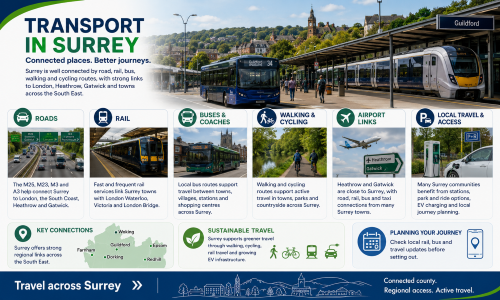
Transport is one of Surrey’s defining practical advantages.
The county includes major road corridors such as the M25, M23, M3 and A3, helping connect Surrey with London, Heathrow, Gatwick and surrounding South East counties.
Rail connections are equally important.
Depending on location, Surrey residents can travel towards London Waterloo, Victoria and London Bridge. Major commuter locations include:
- Woking;
- Guildford;
- Epsom;
- Redhill;
- Reigate;
- Leatherhead;
- Dorking;
- Farnham;
- Weybridge;
- Staines-upon-Thames.
Yet a railway timetable only tells part of the story.
Before choosing a commuter location, consider:
- distance from home to the station;
- parking;
- ticket costs;
- train frequency;
- school-drop arrangements;
- peak road traffic;
- hybrid-working patterns;
- airport access;
- how often the journey will actually be made.
A cheaper property with a longer daily journey can create costs that do not appear in the purchase price.
Surrey’s advantage is therefore not simply that London is nearby.
Residents can choose different balances between access and distance.
Surrey Days Out Range From Historic Estates to Open Hills
Surrey’s appeal extends beyond commuting and housing.
The Surrey Hills National Landscape gives the county a strong countryside identity, with areas such as Box Hill, Leith Hill, Devil’s Punch Bowl, Newlands Corner and Frensham Ponds.
There are also historic, cultural and family destinations across the county, including:
- RHS Garden Wisley;
- Brooklands Museum;
- Painshill;
- Watts Gallery;
- Guildford Cathedral;
- Denbies Wine Estate;
- the British Wildlife Centre;
- the North Downs Way;
- the River Wey.
The contrast is important.
A household can live within reach of one of the world’s largest cities while spending its weekends in woodland, on open hills or beside rivers.
That is one of the clearest location-specific answers to why move to Surrey.

Food, Culture and the Weekends That Become Everyday Life

House prices may determine where you start your search.
Everyday life often determines whether the move still feels right once the boxes are unpacked.
Surrey’s towns have distinct centres, not one dominant county hub.
Guildford offers theatres, restaurants, cafés and shopping. Farnham combines independent businesses with a market-town setting. Reigate, Dorking, Cobham, Weybridge, Epsom and Godalming each have their own mix of pubs, cafés, restaurants and local shops.
The county also has a strong connection with local food and drink.
Denbies Wine Estate near Dorking is part of Surrey’s wine industry, and the county also has breweries, distilleries, farm shops, and local producers.
The landscape contributes to the experience too.
A Sunday in Surrey might involve:
- walking across Box Hill;
- cycling through the Surrey Hills;
- lunch in a village pub;
- visiting a vineyard;
- shopping in Guildford;
- walking beside the River Wey;
- spending the afternoon in one of the county’s historic towns.
These details can sound secondary when somebody is calculating deposits and mortgage payments.
After the move, they become part of why they live there.
Planning the Mortgage Around the Surrey Move
A property search becomes more useful when borrowing is considered alongside it.
Surrey’s range of property prices means households can move between very different borrowing requirements within relatively short distances.
A buyer looking in Woking may face a different deposit and affordability calculation from someone considering Weybridge or Cobham.
Mortgage planning may involve:
- deposit size;
- loan-to-value;
- mortgage term;
- affordability;
- monthly repayments;
- existing borrowing;
- lender criteria;
- property valuation;
- employment or business income.
The property itself can also influence the route.
A modern Woking apartment may require consideration of lease length and service charges.
A larger period property near Guildford may create different valuation questions.
A rural property close to the Surrey Hills could involve land, access, outbuildings or unusual construction.
If you are comparing several Surrey areas, Find a Mortgage Adviser by Location can help you identify advisers covering the places you are considering.
Remember the philosophical question behind affordability.
Being able to borrow a certain amount doesn’t automatically mean borrowing that amount creates the life you moved for.
Commuting, education, childcare, travel and everyday living still exist after the mortgage payment leaves the account.

Higher-Value Surrey Homes Can Change the Mortgage Conversation

Higher-value housing shouldn’t be attached to every part of Surrey.
However, it is a genuine feature of several local markets.
Elmbridge provides the clearest example.
The average property price there reached £748,000 in July 2026, while detached homes averaged £1.593 million. Home movers paid an average of £956,000.
Higher-value markets include locations such as:
- Cobham;
- Weybridge;
- Esher;
- Oxshott;
- parts of Guildford;
- selected areas around the Surrey Hills.
A high-value property does not automatically mean the borrower has a straightforward high salary.
Income might include:
- substantial bonuses;
- retained company profits;
- dividends;
- investment income;
- partnership drawings;
- overseas earnings;
- share awards;
- several income streams.
That distinction can change the choice of lender.
When borrowing size, property value, or financial structure falls outside standard lender criteria, experience with High Net Worth Mortgage Brokers may be appropriate.
For Surrey, that link makes sense.
It connects the county’s high-value housing markets with the underwriting those purchases sometimes require.
A Surrey Move Can Also Be About the Next Stage of Life
Not everyone moving to Surrey wants more bedrooms or a faster train.
Some people move because their priorities have changed.
A homeowner may want to:
- downsize;
- move closer to family;
- reduce household running costs;
- leave London after retirement;
- live closer to countryside;
- move from a large house into a smaller town-centre property;
- consider how housing wealth fits into later life.
Surrey’s mix of villages, market towns, and established residential communities offers several options.
But retirement can also change the mortgage calculation.
A borrower may need to consider pension income, an outstanding mortgage, downsizing proceeds, or whether to continue borrowing into retirement.
Equity release differs from a conventional residential mortgage and should be treated as a separate, specialist decision.
Where it is relevant, homeowners can explore Equity Release Advisers in Surrey.
The important point is that moving later in life should still begin with the same question as any other move:
What should the property allow the next stage of life to look like?

Surrey Can Make Sense at More Than One Stage of Life

The answer to why move to Surrey can change as life changes.
A young professional may choose Woking because commuting matters most.
A first-time buyer might compare Camberley, Redhill, Woking or other locations where the property mix provides different entry points.
A family might prioritise Guildford, Epsom, Reigate or Farnham because schools, space and everyday services become more important.
A senior executive could focus on Cobham, Weybridge or Esher, where access to London, Heathrow and larger homes may fit a different set of priorities.
Someone approaching retirement might look towards Dorking, Farnham, the Surrey Hills or smaller communities where countryside and pace of life matter more than commuting.
The county does not provide one answer.
That is its strength.
The right Surrey move should work not only on completion day, but when jobs change, children grow older, commuting patterns shift and financial priorities evolve.
A postcode is only where the property stands.
A move succeeds when the life around it still works.
Browse Our Advisers in Surrey
Once you have decided which part of Surrey might suit you, the next question is whether the mortgage fits the property and the circumstances behind the move.
Connect Experts allows you to find mortgage advisers by location, language and mortgage expertise.
Compare advisers based on the decision you need to make, rather than simply choosing the nearest postcode.
Connect Experts is a mortgage adviser directory and matching platform. It does not provide mortgage advice directly. Advice is provided by the adviser or firm you select.




People who found this page helpful also explored these related topics:

Mortgage Broker in Farnham: High-Value Home Mortgage Advice

Mortgage Broker in Dorking: Surrey Adviser Search

Mortgage Broker in Cobham: Essential Prime Home Finance

Epsom Mortgage Advisers: Buying and Moving in KT17

Mortgage Broker in Oxted: Surrey RH8 Mortgage Advice

Mortgage Broker in Camberley: Find Expert Mortgage Advice
FAQs: Why Move to Surrey?
Can I live in Surrey without commuting into London?
Yes. Surrey has its own employment centres, particularly around Guildford and Woking, together with activity in technology, healthcare, professional services, education and other sectors. Its location also gives you access to Heathrow, Gatwick, and neighbouring South East employment markets. The right area will depend on where you work and how often you need to travel.
Why do Surrey property prices vary so much between areas?
Surrey contains several separate housing markets. Transport connections, proximity to London, school demand, property size and local housing supply all affect prices. In July 2026, the average property in Elmbridge was £748,000, compared with £440,000 in Woking and £458,000 in Surrey Heath.
Is Surrey suitable if countryside is as important as commuting?
It can be. Locations around Dorking, Farnham, Guildford, and the Surrey Hills offer access to substantial green space while staying connected to larger towns and transport routes. Buyers should still compare station access and actual journey times because rural Surrey often relies more on the car.
Why might buying in Elmbridge require different mortgage planning?
Elmbridge has some of Surrey’s most expensive property. Its average house price was £748,000 in July 2026, with detached homes averaging £1.593 million. Larger loans and complex income can affect lender choice, deposit requirements, and underwriting, particularly for borrowers with bonuses, dividends, or business income.
Does moving to Surrey necessarily mean getting more property than in London?
Not automatically. Surrey has some very expensive areas, so moving outside London doesn’t guarantee a larger or cheaper home. Buyers should compare actual property size, mortgage cost, commuting expenditure and local priorities rather than assuming moving beyond the London boundary will reduce overall costs.
What should families compare before choosing where to live in Surrey?
Families should consider the property alongside school journeys, catchment requirements, childcare, commuting, transport costs and household expenditure. Surrey has a particularly significant independent-school sector, so families considering fee-paying education may also need to factor school fees into longer-term affordability planning.