
Why move to the West Midlands? Choosing where to live is not only about finding a property; it is about deciding how home, work, family, travel, and the years ahead should fit together.
The West Midlands metropolitan county gives people very different ways to make that decision within one connected area.
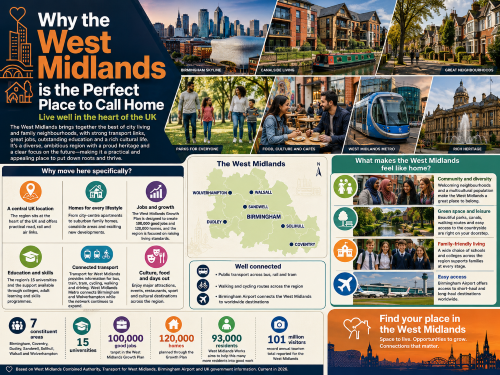
Birmingham provides major-city employment, culture, universities and neighbourhoods ranging from city-centre apartments to established suburbs. Coventry offers its own university, engineering heritage, and links to Warwickshire. Solihull combines suburban and village-style living with Birmingham Airport and strong road connections.
To the west, Dudley, Sandwell, Walsall and Wolverhampton make up much of the Black Country, where established communities, industrial heritage, town centres and a broad mix of housing create a different proposition.
That diversity matters.
The better question is not simply whether you should move to the West Midlands. It is which part of the West Midlands works for the life you want to build next.
When the decision becomes financial, explore Mortgage Brokers in the West Midlands to compare advisers across the metropolitan county.
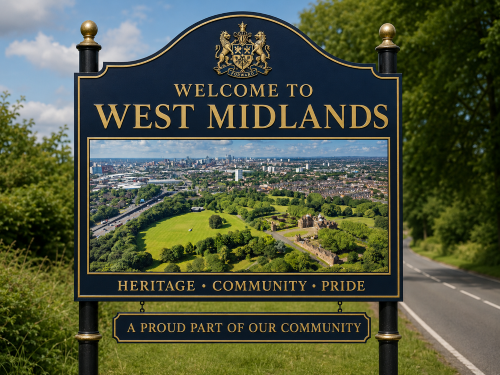
Seven Boroughs, Many Ways to Call the West Midlands Home
The West Midlands should not be treated as another name for Birmingham.
The metropolitan county is built around Birmingham, Coventry, Dudley, Sandwell, Solihull, Walsall and Wolverhampton, and the character varies considerably across them.
Birmingham itself contains very different residential markets. A city-centre apartment offers a different lifestyle from a family home in Harborne, Moseley or Sutton Coldfield.
Coventry combines a compact city centre with established residential neighbourhoods such as Earlsdon, Finham and Allesley.
Solihull has a more suburban character, while places such as Knowle, Dorridge and Shirley create alternatives for households that want access to Birmingham without living in its centre.
The Black Country offers another experience. Dudley, Walsall, Sandwell and Wolverhampton contain traditional terraces, inter-war housing, established suburbs, newer developments and former industrial areas undergoing change.
Someone asking why move to the West Midlands might therefore be looking for:
- city-centre living;
- a first family home;
- more space within commuting distance of Birmingham;
- access to universities or major employers;
- an established suburban neighbourhood;
- a Black Country town with local identity;
- a larger home in or around Solihull.
One metropolitan county can answer those questions very differently.
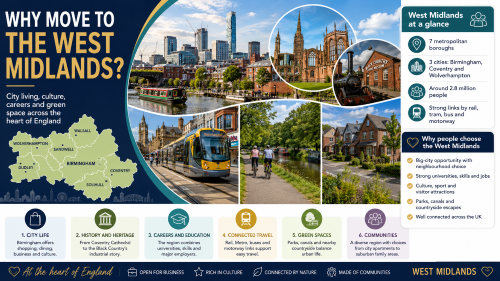
From Birmingham Flats to Solihull Homes: Understanding the Housing Market
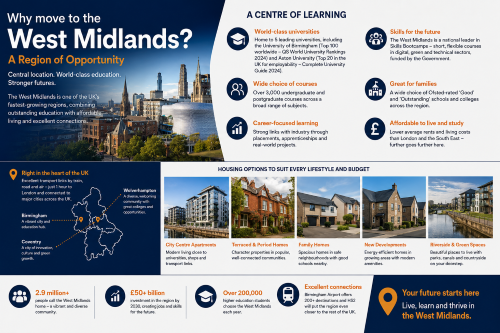
There is no single West Midlands property market.
The latest ONS data for July 2026 illustrates the difference between its seven metropolitan areas:
- Birmingham: £234,000
- Coventry: £228,000
- Dudley: £232,000
- Sandwell: £206,000
- Solihull: £337,000
- Walsall: £215,000
- Wolverhampton: £221,000
Across the wider West Midlands region, the average was £251,000. These figures are provisional and individual homes can vary substantially from local-authority averages.
Explore the underlying ONS local housing data.
The difference means buyers could be comparing:
- a leasehold apartment in central Birmingham;
- a Victorian or Edwardian terrace in Coventry;
- a semi-detached home in Wolverhampton;
- established housing in Dudley or Walsall;
- a family property in Sandwell;
- a higher-value detached home in Solihull.
The property matters as much as the postcode.
Lease length, service charges, construction type, valuation, planning history, new-build incentives and property condition can all affect mortgage underwriting.
A lower purchase price also doesn’t automatically mean a better financial fit. Travel, renovation, energy use, and ongoing household costs should be included in the same calculation.
Schools, Universities and the Cost of Family Decisions
Education can influence where a household chooses to settle in the West Midlands.
The metropolitan area has a substantial higher-education presence, including the University of Birmingham, Aston University, Birmingham City University, University College Birmingham, Coventry University and the University of Wolverhampton.
Families also have state, grammar, academy, specialist and independent-school options across different boroughs.
That can influence a move in practical ways.
Parents may need to consider:
- admissions arrangements;
- school journeys;
- public transport;
- childcare;
- whether both parents commute;
- after-school provision;
- future sixth-form or college options;
- independent-school fees where relevant.
The last point can matter financially.
Independent schools in and around Birmingham and Solihull mean some households are balancing mortgage costs with substantial education expenditure. Where school fees form part of longer-term financial planning, Education Finance may be relevant.
A property close to the preferred school can cost more. A cheaper home farther away may introduce greater transport or childcare costs.
The financial decision therefore extends beyond the purchase price.
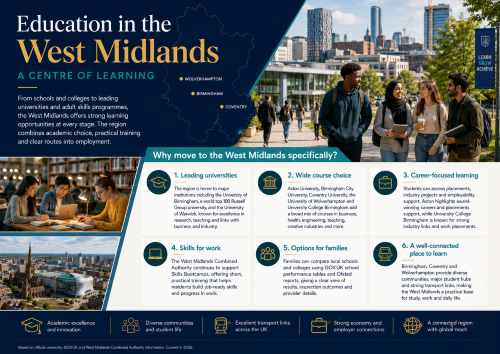
Careers and Industry Give People Reasons to Move Towards the Region
Not everybody living in the West Midlands is commuting somewhere else.
The area has its own substantial and changing economy.
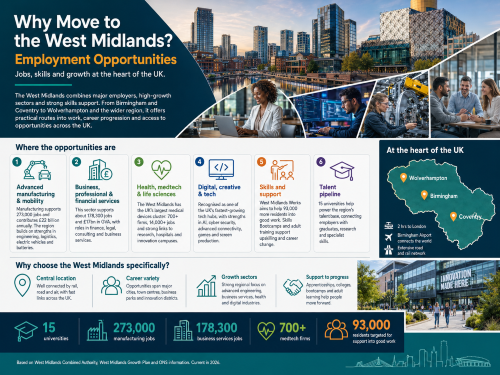
The West Midlands Combined Authority’s current Growth Plan identifies growth opportunities in advanced manufacturing and electric vehicles, green technology, health technology, digital and creative industries, and professional and financial services.
Birmingham has a major business, professional, and financial services base alongside healthcare, education, retail, and public-sector employment.
Coventry retains strong links with advanced manufacturing, engineering, automotive technology and education.
Wolverhampton, Dudley, Sandwell and Walsall retain significant manufacturing and industrial connections while also supporting healthcare, logistics, construction, education and service-sector employment.
Solihull benefits from business parks, professional employment and its proximity to Birmingham Airport and the wider motorway network.
This also produces different mortgage applicants.
Income may include:
- salary;
- overtime;
- commission;
- annual bonuses;
- shift allowances;
- company-director income;
- dividends;
- retained profits;
- contracting income;
- income from several sources.
The WMCA’s 2026 State of the Region report points to strengthening high-growth businesses, R&D and investment in advanced manufacturing, electric vehicles, services and green-energy systems.
For someone relocating for work, how that income is structured may matter to a lender as much as the new postcode.
Mortgage Planning Should Start Before the Removal Van Arrives
A property search is more useful when you consider borrowing.
Moving between areas in the West Midlands can change:
- deposit requirements;
- loan-to-value;
- monthly repayments;
- commuting costs;
- council tax;
- childcare;
- school costs;
- property maintenance;
- the amount of disposable income left each month.
Someone buying a £200,000 property in Sandwell makes a different financial decision than someone buying a substantially higher-value family home in Solihull.
Property characteristics can also change lender requirements.
A Birmingham apartment may involve lease length, ground rent or service charges.
A period house in parts of Coventry may require different valuation considerations.
An older Black Country property may need careful assessment of construction and condition.
A new development can bring incentives and lender-specific new-build criteria.
If you are comparing several areas, Find a Mortgage Adviser by Location can help narrow the search according to where you intend to buy.
The useful question is not simply:
“How much could a lender allow me to borrow?”
It is also:
“What level of borrowing leaves enough room for the life I am moving there to have?”

Larger Homes and More Complex Borrowing in Parts of the West Midlands

Higher-value property is part of the West Midlands market, but it should not be used to describe the entire area.
Solihull demonstrates the difference particularly clearly.
Its average house price was £337,000 in July 2026, compared with £234,000 in Birmingham and £206,000 in Sandwell. The average detached property in Solihull was approximately £600,000.
Higher-value homes can also be found in areas such as:
- Knowle;
- Dorridge;
- parts of Solihull;
- Sutton Coldfield;
- Edgbaston;
- selected Birmingham suburbs.
Higher property values don’t automatically make a mortgage more complex. However, higher borrowing can coincide with income that lenders need to assess differently.
Applicants might have:
- bonuses;
- partnership income;
- retained company profits;
- dividends;
- investment income;
- share awards;
- several businesses;
- property income.
Where this applies, experience with High Net Worth Mortgage Brokers may be more relevant than simply choosing the closest adviser.
The purpose is not to label an area as wealthy. It is to make sure the advice reflects the actual size and structure of the borrowing.
When Moving Is About the Next Chapter Rather Than More Space
Not every move is driven by career progression or a growing family.
Some West Midlands homeowners may be:
- downsizing;
- moving closer to children;
- leaving a large family home;
- reducing household running costs;
- relocating after retirement;
- looking for a bungalow or more manageable property;
- thinking differently about property wealth.
That can change the financial questions.
Someone approaching retirement may need to consider whether an existing mortgage should be repaid, how pension income affects affordability, what capital a move may release and whether the next property still works as needs change.
A homeowner selling a higher-value property in Solihull or Sutton Coldfield may be in a different position from someone downsizing within Dudley, Wolverhampton or Walsall.
Where equity release is being considered, it should be assessed separately from a conventional residential mortgage because it can affect inheritance and entitlement to means-tested benefits.
Homeowners can explore Equity Release Advisers in the West Midlands for specialist later-life advice.
A later-life move is still a move towards something. The priorities simply change.

Trains, Trams and Motorways Shape Everyday Life Here
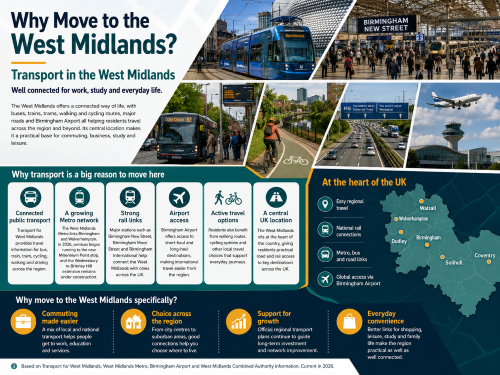
Transport is one of the defining practical features of the West Midlands.
Birmingham New Street sits at the centre of a major national rail network, while Coventry, Wolverhampton, Birmingham International and other stations provide important regional and inter-city connections.
The West Midlands Metro links Birmingham and the Black Country, with continued investment intended to extend the network and connect more communities. Transport for West Midlands is also investing in rail, bus, Metro, walking and cycling infrastructure across the area.
Road connections include:
- M5;
- M6;
- M42;
- M40;
- M54;
- A45;
- A34;
- A41.
Birmingham Airport adds domestic and international travel connections.
See current network information from Transport for West Midlands.
Yet transport should be considered as a household cost, not simply a convenience.
Before choosing an area, consider:
- door-to-door commuting time;
- parking;
- rail or Metro fares;
- school journeys;
- peak-time road congestion;
- hybrid working;
- how often each household member travels.
A lower mortgage payment farther from work can lose some of its advantage if the household spends substantially more time and money travelling.
Heritage, Canals and Green Space Change the Picture
The West Midlands has an industrial identity, but that is only one side of it.
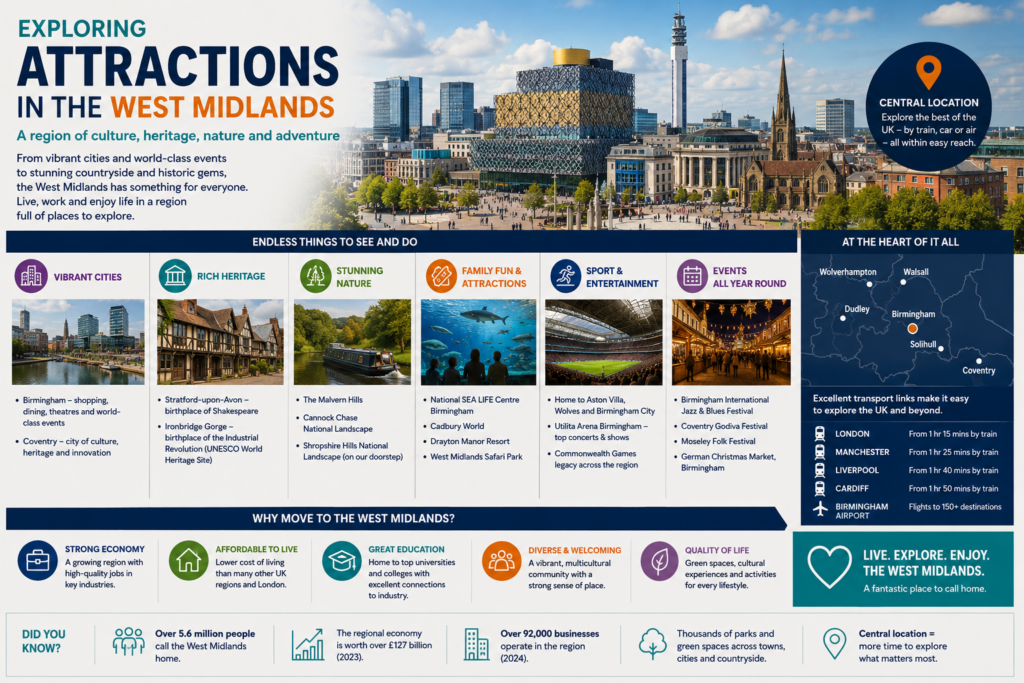
The area contains major museums, heritage sites, canals, parks, nature reserves and family attractions.
Examples include:
- Birmingham’s extensive canal network;
- Birmingham Botanical Gardens;
- Sutton Park;
- Coventry Cathedral;
- the Herbert Art Gallery and Museum;
- Black Country Living Museum;
- Dudley Castle;
- Walsall Arboretum;
- Sandwell Valley Country Park;
- Wolverhampton Art Gallery.
Sutton Park is particularly significant for Birmingham residents seeking large-scale green space within the metropolitan area.
Sandwell Valley and other local parks create similar opportunities farther west.
The Black Country Living Museum also preserves and interprets the area’s industrial and social history.
This mix matters because urban living doesn’t have to mean abandoning open space.
A household can prioritise employment and transport while still choosing an area where parks, canals, walking routes and leisure are part of everyday life.
Food, Music and Culture Make the Region More Than a Workplace
The reasons to move somewhere aren’t just the commute and mortgage.
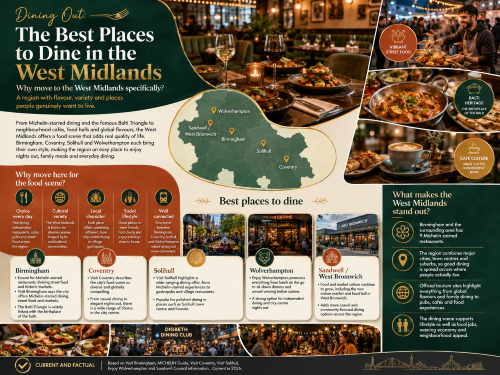
Birmingham has one of the UK’s largest city-centre leisure economies, with restaurants, theatres, music venues, shopping and neighbourhood food scenes stretching well beyond the centre.
Digbeth has a distinctive creative identity, while the Jewellery Quarter mixes employment, independent businesses, hospitality and historic streets.
Moseley and Stirchley offer another side of Birmingham’s neighbourhood life.
Coventry brings its own cultural history, music heritage and arts venues.
Wolverhampton has theatres, music venues, and a city-centre leisure scene, while Solihull combines town-centre restaurants and shopping with nearby smaller centres and villages.
The Black Country retains its own pub, market and food traditions rather than simply functioning as Birmingham’s western suburbs.
These details may look secondary while someone is comparing mortgage payments.
After moving, they often determine whether somewhere feels like home.
Why move to the West Midlands? For many households, part of the answer is the ability to access a major cultural region without every leisure decision requiring a journey to London.
One Region Can Work Very Differently as Life Changes
One of the strongest answers to why move to the West Midlands is that the right location may change as your priorities change.
A graduate may choose central Birmingham or Coventry for university, work, and social life.
A first-time buyer may compare Birmingham with Wolverhampton, Walsall, Dudley or Sandwell depending on budget and commuting needs.
A growing family may start looking towards suburban Birmingham, Solihull or established residential neighbourhoods across the Black Country.
A senior professional might prioritise Solihull, Sutton Coldfield or Edgbaston.
Someone approaching retirement may prioritise a quieter neighbourhood, access to healthcare, public transport or a more manageable property.
There is no single West Midlands lifestyle.
That is the point.
A good move should not only work on completion day. It should keep making sense as careers change, children grow older, commuting patterns shift, and financial priorities develop.
Browse Our Advisers in the West Midlands
Once you have decided which part of the area interests you, the next question is whether a mortgage suits the property and your circumstances.
Connect Experts allows users to compare mortgage advisers by location and other relevant preferences.
The aim is not to recommend the adviser who happens to be geographically closest. It helps users identify someone whose experience fits the decision they need to make.
Connect Experts is a mortgage adviser directory and matching platform. It does not provide mortgage advice directly. Mortgage advice is provided by the adviser or firm you choose.






People who found this page helpful also explored these related topics:

Mortgage Broker in Wightwick: Expert HNW Advice

Mortgage Broker in Smethwick: Clear Specialist Advice

Mortgage Broker in Knowle: Confident HNW Specialist Advice

Mortgage Broker in Dorridge: Expert Help for Complex Needs
Mortgage Broker in Four Oaks: HNW Advice That Fits

Mortgage Broker in Wolverhampton: Confident Choices
Neighbouring Counties
FAQs: Why Move to the West Midlands?
Is the West Midlands just another name for Birmingham?
No. Birmingham is the largest city, but the West Midlands metropolitan county also includes Coventry, Dudley, Sandwell, Solihull, Walsall and Wolverhampton. Each has its own housing market, transport connections and local character, so buyers should compare individual areas rather than treating the region as one city.
Where are house prices highest within the West Midlands?
The latest ONS figures show a clear difference between local authorities. In July 2026, Solihull had an average price of £337,000, compared with £234,000 in Birmingham, £228,000 in Coventry, and lower averages across several Black Country authorities. Property type and neighbourhood can create even larger differences within each borough.
Could the Black Country suit buyers who need more choice on budget?
Potentially. Average prices in Dudley, Sandwell, Walsall and Wolverhampton were below the wider West Midlands regional average in July 2026. However, buyers should also consider the specific neighbourhood, property condition, commuting costs, and future plans rather than relying on headline averages alone.
Which parts of the West Midlands work well for Birmingham commuters?
Options extend well beyond Birmingham itself. Solihull, Wolverhampton, Sandwell, Walsall and Dudley all have road or public-transport connections towards Birmingham. The right choice depends on where someone works, how often they commute and whether rail, Metro, bus or car travel is most practical.
Why might someone choose Coventry rather than Birmingham?
Coventry has its own employment base, universities, established residential neighbourhoods, and links to Warwickshire and Birmingham. Its average house price in July 2026 was also lower than Birmingham’s. Someone working around Coventry or the eastern side of the metropolitan area may therefore have little reason to base their search around Birmingham.
What should I compare before deciding where to live in the West Midlands?
Compare more than the asking price. Consider mortgage affordability, commuting costs, schools, childcare, property type, transport, green space, local services, and how much disposable income you’ll have left after the move. The cheapest property is not automatically the lowest-cost lifestyle.