
Why move to Hertfordshire? Because sometimes the best place to live isn’t at the centre of everything, but somewhere that keeps different parts of life within reach.
Hertfordshire sits immediately north of London, yet its identity is far broader than being a commuter county. St Albans offers a historic cathedral city, Hertford has a traditional county-town feel, Hitchin combines a market-town centre with rail connections, while Welwyn Garden City and Letchworth Garden City were shaped around a very different idea of how towns and green space could work together.
Elsewhere, Watford offers a larger commercial centre, Bishop’s Stortford sits close to the Essex border and the Stansted corridor, and towns such as Harpenden, Berkhamsted, Radlett and Rickmansworth offer another mix of housing, schools and access to London.
Hertfordshire can therefore work for very different households.
The more useful question is not simply whether Hertfordshire is a good place to live. It is which part of Hertfordshire fits the life you are trying to create.
When that decision involves property and borrowing, Mortgage Brokers in Hertfordshire can help you explore advisers across the county.
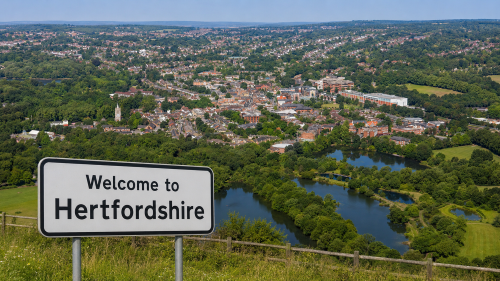
Historic City, Garden City or Market Town: Hertfordshire Gives You Choice
Hertfordshire offers more than one version of suburban life.
St Albans combines Roman history, a cathedral, established residential areas and direct connections towards London.
Hertford has a smaller county-town setting with period streets, riverside areas and surrounding villages.
Hitchin offers a traditional market-town centre alongside Victorian, Edwardian and modern housing.
Welwyn Garden City and Letchworth Garden City are distinctive because their planning placed housing, employment and green space at the heart of their development.
Further south, Watford, Bushey, Borehamwood and Potters Bar put residents closer to Greater London, while Berkhamsted, Tring and Harpenden offer established town centres with nearby countryside.
To the east, Bishop’s Stortford, Ware and Sawbridgeworth create another corridor towards London, Stansted and Cambridge.
This variety matters because two households moving only a few miles apart may be choosing very different lifestyles.
One household may prioritise the fastest possible rail journey.
Another may want a larger garden.
A family may place schools first.
Someone working from home may care more about green space, local amenities and the property itself. Hertfordshire gives people room to make those choices without assuming everybody wants the same thing.
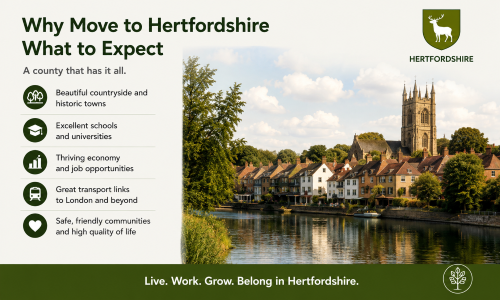
Housing in Hertfordshire: One County, Very Different Price Points

Understanding why move to Hertfordshire also means understanding that there is no meaningful single Hertfordshire house price.
The differences between its districts are substantial.
ONS figures for July 2026 show:
- St Albans: average house price £647,000
- Three Rivers: £591,000
- Hertsmere: £549,000
- East Hertfordshire: £457,000
- North Hertfordshire: £419,000
St Albans had the highest average house price in the East of England in July 2026, while Three Rivers ranked second and Hertsmere third.
The first-time buyer figures also show why location matters. In July 2026, first-time buyers paid an average of £475,000 in St Albans, compared with £358,000 in East Hertfordshire and £339,000 in North Hertfordshire.
You can review the latest figures through the Office for National Statistics housing data.
A buyer might therefore be comparing:
- a flat in Watford;
- a Victorian terrace in Hitchin;
- a family house in Welwyn Garden City;
- a period property in Hertford;
- a higher-value home around St Albans or Harpenden;
- a village property in East Hertfordshire;
- a commuter home around Borehamwood or Potters Bar.
Property type can matter as much as location.
Listed buildings, older homes, leasehold flats, converted properties, new-build developments, and rural homes can each raise different questions about valuation and lender criteria.
Choosing where to live can therefore affect both the amount you need to borrow and how lenders assess the property.
Education Can Become Part of the Hertfordshire Move
For many families, a home search eventually becomes a school search as well.
Hertfordshire County Council’s school directory covers communities throughout the county, including St Albans, Harpenden, Hertford, Hitchin, Bishop’s Stortford, Berkhamsted, Watford, Welwyn Garden City, Radlett, Bushey and many others. The county has maintained schools, academies and independent education.
The council states that almost 300,000 children and young people are provided with a place at a good school and that 94% receive one of their preferred secondary or upper-school choices.
However, choosing a school and financing a household are separate decisions that eventually meet in the same monthly budget.
Families may need to consider:
- catchment or admissions arrangements;
- school journey times;
- childcare;
- commuting;
- transport costs;
- school fees where applicable;
- whether a future move might be required;
- how education expenditure affects disposable income.
Where independent education forms part of the longer-term plan, Education Finance may be relevant alongside wider mortgage and household planning.
A home can look right on paper but fall short in practice if the daily routine around it doesn’t work.

Hertfordshire Has Its Own Employment Story

Living in Hertfordshire does not necessarily mean working in London.
The county has a diverse economic base with particular concentrations in pharmaceutical manufacturing, scientific research and development, software, telecommunications, construction, professional services and head-office activity.
Hertfordshire’s economic data show that pharmaceutical manufacturing has a much higher employment concentration than the national average. Scientific research and development, computer programming, legal and accounting services, construction, and management consultancy also make up a significant part of the local economy.
That matters from a mortgage perspective because Hertfordshire’s workforce can include applicants with very different income arrangements.
Some will have straightforward salaries.
Others may receive:
- annual bonuses;
- commission;
- share awards;
- company-director income;
- retained profits;
- contract income;
- consultancy income;
- investment income;
- income from several sources.
The question for a lender is not simply how much someone earns.
It is how that income is structured, evidenced and likely to continue.
For households relocating to Hertfordshire for employment, understanding that distinction before choosing a lender can be valuable.
Mortgage Considerations When Moving to Hertfordshire
Hertfordshire’s wide spread of property values makes early mortgage planning particularly useful.
The difference between purchasing in St Albans, Stevenage, Hitchin, Hertford, Watford or a smaller village can materially change:
- the required deposit;
- loan-to-value;
- mortgage size;
- affordability;
- stamp duty;
- lender choice;
- property valuation.
Property characteristics can create another layer.
A lender assessing a modern flat in Watford may ask different questions from one assessing an older property in St Albans or a village home in East Hertfordshire.
The useful financial question is therefore not simply:
“What is the maximum I can borrow?”
It is:
“What level of borrowing allows the move and the life around it to remain comfortable?”
That distinction matters in a county where housing costs, commuting, childcare and education expenses can all be significant.
If you are still comparing towns, Find a Mortgage Adviser by Location lets you search by town, city, county, or postcode and compare advisers by expertise and geography.

Higher-Value Homes and Complex Income in Hertfordshire

Hertfordshire has a genuine high-value housing story, particularly across parts of St Albans, Three Rivers and Hertsmere.
ONS data for July 2026 shows average detached-property values of approximately:
- £1.259 million in St Albans
- £1.206 million in Three Rivers
- £1.2 million in Hertsmere
This does not mean every Hertfordshire buyer is high-net-worth.
It does mean that larger mortgage requirements are a natural part of some local markets, including areas around St Albans, Harpenden, Radlett, Rickmansworth, Chorleywood and other established higher-value communities.
Larger borrowing can also coincide with more complex income, including:
- bonuses;
- dividends;
- partnership drawings;
- retained company profits;
- investment income;
- multiple directorships;
- shares or equity awards;
- income from several businesses.
In these cases, specialist experience may matter more than choosing the adviser with the closest office.
Users with larger or more complex borrowing requirements can explore High Net Worth Mortgage Brokers.
Later-Life Moves in Hertfordshire
Not everybody asking why move to Hertfordshire is moving for a new job, school place or London commute.
Some households may be downsizing.
Others may want to move closer to children or grandchildren, trade a larger family home for something easier to maintain, or reconsider where they live once daily commuting no longer matters.
A homeowner who spent years prioritising access to London may later place greater value on:
- a smaller town;
- shops within walking distance;
- public transport;
- healthcare;
- green space;
- family nearby;
- a lower-maintenance property.
The financial questions can change too.
Someone approaching retirement may need to consider whether to:
- repay an existing mortgage;
- remortgage into retirement;
- downsize;
- retain more savings;
- use pension income for borrowing;
- access some property wealth.
Equity release is only one option and should be considered separately from a standard residential mortgage.
When relevant, homeowners can explore Equity Release Advisers in Hertfordshire for specialist later-life advice. The Hertfordshire guide also explains that the assessment should consider age, property value, existing borrowing, future plans, and alternatives.

Transport and Commuting Are Central to Hertfordshire Life

Hertfordshire’s proximity to London is one of its defining practical advantages, but the county has several different commuting corridors.
Great Northern and Thameslink services link towns including Stevenage, Welwyn Garden City, Hatfield, Hitchin and surrounding areas with London and destinations further north. The A1(M) provides an important north-south road route, while the A414, A602 and A505 help connect different parts of the county.
Other routes connect Watford, St Albans, Harpenden, Berkhamsted and Bishop’s Stortford towards London through different rail networks.
That means the commuter question is not simply:
“How far is this town from London?”
A better set of questions is:
- Which London station does the train arrive at?
- How far is the home from the local station?
- How frequent is the service?
- Will station parking be required?
- Does the journey still work on office days?
- Would hybrid working justify looking further out?
- What happens if employment changes?
A property further from London may offer more space, but the financial calculation should include travel costs as well as the mortgage.
For some households, the best-value move is not the cheapest property or shortest commute. It is the combination they can live with comfortably.
Dining Out: The Best Places to Dine in Hertfordshire
Hertfordshire has a strong food and drink scene. It includes fine dining, pubs, cafés, farm shops, restaurants, afternoon tea, breweries, distilleries, market-town food, and country dining.
Visit Herts says the county offers fine dining restaurants, afternoon teas, wineries, distilleries, craft breweries, and a wide range of food and drink options.
St Albans is a major dining destination. Enjoy St Albans describes the city as a place for global street food on market days, local ale, fine dining, cafés, and food-led festivals.
Hertford, Hitchin, Watford, Berkhamsted, Tring, Harpenden, and Bishop’s Stortford also offer strong local options. Residents can enjoy town-centre restaurants, countryside pubs, independent cafés, bakeries, and local produce.
For buyers, dining adds to lifestyle value. It can also help make town centres more attractive to families, professionals, renters, and visitors.

Film, Culture and Everyday Life Add Another Dimension

Hertfordshire also has an unusually visible relationship with the film and television industry.
Warner Bros. Studio Tour near Watford has become one of the county’s best-known attractions, while the wider area around Leavesden is closely associated with major film production. VisitEngland highlights the studio tour as a major destination for visitors to Hertfordshire.
Elsewhere, towns such as St Albans, Hitchin, Hertford and Berkhamsted have established high streets, restaurants, cafés and independent businesses.
For residents, these details can matter more over time than they first appear.
Before a move, attention often falls on:
- price;
- bedrooms;
- schools;
- station distance;
- mortgage payments.
After the move, everyday questions become equally important:
- Where will you shop?
- Where will you walk?
- Is the town centre somewhere you will use?
- Can children travel independently as they get older?
- Is there somewhere to spend a Saturday without driving into London?
- Does the area still work if commuting becomes less important?
A successful relocation is usually one where ordinary life works as well as the initial property purchase.
Why Hertfordshire Can Work at Different Stages of Life
One of Hertfordshire’s strengths is that people can change their reasons for living there without necessarily leaving the county.
A first-time buyer might prioritise a flat or a smaller house with rail access.
A growing family may look towards schools, bedrooms, outdoor space and a manageable commute.
A professional may want to shorten the journey into London while retaining more space than a central London budget would provide.
A senior executive or business owner may prioritise a larger home in St Albans, Harpenden, Radlett or another higher-value area.
Someone approaching retirement may eventually care less about a station and more about community, healthcare and everyday convenience.
Hertfordshire is not compelling because every part of it offers the same lifestyle.
It is compelling because the county offers several different ways to live while keeping London, major employment centres and established communities within reach.
That can let the place you call home evolve with your priorities rather than simply reflect the stage of life you are in today.
Browse Our Advisers in Hertfordshire
Once you have narrowed down where you want to live, the next question is whether your mortgage fits the property and the circumstances behind the move.
Connect Experts lets you choose mortgage advisers by location and other relevant preferences.
Compare advisers based on the decision you need to make rather than simply choosing the closest postcode.
Connect Experts is a mortgage adviser directory and matching platform. It does not provide mortgage advice directly. Mortgage advice is provided by the adviser or firm you choose.




People who found this page helpful also explored these related topics

Find a Trusted Mortgage Broker in Broxbourne

Find a Trusted Mortgage Adviser in Royston

Mortgage Broker in Harpenden – Find Experts Advisers

Find a Mortgage Broker in Borehamwood, Hertfordshire

Mortgage Broker in Hatfield – Find Local Expertise With Trusted Guidance

Mortgage Broker in Bishop’s Stortford – Find a Trusted Adviser
Neighbouring Counties
FAQs: Why Move to Hertfordshire?
Is Hertfordshire a practical alternative to living in London?
For some households, yes. Hertfordshire borders Greater London and several towns have direct rail connections into the capital, while offering different housing types, town centres and access to green space. Whether it works financially depends on the property price, commuting costs and how frequently someone needs to travel into London.
Which parts of Hertfordshire have the highest house prices?
Property values vary considerably. In July 2026, St Albans had an average house price of £647,000, Three Rivers £591,000 and Hertsmere £549,000. These were the three highest local-authority averages in the East of England at that point. Individual towns and properties can differ considerably from district averages.
What is the difference between Hertfordshire's garden cities and older towns?
Welwyn Garden City and Letchworth Garden City were deliberately planned around homes, employment and green space. Older centres such as St Albans, Hertford and Hitchin developed differently and contain more historic street patterns and period housing. The choice comes down to the type of environment and property that fits the buyer.
Does moving further north in Hertfordshire always mean cheaper housing?
Not necessarily. Average values generally differ across the county, but town, street, property type, condition and transport links can all affect price. North Hertfordshire’s average was £419,000 in July 2026, below St Albans, Three Rivers and Hertsmere, but that does not mean every property in the north will cost less than every property further south.
What should I compare before choosing a Hertfordshire town?
Consider the property budget, commuting time, rail destination, school arrangements, childcare, local amenities, property type, and future plans. A town that looks more affordable can become less attractive if the daily travel costs or lifestyle compromises outweigh the savings.