
Why move to Greater Manchester? Because a move is rarely about finding one perfect postcode. It is about deciding how work, travel, family life, housing costs and the years ahead should fit together.
Greater Manchester gives people unusually different ways to make that choice within one city region.
Manchester and Salford provide dense urban living, major employment centres and extensive apartment markets. Trafford and Stockport include established suburban and higher-value neighbourhoods. Bolton, Bury, Oldham, Rochdale, Tameside and Wigan offer their own town centres, housing markets, communities and links into the wider region.
The more useful question is therefore not simply whether Greater Manchester suits you.
It is which part of Greater Manchester supports the life you want after you move.
When property becomes part of that decision, you can explore Mortgage Brokers in Greater Manchester and compare advisers covering different parts of the city region.
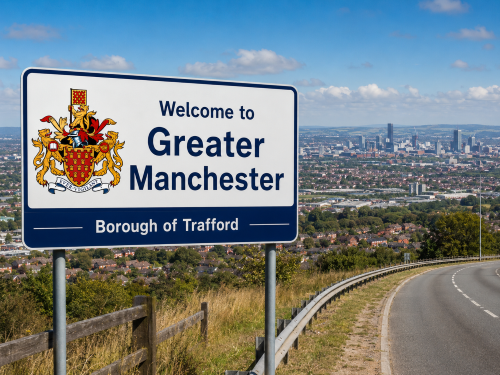
One City Region, Ten Very Different Places to Live
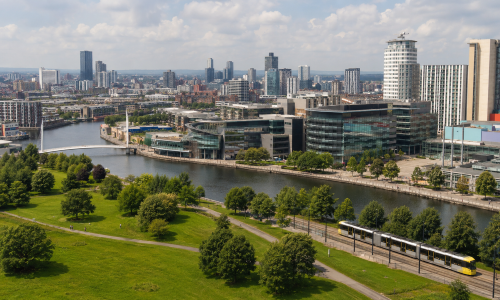
Greater Manchester is not one housing market and it is not one lifestyle.
The city region is made up of Bolton, Bury, Manchester, Oldham, Rochdale, Salford, Stockport, Tameside, Trafford and Wigan. Each has its own housing stock, transport connections and character.
Someone asking why move to Greater Manchester might be thinking about:
- an apartment close to Manchester city centre;
- waterside living around Salford Quays;
- a family home in Trafford or Stockport;
- Victorian and Edwardian housing around Didsbury;
- a traditional terrace in Bolton or Oldham;
- suburban living around Bury;
- a larger home around Worsley;
- a town-centre move in Rochdale or Wigan;
- access to the Pennine edge around eastern Greater Manchester.
That choice is one of the region’s strongest practical advantages.
You can move closer to city-centre employment without necessarily living in the city centre itself. You can also choose a quieter residential area while keeping access to rail, tram, bus, and motorway connections.
The region therefore works best when you compare locations according to daily life rather than reputation alone.
Greater Manchester Housing: Prices Change Sharply by Borough
Property prices across Greater Manchester vary widely, so a single regional average can be misleading.
Latest ONS figures for July 2026 recorded average house prices of:
- £204,000 in Bolton
- £229,000 in Salford
- £252,000 in Manchester
- £401,000 in Trafford
The difference is significant. First-time buyers paid an average of £180,000 in Bolton, £211,000 in Salford, £237,000 in Manchester and £323,000 in Trafford.
That means two households moving to Greater Manchester could face very different financial decisions.
One buyer may be comparing:
- a city-centre apartment in Manchester;
- a converted or modern flat in Salford;
- a terrace in Bolton;
- a family semi in Stockport;
- a suburban property in Bury;
- a higher-value home in Trafford;
- a period home in Didsbury;
- a property in Worsley or Sale.
Property type matters too.
Leasehold apartments, converted mills, new-build flats, older terraces, larger period homes and unusual construction can each raise different questions during valuation and underwriting.
If you are buying your first home, the First-Time Buyer Mortgage Guide can help explain how deposits, affordability and mortgage applications fit together.
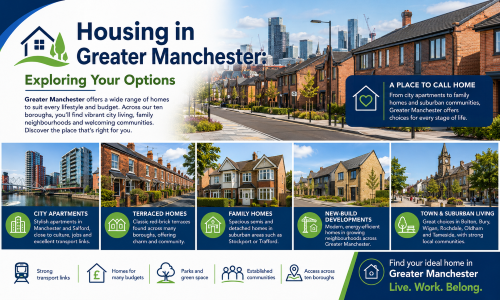
Education Can Shape the Move More Than the House

For some households, moving to Greater Manchester is partly about education.
The region includes universities, colleges, state schools and established independent schools. Greater Manchester’s universities and colleges also support a large student and graduate population, which influences both housing demand and local employment.
Families may look closely at areas such as Manchester, Trafford and Stockport when weighing schooling against commuting and housing.
Yet the decision should not rest on school reputation alone.
It is also worth considering:
- school journey times;
- catchment arrangements;
- childcare;
- transport costs;
- whether both parents commute;
- the cost of clubs and activities;
- school fees where applicable;
- how education costs affect household affordability.
Regular education costs can become part of a much wider financial picture.
Where independent education is part of the plan, Education Finance may be relevant. Borrowing secured against a home isn’t suitable for everyone, so affordability, property equity, and repayment plans all need careful assessment.
Greater Manchester Can Be the Destination for Work, Not Just the Commute
Not everyone moves to Greater Manchester just to get easier access to somewhere else.
The city region itself has major employment centres across finance, digital, creative industries, healthcare, education, manufacturing, logistics, hospitality and professional services. Manchester city centre, MediaCity, Salford Quays, Trafford Park, Manchester Airport, Stockport, Bolton and Wigan all support significant employment activity.
That matters because work can influence both where you live and how a lender assesses income.
Some applicants will have straightforward salaries.
Others may receive:
- bonuses;
- commission;
- contractor income;
- company-director income;
- dividends;
- retained profits;
- freelance earnings;
- income from more than one source.
A relocation linked to a new job may also involve a new contract, probation period or different travel costs.
The mortgage question is therefore not always simply:
How much can I borrow?
A more useful question can be:
Which lenders are comfortable with how my income is actually earned?
That distinction matters most for professionals, contractors, business owners, and self-employed applicants moving into the region.

The Bee Network Changes How the Region Connects

Transport is one of the strongest practical reasons people consider moving within Greater Manchester.
The Bee Network is Greater Manchester’s joined-up transport network, bringing together buses, trams and wider travel options. Metrolink links Manchester city centre with locations including Altrincham, Bury, Rochdale, East Didsbury, Eccles, Trafford Centre and Manchester Airport.
Rail connections extend that choice further.
Stations across the region include:
- Bolton;
- Stockport;
- Altrincham;
- Rochdale;
- Wigan;
- Salford Crescent;
- Bury-area connections through Metrolink;
- Manchester Piccadilly;
- Manchester Victoria;
- Manchester Airport.
Manchester Airport also has direct rail access to Manchester Piccadilly, with TfGM describing journey times of around 20 minutes.
Road travel is supported by routes including the M60, M62, M56, M61, M66 and M67.
That network creates flexibility, but commuting should still be judged by everyday reality.
Before choosing a home, compare:
- station or tram-stop distance;
- peak-time journey times;
- parking;
- ticket costs;
- school runs;
- hybrid working patterns;
- motorway congestion;
- how often the journey will actually be made.
A lower-priced home further from work can sometimes become more expensive once travel time and transport costs are added.
Weekends Can Look Completely Different Without Leaving Greater Manchester
Greater Manchester offers more than city-centre attractions.
Residents can move between urban, suburban and greener settings without travelling far.
The region includes attractions and leisure destinations such as:
- the National Football Museum;
- major football stadiums;
- Aviva Studios;
- MediaCity and The Quays;
- RHS Garden Bridgewater;
- Heaton Park;
- Fletcher Moss Botanical Garden;
- Alexandra Park;
- local museums and galleries;
- canals, country parks and Pennine-edge walks.
Visit Manchester also presents individual guides for the different Greater Manchester boroughs, underlining how much the visitor and lifestyle offer change across the city region.
That variety matters for residents.
A weekend might mean a city exhibition, a football match, a market, a tram journey to another borough or a walk near the Pennines.
The region’s appeal is not that every area offers the same lifestyle.
It is that different lifestyles can sit relatively close together.

Food, Culture and the Things That Fill the Week

A relocation decision is not made through house prices alone.
Manchester city centre provides one of the region’s broadest concentrations of restaurants, cafés, bars, music venues and cultural spaces.
Salford Quays and MediaCity offer waterside leisure and entertainment.
Altrincham, Sale, Chorlton, Didsbury, Stockport, Prestwich, Bury, Bolton, Rochdale and Wigan all have their own food and hospitality scenes.
Greater Manchester also has strong cultural and sporting identities, including:
- major football clubs and stadiums;
- museums and galleries;
- live music;
- theatre;
- independent markets;
- neighbourhood restaurants;
- parks and gardens;
- canals and waterside routes.
For someone deciding why move to Greater Manchester, these details may matter more after the move than they do during the property search.
Where you eat, exercise, meet friends, take children or spend a Sunday often becomes part of whether a place feels right.
Mortgage Planning When Moving Across Greater Manchester
A property search is more useful when you plan your mortgage alongside it.
Greater Manchester includes housing markets that are comparatively accessible and significantly higher-value areas within the same city region. That affects:
- deposit requirements;
- loan-to-value;
- affordability;
- lender selection;
- monthly repayments;
- service charges;
- valuation;
- required borrowing.
A £200,000 property in Bolton creates a very different financial decision from a £500,000 or £700,000 home in parts of Trafford.
The property itself can also change the conversation with your lender.
A city-centre apartment may involve lease length, ground rent, service charges or cladding considerations.
A converted mill may require a lender comfortable with the building and construction.
A Victorian home in Didsbury may raise different valuation issues from a modern property in Salford.
A larger home in Stockport or Trafford may simply require substantially more borrowing.
If you are comparing several parts of the city region, Find a Mortgage Adviser by Location can help you identify advisers covering the places you are considering.
The closest adviser isn’t automatically the most suitable. Relevant experience can matter more than postcode.

Where Higher-Value Homes Change the Mortgage Conversation

Greater Manchester should not be described as uniformly high-value.
However, some areas are clearly higher-value, particularly parts of Trafford, Stockport, Didsbury, Altrincham, Sale, Hale, Bowdon and Worsley.
ONS figures illustrate the difference. In Trafford, the average house price was £401,000 in July 2026, while detached homes averaged £807,000. First-time buyers in Trafford paid an average of £323,000.
Higher-value areas may also attract borrowers with less straightforward income.
Applicants may receive:
- bonuses;
- investment income;
- partnership drawings;
- retained company profits;
- dividends;
- share awards;
- income from multiple businesses;
- substantial asset income.
In these circumstances, experience with High Net Worth Mortgage Brokers may be relevant where borrowing size or income structure sits outside straightforward lender criteria.
This is particularly appropriate in areas such as Altrincham, Hale, Bowdon, Didsbury, Sale and parts of Stockport and Worsley, where higher-value property can make borrowing requirements more complex. Connect Experts already treats Didsbury as relevant to HNW mortgage searches.
Later-Life Moves Can Change What Matters Most
Not everybody asking why move to Greater Manchester is looking for a larger home or a shorter commute.
Some households may be:
- downsizing;
- moving closer to family;
- relocating after retirement;
- reducing household running costs;
- moving from a large house into an apartment;
- releasing capital through a move;
- considering how property wealth fits into retirement.
A later-life move can change the questions behind the mortgage.
Instead of prioritising maximum borrowing, someone may need to consider:
- pension income;
- an existing mortgage balance;
- whether downsizing releases enough capital;
- long-term running costs;
- access to healthcare and transport;
- proximity to family;
- whether property wealth should remain untouched.
If equity release is part of the discussion, treat it as a separate specialist decision rather than a standard residential mortgage.
Homeowners can explore Equity Release Advisers in Greater Manchester where later-life borrowing is relevant. Equity release can reduce an estate’s value and may affect entitlement to means-tested benefits.

Greater Manchester Can Work at Different Stages of Life

One reason why move to Greater Manchester remains such a useful question is that the answer can change with age and circumstances.
A graduate might choose Manchester or Salford for work and city life.
A first-time buyer may compare Bolton, Wigan, Oldham or Rochdale with Manchester and Salford.
A family might look towards Stockport, Trafford, Bury or suburban parts of Tameside.
A senior professional may prioritise Altrincham, Hale, Didsbury or access to Manchester Airport.
Someone approaching retirement may want quieter surroundings, closer access to family, or a smaller property near local services.
The region doesn’t offer a single version of life.
That is its advantage.
A move should work not only on completion day. It should still make sense when work changes, children grow older, commuting patterns shift or financial priorities become different.
Browse Our Advisers in Greater Manchester
Once you know where you might want to live, the next question is whether the borrowing fits the property and the circumstances behind your move.
Connect Experts allows users to compare mortgage advisers by location, mortgage expertise, language and other preferences.
That is particularly useful in Greater Manchester because a city-centre apartment, a Trafford family home and a Bolton terrace can create very different mortgage questions.
Use the Connect Experts mortgage adviser directory to compare advisers based on the decision you need to make rather than simply choosing whoever is geographically closest.
Connect Experts is a mortgage adviser directory and matching platform. It does not provide mortgage advice directly. Advice is provided by the adviser or firm you choose.






People who found this page helpful also explored these related topics:

Mortgage Broker in Trafford: Clear Advice for Complex Needs

Mortgage Broker in Worsley: Clear Expert Specialist Advice

Mortgage Broker in Eccles: Confident Mortgage Choices

Mortgage Broker in Marple: Clear Advice for SK6

Mortgage Broker in Cheadle: Expert Advice for Large Loans

Mortgage Broker in Oldham: Clear Advice for Real Choices
Neighbouring Counties
FAQs: Why Move to Greater Manchester?
Is Greater Manchester only suitable if I want city living?
No. Manchester city centre and Salford provide urban living, but the wider city region also includes suburban towns, established residential areas and communities closer to open countryside. Trafford, Stockport, Bury, Bolton, Rochdale, Tameside and Wigan all offer alternatives to central Manchester.
Which part of Greater Manchester may suit a first-time buyer?
That depends on budget, commuting needs and property type. ONS figures show meaningful price differences between boroughs. In July 2026, first-time buyers paid an average of £180,000 in Bolton, £211,000 in Salford, £237,000 in Manchester, and £323,000 in Trafford.
Does Greater Manchester work for people who do not drive?
It can. Greater Manchester has extensive bus, tram and rail networks. The Bee Network and Metrolink connect many major residential and employment locations, but their practical usefulness depends on your specific home, workplace, and journey.
Why can mortgages on Greater Manchester flats need extra checks?
City-centre and converted properties may involve lease length, service charges, building construction, cladding, valuation or new-build criteria. Different lenders apply different rules, so the property can influence lender choice as much as the applicant’s income.
Where are some of Greater Manchester's higher-value housing markets?
Trafford contains some of the region’s highest-value housing, with Altrincham, Hale, and Bowdon particularly notable. Didsbury, parts of Stockport and Worsley can also contain higher-value homes. Trafford’s average house price was £401,000 in July 2026, while detached homes averaged £807,000.
What should I compare before choosing a Greater Manchester borough?
Compare more than the purchase price. Consider commuting costs, transport connections, schools, childcare, council tax, property type, service charges (where relevant), access to green space, local amenities, and how much borrowing leaves room for other priorities.