
Why move to Rutland? Because sometimes a smaller place gives you more room for what matters.
Rutland is England’s smallest historic county, but that doesn’t make living there any less meaningful. Oakham and Uppingham provide market-town life, while places such as Empingham, Ketton, Edith Weston, Ryhall, Cottesmore and Whissendine offer a more rural setting.
Rutland Water sits at the centre of much of the county’s outdoor identity, bringing walking, cycling, sailing, fishing and wildlife into everyday life.
For some buyers, the attraction is countryside. For others, it is the schools, village character or access to places such as Stamford, Leicester and Peterborough.
The real question, therefore, is not simply whether Rutland is a good place to live.
It is whether its scale, character and pace fit the life you want after moving.
When your plans become a mortgage decision, you can also explore Mortgage Brokers in Rutland and compare advisers who cover the county.
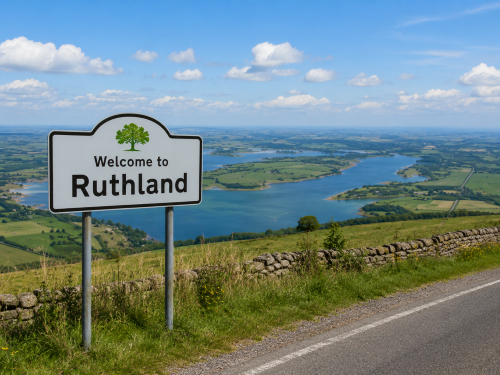
Market Town or Village Life: Rutland Makes the Choice Personal
Rutland doesn’t need many towns to offer different ways of living.
Oakham is the county town and provides the clearest concentration of shops, schools, cafés, services and rail connections.
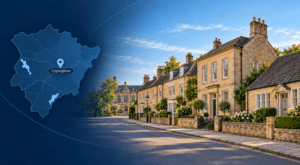
Uppingham has a different feel. Its historic streets, independent businesses, galleries and established school give it the character of a traditional market town.
Outside the two towns, much of Rutland’s appeal comes from its villages.
Empingham and Edith Weston provide access towards Rutland Water.
Ketton and Ryhall sit closer to Stamford and the county’s eastern side.
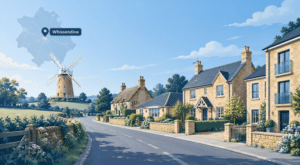
Cottesmore, Langham and Whissendine offer another version of rural Rutland, where village identity and the surrounding countryside play a bigger role in everyday life.
That distinction matters.
One household asking why move to Rutland may want to walk into Oakham for coffee or shopping.
Another may prefer a stone village property where the view from the window matters more than proximity to a high street.
Rutland works best when you choose a place around your life, not just the postcode.
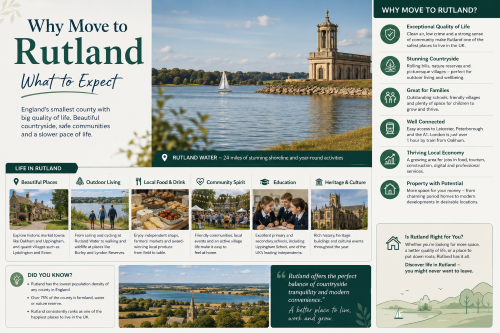
Homes in Rutland: A Small County with Distinct Property Choices
Rutland has a smaller housing market than many neighbouring counties, but property values can vary widely.
The latest Office for National Statistics figures show an average Rutland house price of £299,000 in July 2026. First-time buyers paid an average of £233,000, while mortgage buyers averaged £288,000.
Property type changes the picture further:
- Detached homes: £431,000
- Semi-detached homes: £279,000
- Terraced homes: £229,000
- Flats and maisonettes: £129,000
Rutland had the fourth-highest average house price in the East Midlands in July 2026.
Those figures help explain why buyers should look beyond a county average.
A first-time buyer may compare a smaller home in Oakham with a terrace elsewhere in the county.
A family may prioritise a detached property near schools.
Someone moving for lifestyle reasons may focus on a cottage, barn conversion or village house.
Rural properties may also raise mortgage questions around:
- private drainage;
- access rights;
- land or paddocks;
- outbuildings;
- listed status;
- older construction;
- renovation requirements.
For buyers already comparing individual areas, Find a Mortgage Adviser by Location can help identify advisers who cover the towns or villages you’re considering.
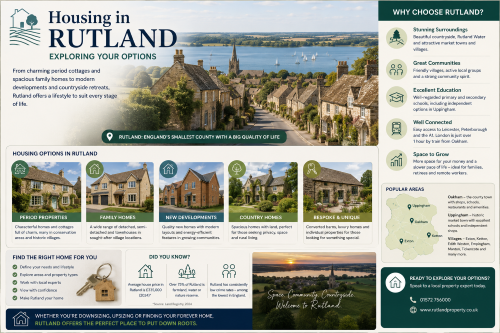
Schools Can Shape a Rutland Move Long Before the Keys Change Hands
For some families, the home search begins with education rather than property.
Rutland has a relatively compact education network, but it also contains two nationally recognised independent schools.
Oakham School and Uppingham School both contribute strongly to their towns’ identities.
That does not mean a move should be made around one school alone.
Families also need to consider:
- admissions;
- school journeys;
- transport arrangements;
- childcare;
- extracurricular travel;
- whether parents commute;
- school fees where applicable;
- how those costs fit alongside the mortgage.
Rutland County Council also runs school transport routes between rural villages and education centres, showing how location can directly affect daily routines.
Where independent education is part of a longer-term financial plan, Education Finance may be relevant to the wider household discussion.
A house can meet today’s needs perfectly, yet still become impractical if every weekday begins with an unsustainable school journey.
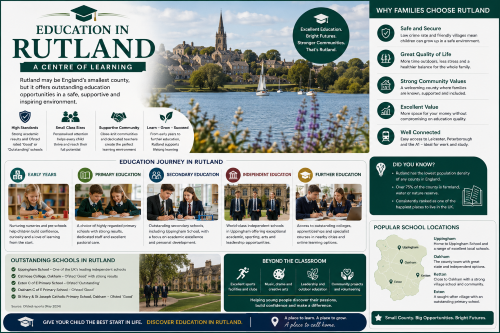
Rutland's Economy Works Locally and Beyond the County Boundary
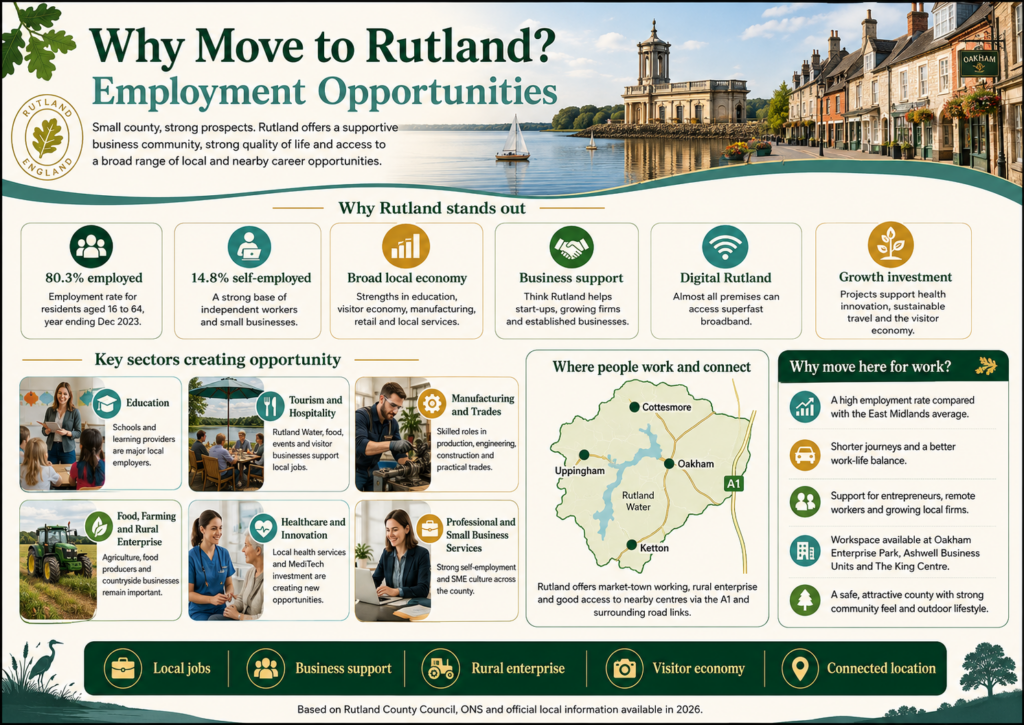
Not everybody moving to Rutland will work in Rutland.
That is part of what makes its employment picture distinctive.
The local economy includes:
- education;
- public services;
- healthcare;
- farming;
- food production;
- tourism;
- hospitality;
- retail;
- construction;
- small businesses;
- professional services.
Rutland County Council’s current economic strategy also focuses on supporting business growth, infrastructure, active travel and a productive rural economy.
Tourism plays an important role too.
Rutland Water, Oakham, Uppingham and the county’s villages support hospitality, attractions, accommodation and visitor services. Council planning evidence identifies the visitor economy as a significant part of local economic activity.
Many residents may also work outside the county.
Nearby employment centres include:
- Stamford;
- Peterborough;
- Leicester;
- Melton Mowbray;
- Corby;
- Nottingham.
Hybrid working can further widen those choices.
That creates different mortgage profiles.
One applicant may receive a straightforward salary.
Another may be:
- self-employed;
- a company director;
- a contractor;
- receiving bonuses;
- taking dividends;
- earning from several sources.
The property may be rural, but the income supporting it can be much more complex.
Mortgage Planning When Moving to Rutland
Once the lifestyle decision becomes a financial one, the property itself matters.
A mortgage lender considers more than the applicant’s salary and deposit.
It may also assess:
- property construction;
- condition;
- valuation;
- lease length;
- service charges;
- flood considerations;
- acreage;
- outbuildings;
- access;
- resaleability;
- loan-to-value;
- income structure.
That can be particularly relevant in a county with such varied housing.
From an underwriting perspective, a coastal house, Ipswich flat, listed village property, and rural home are not interchangeable.
A suitable adviser can help you understand whether your circumstances and intended property are likely to fit particular lender criteria.
You can compare advisers through the Connect Experts mortgage adviser directory or search more locally through Find a Mortgage Adviser by Location.
If you’d prefer to discuss detailed financial information in another language, Bilingual Mortgage Brokers offers another search option.

Character Homes, Larger Properties and More Complex Borrowing

Rutland should not be presented as uniformly high-net-worth.
However, some parts of the county have larger detached homes, village properties, substantial period houses, and homes close to Rutland Water, which can involve higher purchase prices or larger borrowing requirements.
The latest ONS figures show detached properties averaged £431,000 in July 2026, considerably above the county-wide average.
Higher-value property can also involve more complex income.
Applicants may receive:
- dividends;
- retained profits;
- investment income;
- partnership drawings;
- bonuses;
- income from property;
- income from several businesses.
In such cases, adviser experience can matter more than physical distance.
Where borrowing, assets or income structure require a more specialist approach, High Net Worth Mortgage Brokers may be relevant.
The important distinction is that the link should be driven by the borrower’s circumstances, not simply by living in Rutland.
When Moving to Rutland Is Part of a Later-Life Plan
Not every move is about climbing the property ladder.
Some people consider Rutland to slow down.
That might mean:
- downsizing;
- leaving a larger town or city;
- moving closer to family;
- choosing a village;
- retiring near countryside;
- reducing day-to-day travel;
- using housing wealth differently.
Oakham may suit someone who still wants shops, services and rail access.
A village may appeal to someone who values space and quiet.
Rutland Water and the county’s outdoor character may become more important as commuting becomes less important.
The financial questions can also change later in life.
Homeowners may need to consider:
- an existing mortgage;
- pension income;
- downsizing;
- future care or accessibility;
- inheritance plans;
- whether property wealth should remain untouched.
If equity release is part of that discussion, treat it as a specialist financial decision rather than an ordinary residential mortgage.
Homeowners considering this route can explore Equity Release Advisers in Ruthland, where the product, long-term cost and alternatives can be considered with a suitably qualified adviser.

Getting Around Rutland: Small Distances Do Not Always Mean Simple Journeys
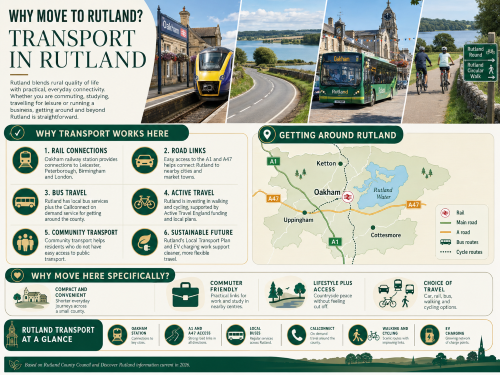
Rutland is compact, but transport still deserves careful thought.
Oakham offers the county’s strongest rail connection, with services to destinations including Leicester and Peterborough.
Road travel also matters.
Residents may regularly travel towards:
- Stamford;
- Peterborough;
- Leicester;
- Melton Mowbray;
- Corby;
- the A1 corridor.
Village living can increase reliance on a car, particularly for work, school runs, shopping and evening travel.
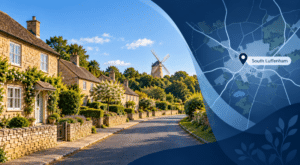
Rutland County Council’s school routes also show how transport differs considerably between settlements such as Empingham, Ketton, Edith Weston, North Luffenham and Oakham.
Before buying, test the real journey rather than relying only on mileage.
Consider:
- station access;
- school runs;
- peak-time driving;
- parking;
- evening transport;
- hybrid-working patterns;
- access to healthcare;
- how often the journey will actually be made.
A beautiful rural home can become less practical if every ordinary journey feels difficult.
Food, Markets and Everyday Rutland Life
Rutland’s lifestyle is shaped by its rural character.
That extends naturally into food.
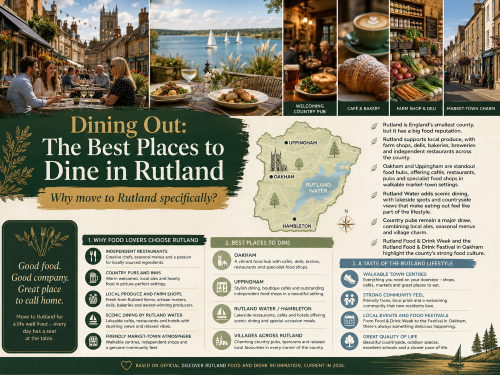
Oakham and Uppingham provide cafés, restaurants, pubs, bakeries and independent businesses, while villages add country pubs, farm shops and destination dining.
The county’s farming heritage also gives local produce a stronger presence than might be expected from its size.
For residents, this creates everyday choices rather than simply visitor attractions.
A Saturday might involve Oakham market, a village pub, a farm shop or a meal near Rutland Water.
Rutland is also associated with recognised destination dining, including Hambleton Hall near Rutland Water.
What matters from a relocation perspective is not whether the county competes with a large city for volume.
It is whether the places you will actually use fit the way you want to live.
For some people, fewer options with a stronger local identity can be more appealing than having hundreds of choices further from home.
Rutland Water, Heritage and Weekends Close to Home
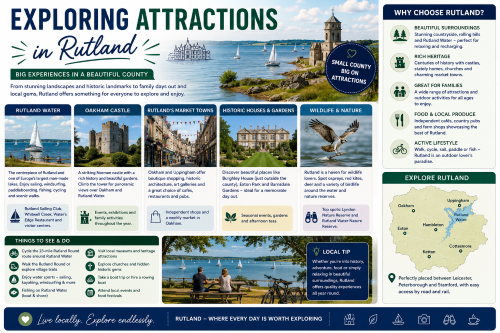
For many people considering why move to Rutland, Rutland Water is central to the answer.
The reservoir and surrounding parkland support:
- walking;
- cycling;
- sailing;
- fishing;
- wildlife watching;
- family activities;
- outdoor events.
The county also has attractions beyond the water.
Oakham Castle adds more than 800 years of history to the county town.
Barnsdale Gardens provides a nationally recognised garden attraction.
Rutland Water Nature Reserve is important for wildlife and is closely associated with the Rutland Osprey Project.
Uppingham contributes galleries, independent shops and historic streets.
Nearby Stamford widens the range of shops, restaurants and heritage attractions without requiring a move into a larger urban centre.
That is one of Rutland’s lifestyle strengths.
Leisure does not always require a long journey.
For residents, places that visitors travel to for the weekend can become part of ordinary life.
Why Rutland Can Make Sense at More Than One Stage of Life
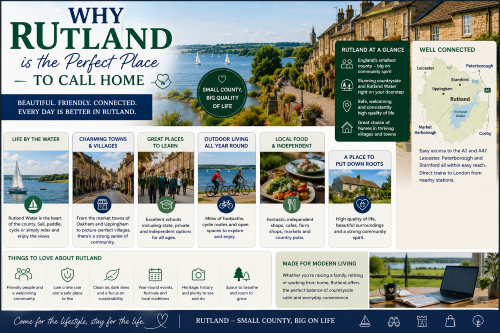
The answer to why move to Rutland can change depending on when you ask it.
A first-time buyer may focus on smaller homes in or around Oakham.
A growing family may place schools, bedrooms and outdoor space higher on the list.
A hybrid worker may be willing to accept a longer occasional commute in return for village life.
A business owner may value space while remaining connected to regional centres.
Someone approaching retirement may think less about commuting and more about community, countryside and daily quality of life.
Rutland does not provide every lifestyle.
That is part of its appeal.
Its strength comes from being clear about what it does offer: two distinctive market towns, close-knit villages, countryside, heritage and a major outdoor setting around Rutland Water.
A successful move should work after the novelty has worn off.
It should still make sense when children grow older, work changes or priorities shift.
Rutland appeals to buyers who want countryside, community, heritage, and calm. It offers a slower pace, yet it still connects to regional towns and cities.
The county’s size is part of its charm. Rutland feels personal and easy to navigate. Oakham and Uppingham provide local focus, while villages add character and space.
Rutland Water gives the county a major lifestyle advantage. It supports activity, family days out, wildlife, and outdoor wellbeing. As a result, many residents gain access to nature without leaving the county.
The housing market offers choice, but supply can be limited. Buyers should prepare early and compare property types. They should also seek advice if a home is older, rural, listed, or unusual.
Education, food, tourism, local business, and transport all add to Rutland’s appeal. However, each move should be planned carefully. Schools, travel, budget, and lender criteria should all be reviewed before committing.
If you are planning a move, a mortgage broker can help you understand affordability, lender requirements, and property-specific issues. This can be useful before you make an offer.
Browse Mortgage Advisers Covering Rutland
Once you have narrowed down where you want to live, the next decision is whether the mortgage fits the property and the circumstances behind the move.
Connect Experts lets users compare mortgage advisers by location and other relevant preferences.
That can be useful where you want:
- local coverage;
- experience with rural property;
- support with complex income;
- advice on a particular mortgage type;
- telephone or video appointments;
- language preferences.
Use the directory to compare advisers based on the decision you need to make, rather than simply choosing whoever is geographically closest.
Connect Experts is a mortgage adviser directory and matching platform. It does not provide mortgage advice directly. Advice is provided by the adviser or firm you choose.
People who found this page helpful also explored these related topics:
Neighbouring Counties
FAQs: Why Move to Ruthland?
Is Rutland too rural for someone who still needs to commute?
Not necessarily. Oakham has rail connections to Leicester and Peterborough, while road routes provide access to Stamford, Corby, Melton Mowbray, and the A1 corridor. However, transport varies considerably between villages, so commuters should test their actual journey before choosing a property.
Does living near Rutland Water usually mean buying a rural property?
No. The areas around Rutland Water include villages, cottages, detached homes and other property types. Buyers should consider the individual property rather than assuming all homes near the reservoir are alike. Rural homes can sometimes raise extra lender questions around land, drainage, access or outbuildings.
Is Oakham or Uppingham better for everyday amenities?
Both offer market-town living, but Oakham is the county town, with the main railway station, a broader range of services, and a larger retail offering. Uppingham has a smaller, more traditional market-town feel, with independent shops, galleries, and strong educational connections. The better choice depends on transport, schools, budget and lifestyle.
Why are Rutland homes more expensive than some other East Midlands areas?
Rutland’s average house price was £ 299,000 in July 2026, compared with £242,000 across the East Midlands. Property mix, limited supply, rural setting, schools, village demand and larger detached homes can all influence local prices.
What should I check before buying an older village home in Rutland?
Consider the survey, construction, listed status, roof and damp issues, drainage, access, boundaries, heating, broadband and any land or outbuildings. Mortgage lenders may also have different criteria for unusual or rural properties, so it helps to understand those requirements before you commit.
Is Rutland suitable for someone looking to downsize?
It can be. Oakham may appeal to downsizers who want shops, services and transport nearby, while villages may suit people who prioritise quiet and countryside. Buyers should also consider future mobility, access to healthcare, car dependency and how practical the property will remain over time.