Protection Adviser in South East London: Protection planning asks a serious financial question: what would happen to your household finances if death, illness or injury suddenly changed the income available to you?
For someone living or working in South East London, the answer may involve mortgage or rent payments, family expenses, childcare, debt, everyday bills and long-term responsibilities.
A protection adviser can examine those commitments before discussing insurance products.
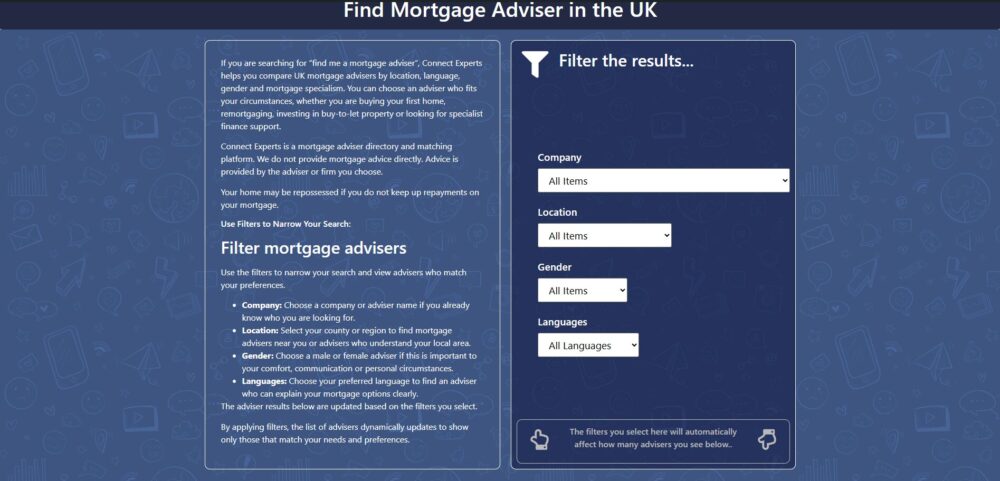
Connect Experts helps you search for a protection adviser in South East London and compare advisers according to location, expertise and available personal preferences. Connect Experts is a directory and matching platform. It does not provide individual protection advice itself. Advice and product recommendations are provided by the adviser or firm you choose.
Protection Advice in South East London
- Protection advice examines the financial consequences of death, serious illness or being unable to work.
- Common products include life insurance, critical illness cover, income protection and family income benefit.
- Your postcode does not determine the cover you need.
- Income, mortgage or rent, dependants, debts, employment, existing benefits, savings, health and budget may all affect a recommendation.
- Policy definitions, exclusions, deferred periods, benefit terms and underwriting can materially affect the value of protection.
- Connect Experts lets you search for advisers covering South East London and compare profiles before choosing who to contact.
- Protection products are designed for different risks, so one policy should not automatically be treated as a replacement for another.
What Does a Protection Adviser in South East London Do?
A protection adviser assesses financial vulnerability before recommending insurance.
The practical purpose is to identify which financial commitments could become difficult if you died, developed a specified serious illness or became unable to work because of illness or injury.
An adviser may examine:
- household income
- mortgage or rent
- outstanding debts
- monthly expenditure
- dependants
- childcare or education costs
- savings and emergency funds
- employer sick pay
- workplace life assurance
- existing insurance
- employment status
- health and medical history
- occupation
- long-term financial responsibilities
- the amount you can reasonably afford to spend on cover
This fact-finding stage is essential because protection insurance is not one-size-fits-all.
Two South East London households with similar incomes may need completely different protection arrangements because their debts, dependants, employment benefits, and savings differ.
The principle is simple: the policy should follow the risk, rather than forcing the risk to fit the policy.
What Types of Protection Can an Adviser Discuss?
Pure protection covers several distinct financial risks.
The Financial Conduct Authority identifies products, including term assurance, critical illness cover, income protection, and whole-of-life insurance, within the UK pure-protection market.
Life Insurance
Life insurance can provide a payment upon the insured person’s death, subject to the policy terms.
Depending on the product, cover may be arranged for a fixed term or for life.
A protection adviser may discuss:
- level term assurance
- decreasing term assurance
- joint or individual policies
- whole-of-life cover
- family income benefit
- cover linked to a mortgage
- broader family protection requirements
The amount required is not automatically equal to the mortgage balance. Some households may also need to consider income replacement, dependants and other financial commitments.
For more detailed information, see Life Insurance Advisers.
Critical Illness Cover
Critical illness insurance can pay a lump sum following the diagnosis of a specified serious illness, provided the claim satisfies the insurer’s policy definition.
The definition is important.
A medical diagnosis does not necessarily mean that every critical illness policy will pay. Policies contain specific conditions, definitions and exclusions.
A protection adviser can therefore help you compare matters such as:
- illnesses covered
- severity requirements
- exclusions
- partial payments where available
- children’s cover where applicable
- policy term
- sum assured
- whether premiums are guaranteed or reviewable
- how critical illness protection fits alongside other cover
The Association of British Insurers describes critical illness insurance as protection against certain illnesses and medical conditions of a specified severity.
Read more about finding Critical Illness Cover Advisers.
Income Protection
Income protection focuses on a different problem: what happens if you remain alive but cannot earn because of illness or injury?
A qualifying policy can replace part of your income where its claim requirements are met.
Important technical features may include:
- the percentage of earnings that can be insured
- deferred period
- benefit amount
- maximum benefit term
- occupation definition
- insurer underwriting
- exclusions
- employment status
- sick-pay arrangements
- whether income changes after the policy starts
The deferred period deserves particular attention. It determines how long you normally need to be unable to work before eligible payments begin.
Someone with six months of employer sick pay may require a different structure from a self-employed person with little financial support available after stopping work.
You can compare specialists through Income Protection Advisers.
Family Income Benefit
Family income benefit is designed to provide regular payments for the remainder of an agreed term following a valid claim, rather than necessarily paying one large lump sum.
That structure can be relevant when the financial objective is replacing part of an income for dependants.
A protection adviser can explain how this differs from conventional lump-sum life assurance.
Why Protection Planning Matters
Protection is fundamentally about financial resilience.
A household may appear secure while its normal income continues. Yet the same commitments can feel very different when an income suddenly stops.
Mortgage payments remain due. Rent remains due. Food, utilities, childcare, transport and debt payments do not disappear because someone is ill.
That is why insurance should be considered in terms of the financial event it is intended to address.
Recent UK claims data illustrates that these policies are used in practice. Association of British Insurers figures for 2024 recorded approximately 275,000 individual life insurance, critical illness and income protection claims, with £5.32 billion paid in individual protection claims during the year.
Market statistics do not prove that a particular policy is suitable for you. They do demonstrate why protection deserves to be treated as a practical financial subject rather than an abstract fear.
Protection Needs in South East London
Living in South East London does not, by itself, determine which insurance products are suitable.
However, location sits within a wider financial picture.
South East London covers areas across the SE postcode districts and includes households with very different property arrangements, income levels, occupations and family structures.
A person renting a flat may have different priorities from a homeowner with a large mortgage.
A self-employed consultant may need to examine income protection differently from an employee with substantial sick pay.
A household relying mainly on one income may have a different level of financial vulnerability than a household with two secure incomes and significant savings.
A parent may need to consider the cost of supporting children for many years.
A company director may need to separate personal protection needs from business risks.
The relevant question is therefore not simply:
“What insurance do people in South East London buy?”
A more useful question is:
“Which financial commitments would become vulnerable if my circumstances changed?”
That is the question professional protection planning should seek to answer.
How Much Protection Cover Might You Need?
There is no universal amount.
An adviser will normally need to understand what the insurance is supposed to achieve before recommending a sum assured or monthly benefit.
For life insurance, that might involve considering:
- the outstanding mortgage
- other debts
- anticipated family expenditure
- dependants
- existing savings
- workplace death benefits
- existing life policies
- the length of time financial support may be required
For income protection, the calculation differs because insurers typically limit benefits to eligible earnings.
For critical illness protection, the objective might include reducing a mortgage, creating a financial recovery buffer or meeting household costs following a serious diagnosis.
The purpose of the cover should therefore come before the amount of the cover.
Protection Insurance Is More Than the Premium
Price matters, but the cheapest premium does not automatically represent suitable protection.
Policy design matters too.
When comparing protection, examine:
| Feature | Why it matters |
|---|---|
| Sum assured | Determines the potential level of lump-sum protection |
| Policy term | Determines how long cover is intended to remain in force |
| Deferred period | Affects when income protection benefits may begin |
| Benefit term | Affects how long qualifying income protection payments can continue |
| Occupation definition | Can affect how incapacity to work is assessed |
| Critical illness definitions | Determine the circumstances in which specified illness claims may qualify |
| Exclusions | Identify circumstances the policy does not cover |
| Underwriting | Determines how the insurer assesses risk and application information |
| Premium structure | Premiums may be guaranteed or reviewable depending on the product |
| Existing benefits | Employer or existing personal cover may change what additional protection is required |
This is one reason advice can add value. A quotation tells you a price. A suitability assessment should explain why the proposed structure addresses the identified financial risk.
Medical Underwriting and Disclosure
Protection insurance frequently involves medical underwriting.
An insurer may ask about matters including your health, medication, previous conditions, family medical history, smoking status, occupation and lifestyle.
Applications must be answered accurately and carefully.
Depending on the information provided and the insurer’s underwriting approach, an application may result in standard terms, changed terms, exclusions, a higher premium, postponement or a decision not to offer cover.
A protection adviser can explain the application process, but the insurer ultimately determines its underwriting decision.
Protection for Employed People
Employees should understand their workplace benefits before buying additional protection.
Relevant benefits may include:
- employer sick pay
- group life assurance
- private medical insurance
- death-in-service benefits
- employer-funded income protection
Workplace protection can be valuable, but you should understand when it ends and whether it changes if you leave your employer.
A protection adviser can consider those benefits as part of the wider assessment.
Protection for Self-Employed People in South East London
Self-employed workers can face different financial risks because they may not have access to the same sick-pay arrangements available to some employees.
An adviser may need to examine:
- provable earnings
- trading history
- business structure
- personal drawings or remuneration
- monthly household commitments
- existing savings
- how long the person could meet expenses without working
Income protection can therefore require particularly careful consideration of earnings and policy definitions.
Protection When You Have a Mortgage
Taking on a mortgage often creates a long-term financial commitment.
Life insurance may help address the risk of death.
Critical illness insurance addresses specified serious illnesses.
Income protection covers loss of earnings due to a qualifying illness or injury.
They are different forms of cover.
For this reason, arranging a mortgage should not lead to the assumption that a single insurance product automatically addresses all financial risks.
Where mortgage and protection requirements overlap, you can also explore Specialist Mortgage and Protection Brokers.
When Should Protection Be Reviewed?
Protection should not necessarily be bought once and forgotten.
A review may become important after:
- buying a home
- increasing a mortgage
- remortgaging
- having or adopting a child
- marriage or civil partnership
- separation or divorce
- changing employment
- becoming self-employed
- a material change in income
- taking on substantial debt
- starting or selling a business
- significant changes to existing workplace benefits
The objective is not to change policies unnecessarily.
It is to check whether the assumptions behind the original protection arrangement still reflect reality.
How to Find a Protection Adviser in South East London
Connect Experts gives users a structured way to search for advisers, rather than selecting someone solely from an advertisement or a single search result.
You can use the directory to compare advisers according to available criteria such as:
- location
- area of expertise
- language
- gender
- company
- protection needs
The adviser you choose should be able to explain both the benefits and limitations of the protection being considered.
Use Find a Mortgage Adviser by Location to explore advisers covering South East London and surrounding areas.
What Should You Ask a Protection Adviser?
Before proceeding, consider asking:
- What financial risk is this policy intended to cover?
- Why have you recommended this type of policy?
- How was the amount of cover calculated?
- How long should the cover last?
- What does the policy exclude?
- Are the premiums guaranteed or reviewable?
- What medical underwriting is required?
- How does my occupation affect the policy?
- What happens if my income changes?
- How does existing employer cover affect the recommendation?
- When should this protection be reviewed?
- How are you paid for arranging the policy?
Clear answers are important.
Protection deals with difficult possibilities, but the decision itself should not depend on fear. It should depend on understanding.
FCA Regulation and Protection Advice
Financial services regulation is an important factor in choosing an adviser.
The Financial Conduct Authority has been examining the UK pure-protection market, including whether consumers receive appropriate value and understand the products they purchase.
You can read more through the Financial Conduct Authority’s Pure Protection Market Study.
Before proceeding with regulated financial advice, consumers can also check the relevant adviser or firm’s regulatory status.
Protection and Later-Life Financial Planning
Protection insurance and later-life lending solve different financial problems.
Someone approaching or already in retirement may need to consider existing life cover alongside pensions, mortgage commitments, estate planning and later-life borrowing.
Where the question specifically concerns releasing funds from a property rather than arranging insurance, homeowners can explore Equity Release Advisers in London separately.
Equity release is not a substitute for protection insurance and should be considered as a separate financial decision.
Why Use Connect Experts?
Connect Experts is designed to help consumers find an adviser who matches their requirements.
Rather than directing every user to a single named broker, the directory allows you to explore available adviser profiles and make your own selection.
That distinction is important.
Protection planning is personal because financial vulnerability is personal.
Connect Experts helps with finding an adviser. The adviser or authorised firm you select is responsible for assessing your circumstances and providing any personalised recommendation.
Frequently Asked Questions
What does a protection adviser in South East London do?
A protection adviser reviews your income, dependants, mortgage or rent, debts, savings, workplace benefits, existing insurance and financial priorities before recommending suitable protection where appropriate.
What types of insurance can a protection adviser discuss?
Depending on their permissions and expertise, protection advisers may discuss life insurance, critical illness cover, income protection, family income benefit and related protection arrangements.
Is life insurance the same as income protection?
No. Life insurance normally provides a benefit following death where the policy conditions are met. Income protection is designed to provide regular payments when qualifying illness or injury prevents you from working.
Does critical illness cover pay for every serious illness?
No. A valid claim normally depends on the condition meeting the definition contained within the policy. Definitions and covered conditions differ between policies.
Do I need a local South East London protection adviser?
Not necessarily. Some people value local knowledge or face-to-face meetings, while others prefer telephone or video advice. Connect Experts lets you compare available advisers and choose one based on your priorities.
Can self-employed people get income protection?
Self-employed people can apply for income protection, subject to the insurer’s eligibility and underwriting requirements. Evidence of earnings and the way income is assessed can be particularly important.
Should protection match my mortgage?
Sometimes mortgage debt is an important part of the calculation, but protection needs can extend beyond the mortgage. Dependants, household expenditure, income replacement, savings and other debts may also be relevant.
Can I search for a protection adviser by language?
Connect Experts provides search options, including location, language, and areas of expertise, where information is available, helping users find an adviser they are comfortable communicating with.
How often should I review protection insurance?
Consider reviewing protection after significant financial or personal changes, such as moving home, changing borrowing arrangements, having children, changing employment, or experiencing a substantial change in income or responsibilities.
Does Connect Experts provide the insurance advice?
No. Connect Experts is an adviser directory and matching platform. Personalised advice and product recommendations are provided by the adviser or firm you choose.
Find a Protection Adviser in South East London
Financial uncertainty cannot be removed completely.
What can be examined is its potential financial effect.
A protection adviser can help you identify the commitments that matter, understand the risks that insurance can and cannot address, compare relevant policy structures and decide whether protection is appropriate for your circumstances.
Search the Connect Experts directory to compare protection advisers covering South East London.
Compare protection advisers through Connect Experts