A Mortgage Broker in Midlem can help turn the question “Can I borrow enough?” into the more useful question: “Does this mortgage, this property and this commitment make sense together?”
That distinction matters in Midlem.
This small Selkirkshire village has a character that cannot be reduced to a postcode or an asking price. Midlem sits around three miles east of Selkirk and is centred on a historic village green. Much of the settlement forms part of a conservation area, with traditional stone buildings, long rig gardens, and a layout that dates back centuries.
For a mortgage applicant, that means the property may deserve as much attention as the borrower.
An adviser can help you assess affordability, lender criteria, mortgage costs, and the home’s practical details before you commit to a route.
At a glance: Mortgage Broker in Midlem
- Midlem is a small hilltop village in Selkirkshire, around three miles east of Selkirk.
- The village is within the TD7 postcode district.
- Almost all of Midlem sits within its designated conservation area.
- Traditional local buildings can feature sandstone, whinstone, harling, slate, sash windows and other historic details.
- The average property price in the Scottish Borders was £195,000 in August 2026.
- First-time buyers in the Scottish Borders paid an average of £150,000 in August 2026.
- Detached properties across the Scottish Borders averaged £374,000, compared with £231,000 for semi-detached homes, £189,000 for terraced homes and £112,000 for flats and maisonettes. These are regional averages, not individual Midlem valuations.
- Scotland uses Land and Buildings Transaction Tax (LBTT) rather than Stamp Duty Land Tax.
- A Scottish Home Report can provide important information about condition, valuation, alterations and energy efficiency before you buy.
- Older construction, alterations, access, land, and outbuildings can sometimes influence a lender’s assessment.
- Adviser experience with the property and your circumstances can matter more than simply choosing whoever is geographically closest.
Why Midlem Property Deserves a More Careful Mortgage Conversation
No mortgage exists separately from the home securing it.
For many conventional properties, the lending assessment can be relatively straightforward. Midlem introduces more possibilities.
Scottish Borders Council describes the village as having traditional vernacular buildings gathered around its green, with sandstone, whinstone, harling and slate among the materials that contribute to its character. Almost the whole village lies within the conservation area, and two listed buildings sit within its amended boundary.
That does not mean an older or conservation-area home is automatically difficult to mortgage.
It does mean you should understand the building rather than assume every lender will view it in exactly the same way.
What Should a Mortgage Broker in Midlem Understand About the Property?
Depending on the home, useful questions could include:
- What is the main construction type?
- Is the roof conventional for the lender concerned?
- Have extensions or alterations been completed?
- Are the necessary planning or building approvals available?
- Are there listed-building or conservation-area considerations?
- Is there any significant acreage?
- Are there barns, workshops or other outbuildings?
- Are private water or drainage arrangements involved?
- Is vehicular access straightforward?
- Is any part of the property used commercially?
- Will any part be separately occupied or let?
- Does the valuation support the proposed borrowing?
The point is not to create obstacles where none exist.
It is to identify genuine issues early enough to choose an appropriate route.
The Home Report Is a Starting Point, Not the Mortgage Decision
Scotland’s buying process gives purchasers information that borrowers elsewhere in the UK may receive at different stages.
A Home Report normally contains:
- a Single Survey and valuation;
- a Property Questionnaire; and
- an Energy Report.
The Single Survey provides information on condition, accessibility, repairs, and the surveyor’s valuation. The Property Questionnaire can disclose matters such as alterations, previous damage, and specialist works.
Those details can be particularly useful when considering an older Midlem home.
However, the Home Report valuation is not the same thing as a guaranteed mortgage valuation.
A lender remains responsible for deciding whether the property provides acceptable security and how much it is prepared to lend against it.
A Mortgage Broker in Midlem can help you understand where the Home Report, lender valuation, purchase price and mortgage application intersect rather than treating any one figure as the complete answer.
Mortgage Affordability: The Property Price Is Only Half the Calculation
A beautiful home can still become the wrong financial decision if the borrowing leaves no room for the life that must happen around it.
Lenders normally consider matters such as:
- employed or self-employed income;
- existing loans and credit commitments;
- childcare and other regular expenditure;
- deposit size;
- credit history;
- mortgage term;
- age and expected retirement position;
- other properties or mortgages;
- the requested loan-to-value; and
- the lender’s own affordability model.
Two applicants with identical salaries can therefore receive very different outcomes.
Likewise, two lenders looking at the same applicant may reach different lending figures because their criteria and affordability calculations differ.
That is why a headline interest rate should be treated as part of the comparison rather than the entire comparison.
You can review current products using Connect Mortgages’ live UK mortgage rates comparison.
The results provide a useful starting point for comparing rates, estimated payments and lender fees, but they do not confirm eligibility. A lender must still assess the borrower and property before agreeing to lend.
Buying Your First Home Around Midlem
First-time buyers across the Scottish Borders paid an average of £150,000 in August 2026, according to the latest provisional ONS housing data.
That regional figure should not be taken as the expected price of a particular Midlem property, especially when local homes differ substantially in age, size, condition, and character.
For a first purchase, it may be useful to establish:
- how much deposit you have available;
- what borrowing is realistically affordable;
- what costs need to remain outside the deposit;
- whether the property is suitable mortgage security;
- what LBTT may apply;
- when a mortgage agreement in principle is useful; and
- how your mortgage fits into the Scottish offer and conveyancing process.
You can search for first-time buyer mortgage advisers if your priority is buying your first home.
Remember LBTT When Planning Your Purchase
Property taxation is another reason mortgage planning in Scotland should not simply copy an English purchase checklist.
In Scotland, Land and Buildings Transaction Tax applies to qualifying land and property transactions and replaced Stamp Duty Land Tax in 2015.
The amount depends on the purchase circumstances and applicable thresholds. Additional Dwelling Supplement may also apply where an additional residential property is being acquired.
Use Revenue Scotland’s Land and Buildings Transaction Tax guidance for the current official rules and rates.
Your solicitor or tax adviser can confirm the tax position for your individual transaction.
Buying an Older or Altered Home in Midlem
The character that makes an older property appealing can also make documentation more important.
For example, a lender or solicitor may need to understand previous:
- extensions;
- loft alterations;
- structural work;
- window changes;
- roof work;
- boundary alterations;
- conversion of outbuildings; or
- changes to the property’s use.
Scottish Government guidance advises sellers to ensure their solicitor knows about changes that required planning permission or building-control consent and to retain certificates for remedial works such as dry-rot or woodworm treatment.
In a conservation area, buyers should also check whether past alterations were completed with the approvals that applied at the time.
This is where preparation can keep a small document issue from becoming a major transaction problem.
Are You Moving Rather Than Buying for the First Time?
Home movers can face a different calculation.
You may have equity in your existing home, but you also have to coordinate:
- the outstanding mortgage balance;
- any early repayment charge;
- deposit funds for the next property;
- purchase and sale dates;
- portability of an existing mortgage;
- affordability for the new borrowing;
- legal costs;
- LBTT; and
- any additional borrowing required.
Porting a mortgage does not normally mean transferring the existing loan automatically. The lender will usually assess the new application, the new property and your current circumstances.
If the new home differs materially from your existing property, the security assessment may also change.
When Your Current Mortgage Rate Is Ending
When a fixed or discounted deal ends, it’s a good time to ask what has changed since you took out the original mortgage.
Your income may be different.
Your property’s value may have changed.
Your outstanding balance should have reduced.
The products available on the market will also differ.
Rather than waiting until you move onto a lender’s standard variable rate, consider reviewing the position in advance.
You can search for a mortgage rate ending adviser to discuss whether a new deal with your existing lender or a remortgage elsewhere suits your circumstances.
Early repayment charges, product fees, valuation requirements and the timing of a new offer should all form part of that comparison.
A Property You Intend to Let Out
A property intended for tenants is assessed differently from a home you intend to occupy yourself.
The lender may consider expected rent, property type, deposit, landlord experience, ownership structure and wider borrowing.
If the property is part of a growing rental business, you can search for a portfolio landlord mortgage adviser.
First-time landlords can use the first-time landlord adviser search instead.
Where a company will own the property, the limited company buy-to-let adviser search can help you find an adviser familiar with that structure.
Limited-company borrowing can involve additional assessment of the company, directors, shareholders, rental income and wider portfolio.
Tax treatment is separate from mortgage advice, so obtain appropriate tax advice before deciding how a property should be owned.
Land, Outbuildings and Rural Property Use
A rural address does not automatically qualify you for a mortgage specialist.
The details do.
A lender may want to understand whether:
- land is purely residential;
- acreage exceeds its normal criteria;
- an outbuilding has commercial use;
- agricultural restrictions exist;
- part of the home generates income;
- there are multiple dwellings on one title;
- access crosses third-party land;
- private drainage or water arrangements apply; or
- the property has an unusual resale market.
The proposed use should therefore be clear from the beginning.
A straightforward residential application should not accidentally become complicated because significant property details only emerge during valuation or conveyancing.
Independent-School Connections in the Wider Area
Families considering Midlem may also look beyond the village itself when assessing schools and day-to-day travel.
In nearby Melrose, St Mary’s School is an independent, co-educational day and boarding preparatory school for children aged 2 to 13.
School proximity shouldn’t determine mortgage suitability, but education, commuting, and family routines can influence how practical a location feels over the life of a mortgage.
That wider perspective matters because affordability should leave room for the life you intend to lead, rather than simply meeting a lender’s maximum borrowing figure.
Protection Advice: Planning for the Mortgage You Keep
Obtaining the mortgage solves today’s financing question.
Protection planning asks what happens if tomorrow does not follow the plan.
When speaking to a Mortgage Broker in Midlem, it can therefore be sensible to discuss whether you also need specialist mortgage protection advice.
Depending on your circumstances, protection advice may consider:
- life insurance;
- critical illness cover;
- income protection;
- family income benefit; and
- mortgage payment protection.
The appropriate cover depends on factors including income, employment, mortgage balance, dependants, savings, existing insurance and budget.
Policy terms, exclusions, waiting periods and eligibility vary between insurers.
The philosophical principle is simple: arranging the borrowing is only one half of responsible planning. The other is considering what protects the household if income or circumstances change.
Later-Life Borrowing and Equity Release in Selkirkshire
Later life can change the mortgage question again.
For an older homeowner, the objective may be to repay an existing mortgage, raise money for improvements, help family members, supplement retirement funds or reorganise borrowing.
Where appropriate, homeowners can read about Equity Release Advisers in Selkirkshire through Connect Lifetime.
The Selkirkshire guide examines lifetime mortgages, property eligibility, drawdown, compound interest, repayments, inheritance, benefits and alternatives to equity release. It also considers how rural homes, land, outbuildings, access and construction may affect provider criteria.
Equity release is not simply a way of calculating how much can be borrowed.
It can reduce an estate’s value, may affect entitlement to means-tested benefits, and can involve interest accumulating over a long period. Alternatives should therefore be considered as part of regulated advice.
Choosing the Adviser Rather Than Simply the Nearest Adviser
Physical distance is only one factor in deciding whether an adviser is right for you.
Consider asking:
- Do they regularly advise on the type of mortgage I need?
- Are they comfortable discussing older or less conventional property?
- Can they explain the difference between the mortgage product and the lender’s property criteria?
- What lenders can they consider?
- What fees will I pay and when?
- How will they communicate with me?
- Can they advise by telephone or online if face-to-face advice is inconvenient?
- Can they explain the full cost rather than quoting only the lowest rate?
- Do they have the appropriate permissions for the mortgage or protection advice I require?
A good adviser should be able to explain not only what they recommend, but why the recommendation fits your circumstances.
That explanation is where information becomes advice.
Prepare Before You Speak to an Adviser
You can make the first conversation more productive by gathering information such as:
- recent payslips or evidence of income;
- accounts or tax information if self-employed;
- bank statements where required;
- details of existing loans and credit commitments;
- evidence of your deposit;
- details of your present mortgage if remortgaging;
- the property particulars;
- the Home Report where available;
- information about land or outbuildings;
- details of significant alterations; and
- your preferred borrowing amount and mortgage term.
For a landlord case, additional information may include tenancy details, rental income, existing mortgages and a property schedule.
Being prepared does not guarantee approval.
It gives the adviser more information to identify realistic options.
Find a Mortgage Broker in Midlem
A mortgage is a financial product, but choosing one is ultimately a decision about the future.
The property must work.
The borrowing must remain manageable.
The lender must accept both the applicant and the security.
And the mortgage should make sense when fees, rates, protection, future plans and the unexpected are considered together.
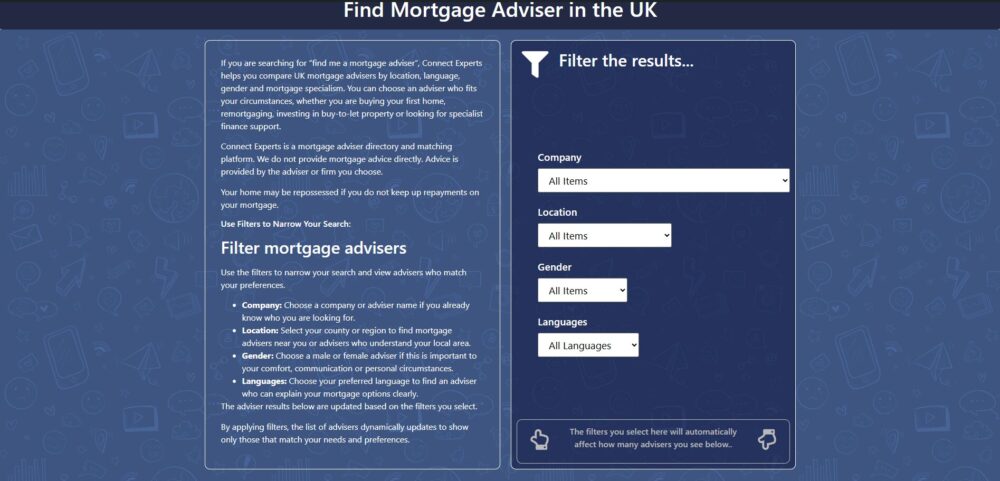
Use Connect Experts to find and compare mortgage advisers who can discuss your circumstances, your property and the type of borrowing you require.
The aim is not merely to complete an application.
It is to begin with the right questions so that any decision that follows has a stronger foundation.