
Why move to Midlothian? Because sometimes the right place is not about choosing between city access and open space, but finding somewhere that gives you a realistic measure of both.
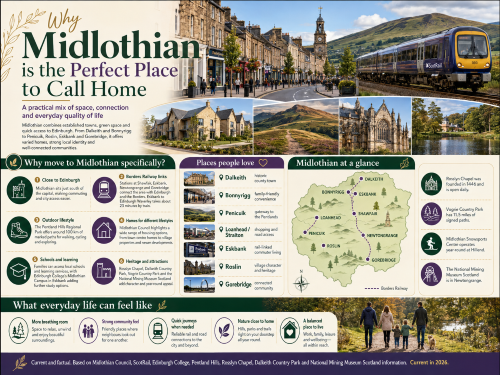
Midlothian sits directly south of Edinburgh, yet its character changes quickly once you move beyond the capital. Dalkeith, Bonnyrigg and Loanhead offer established communities close to Edinburgh. Penicuik sits near the Pentland Hills, while Roslin combines village character with internationally recognised history and science. Newtongrange and Gorebridge sit on the Borders Railway, giving another way to balance commuting with life outside the city.
That variety helps explain Midlothian’s appeal.
The decision is not simply whether you want to live near Edinburgh. It is whether you want your home, work, travel, outdoor space and longer-term finances to fit together differently.
If your relocation is already becoming a mortgage decision, you can explore Mortgage Brokers in Midlothian and compare advisers covering the area.
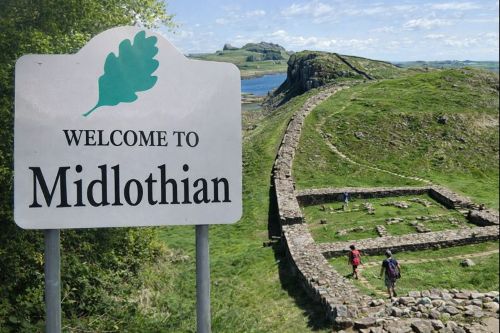
Town, Village or Hillside: Different Ways to Live in Midlothian
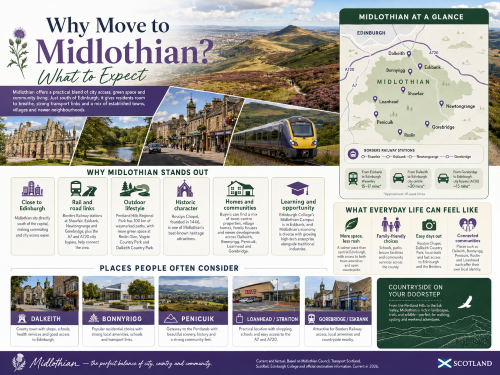
Midlothian does not offer one single type of lifestyle.
Dalkeith combines shops, schools, established housing and access towards Edinburgh.
Bonnyrigg has developed as a substantial residential community and can appeal to families and commuters.
Penicuik offers town amenities while sitting close to the Pentland Hills and countryside.
Roslin has a smaller village identity, shaped partly by Rosslyn Chapel and nearby Roslin Glen.
Loanhead and Straiton place residents close to Edinburgh’s southern edge, retail areas and the City Bypass.
Further east, Newtongrange and Gorebridge have direct access to the Borders Railway, while smaller settlements such as Rosewell and Pathhead offer a different pace.
That matters because two households asking why move to Midlothian may be looking for very different things.
One may want a direct rail route into Edinburgh.
Another may prioritise countryside and walking.
A third may want more space while remaining close enough to the capital for work.
Midlothian allows those choices to exist within the same local authority area.
Housing in Midlothian: Prices, Property Types and Buyer Choices
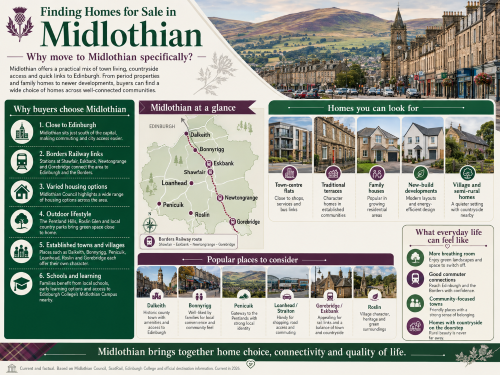
Midlothian has one of Scotland’s higher average property values.
The latest Office for National Statistics figures show an average house price of £283,000 in July 2026. That was the third-highest average among Scottish local-authority areas.
Average prices by property type were:
- Detached: £498,000
- Semi-detached: £301,000
- Terraced: £241,000
- Flats and maisonettes: £159,000
First-time buyers paid an average of £229,000, while home movers paid around £341,000. Homes purchased with a mortgage averaged £285,000.
That variation creates very different buying decisions.
A buyer might compare:
- a flat in Dalkeith;
- a modern family home in Bonnyrigg;
- a property near the Borders Railway;
- an established house in Penicuik;
- a village property around Roslin;
- a larger detached home elsewhere in the county.
Property type matters alongside price.
New-build estates, older stone houses, flats, rural homes and properties with unusual construction can all raise different questions during valuation and underwriting.
For first-time buyers, deposit, Home Report value and affordability should ideally be understood before an offer is made.
Education and Family Planning in Midlothian
Education can strongly influence where a family chooses to live.
Midlothian Council operates schools across towns including Dalkeith, Bonnyrigg, Penicuik, Lasswade, Newtongrange and Gorebridge. Catchment areas, placing requests and school transport can therefore become important parts of a property search.
Families moving closer to Edinburgh may also consider independent education within Edinburgh and the wider Lothian area.
That broader choice can affect household finances.
School fees, childcare, commuting and other regular costs may influence how much disposable income remains after a move.
Useful questions include:
- Which school catchment covers the property?
- Will the school journey require a car?
- How will childcare change?
- Are both parents commuting?
- Could education costs rise later?
- Will the household still have sufficient flexibility after the mortgage payment?
Where fee-paying education forms part of the family’s longer-term plan, Education Finance may also be relevant.
The property and the life built around it should be considered together.
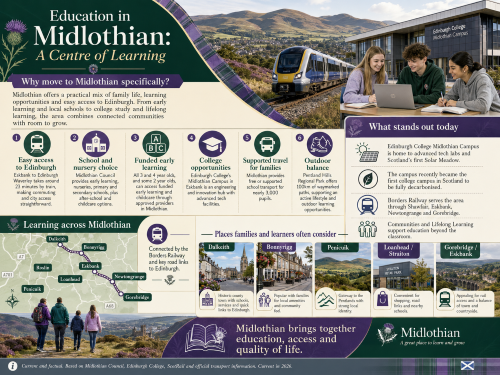
Midlothian's Economy Has More Than One Centre of Gravity
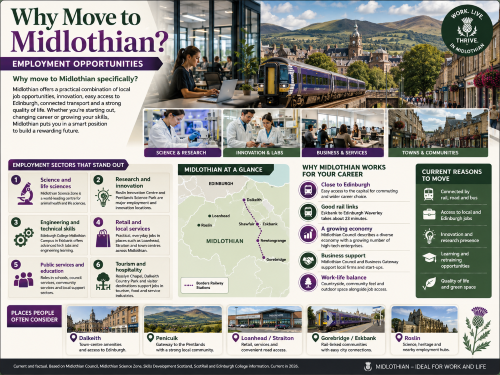
Not everybody living in Midlothian works in Edinburgh.
Midlothian has its own employment base across public services, construction, tourism, food and drink, retail, technology and life sciences.
Its science sector is especially distinctive.
The Midlothian Science Zone includes the University of Edinburgh’s Easter Bush Campus, Roslin Innovation Centre, Pentlands Science Park, Edinburgh Technopole and the BioCampus. The Science Zone describes the area as having Europe’s largest concentration of animal-science-related expertise.
Midlothian Council’s economic strategy also identifies life sciences, construction, food and drink, ICT and digital technologies, and tourism among key sectors.
That creates a range of income profiles.
Some applicants may receive straightforward salaries.
Others may have:
- bonuses;
- research contracts;
- consultancy income;
- company-director income;
- retained profits;
- commission;
- multiple income sources.
Those differences can affect lender criteria.
For someone relocating for work in science, technology, construction, or professional services, the mortgage assessment may depend as much on how income is structured as on the property’s location.
Mortgage Planning When Moving to Midlothian
A property search is more useful when you consider borrowing.
Midlothian combines first-time buyer markets, substantial family homes, commuter developments and rural property.
That can affect:
- deposit size;
- loan-to-value;
- affordability;
- lender choice;
- Home Report valuation;
- monthly repayments;
- required borrowing.
Scotland’s buying process also creates particular considerations.
A lender will normally consider the valuation rather than simply the amount a buyer agrees to pay. If an offer exceeds the Home Report valuation, the buyer may need to cover the difference from their own funds.
That can matter in competitive locations.
The property itself also deserves attention.
A flat in Dalkeith may involve communal maintenance.
A larger village home may require a different valuation approach.
A new-build property may involve lender-specific criteria and incentives.
If you are comparing several parts of the county, Find a Mortgage Adviser by Location can help you compare advisers covering the areas you are considering.
The useful question is not only:
How much could I borrow?
It is also:
How much borrowing still leaves enough room for the life I want to have there?

Larger Homes and More Complex Borrowing in Midlothian

Midlothian should not be presented as uniformly high-net-worth.
However, the county does include substantial property values.
The average detached property reached £498,000 in July 2026, while the average Midlothian home mover paid around £341,000.
Some purchases can therefore require larger mortgages, particularly when buyers move from Edinburgh, buy detached homes, or combine several income sources.
More complex applicants may receive:
- bonuses;
- dividends;
- retained company profits;
- partnership income;
- investment income;
- income from more than one business;
- variable professional earnings.
In these circumstances, proximity should not be the only factor when choosing an adviser.
Experience with High Net Worth Mortgage Brokers may be relevant where borrowing size, assets or income structure fall outside straightforward lender criteria.
That link is not meant to label Midlothian as a high-net-worth county. It is to recognise that some households moving there will require more specialist assessment.
Later-Life Moves Can Change the Financial Question
Not everybody moves because they need a bigger home.
Some Midlothian homeowners may be:
- downsizing;
- moving closer to family;
- approaching retirement;
- reducing household running costs;
- moving from Edinburgh into a smaller town or village;
- considering how property wealth fits into retirement planning.
The financial priorities can change with age.
A later-life move may require questions such as:
- Should an existing mortgage be repaid?
- How will pension income affect borrowing?
- Would downsizing release enough capital?
- Is the new property suitable for future needs?
- Should housing wealth remain untouched?
- Are there alternatives to borrowing against the home?
Equity release should be considered separately from a standard residential mortgage.
Where later-life borrowing is relevant, the broader Equity Release in Midlothian guide explains lifetime mortgages, alternatives and some of the long-term implications.

Rail, Road and Edinburgh Access Shape Daily Life
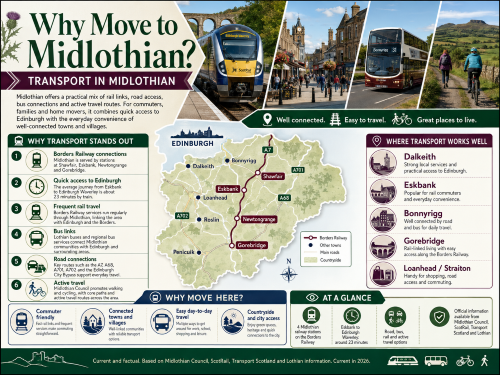
Transport is one of the strongest practical reasons some people choose Midlothian.
The Borders Railway serves Shawfair, Eskbank, Newtongrange and Gorebridge, providing rail access towards Edinburgh Waverley and the Scottish Borders. Midlothian’s existing transport research identifies Eskbank as the most heavily used local station.
Road connections are equally important.
Key routes include:
- A7;
- A68;
- A701;
- A702;
- Edinburgh City Bypass.
Bus services also connect communities including Dalkeith, Bonnyrigg, Penicuik, Roslin and Gorebridge with Edinburgh.
But a useful commuting decision should go beyond the map.
Consider:
- station access;
- parking;
- peak-hour traffic;
- ticket costs;
- bus frequency;
- school journeys;
- hybrid working patterns;
- how often the commute will actually be made.
A cheaper property that requires a longer daily journey may not always reduce overall household costs.
Eating Out, Local Produce and Everyday Life in Midlothian
Moving somewhere is partly about what happens between work and mortgage payments.
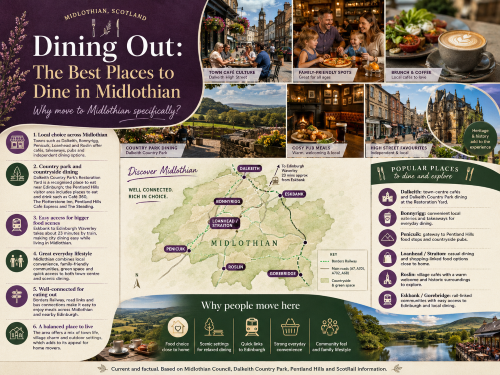
Midlothian has a mix of cafés, pubs, restaurants, country hotels, local producers and visitor destinations.
Dalkeith, Penicuik, Lasswade, Roslin and the surrounding villages each offer their own local hospitality choices.
Examples across the area include countryside dining, town-centre cafés and venues linked to destinations such as Dalkeith Country Park.
Midlothian also has local drinks producers, including Stewart Brewing near Loanhead.
These places are not just for tourism.
They become the everyday places where residents meet friends, take family, spend weekends or stop after a walk.
That is part of the relocation decision too.
History, Countryside and Things to Do in Midlothian
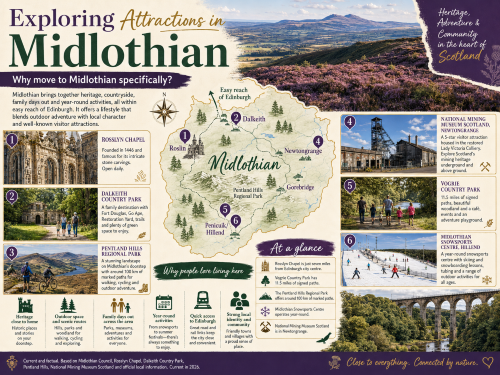
Midlothian has a particularly strong mix of heritage and outdoor access.
Rosslyn Chapel, founded in 1446, remains one of the area’s best-known landmarks.
Nearby attractions and outdoor locations include:
- Roslin Glen;
- National Mining Museum Scotland;
- Dalkeith Country Park;
- Vogrie Country Park;
- Newbattle Abbey;
- Crichton Castle;
- Penicuik Estate;
- Pentland Hills Regional Park.
Rosslyn Chapel’s own visitor information highlights many of these places as attractions in the surrounding area.
For someone asking why move to Midlothian, this matters because you don’t need to live far from major employment or transport links to access the countryside.
A weekday may involve Edinburgh.
A weekend can look completely different.
Midlothian Can Fit Different Stages of Life
One reason why move to Midlothian remains a useful question is that the answer can change with age and circumstances.
A first-time buyer may compare flats or smaller homes around Dalkeith, Newtongrange or Gorebridge.
A commuter may prioritise Eskbank, Shawfair or access to the City Bypass.
A growing family may look towards Bonnyrigg, Penicuik, Lasswade or newer developments.
Someone working in science or research may want access to Roslin and Easter Bush.
A homeowner approaching retirement may begin thinking about a smaller property, countryside access or being nearer family.
Midlothian does not offer one lifestyle.
Its appeal lies partly in allowing households to remain close to Edinburgh while choosing between town, village, rail-connected and countryside settings.
A good move should still work once the first excitement has passed.
It should make sense when work changes, children grow older or financial priorities move with them.
Browse Our Advisers That Covers Midlothian
Once you have narrowed down where you might live, the next question is whether the mortgage fits both the property and the circumstances behind your move.
Connect Experts allows users to compare advisers by location, language and mortgage expertise.
Use the directory to Find Mortgage Advisers covering Midlothian and compare profiles before deciding who to contact.
The closest adviser is not automatically the most suitable adviser.
Relevant experience with your income, property type and mortgage requirement may matter more than postcode alone.
Connect Experts is a mortgage adviser directory and matching platform. It does not provide mortgage advice directly. Advice is provided by the adviser or firm you choose.




People who found this page helpful also explored these related topics:

Mortgage Broker in Mayfield EH22: Practical Advice

Mortgage Broker in Newtongrange: Expert Mortgage Decisions

Mortgage Broker in Milton Bridge: Property & Affordability

Mortgage Broker in Mauricewood for New-Build Buyers

Mortgage Broker in Lasswade: Historic Homes & New Growth

Mortgage Broker in Eskbank for Commuters and Homebuyers
Neighbouring Counties
FAQs: Why Move to Midlothian?
Is Midlothian a practical choice for someone working in Edinburgh?
It can be. Midlothian borders Edinburgh and has road, bus and rail connections towards the city. The Borders Railway serves Shawfair, Eskbank, Newtongrange and Gorebridge. Buyers should still compare total journey time, ticket or fuel costs, parking and how frequently they need to commute.
Which Midlothian locations suit buyers who want countryside access?
Penicuik has close access to the Pentland Hills, while Roslin combines a village setting with Roslin Glen. Areas around Gorebridge, Pathhead, and smaller rural communities offer a more countryside-led lifestyle. The right choice depends on how much you value transport, schools, and local amenities.
Why are detached homes considerably more expensive in Midlothian?
Property type creates a significant difference in Midlothian. In July 2026, detached homes averaged £498,000, while flats and maisonettes averaged £ 159,000. Size, plot, location, supply and local demand can all influence the gap.
Is Midlothian useful for people working in science and research?
Yes, particularly around Roslin and Easter Bush. Midlothian Science Zone contains major research and life-science facilities, including the University of Edinburgh Easter Bush Campus, Roslin Innovation Centre and Pentlands Science Park.
What should a first-time buyer consider before moving to Midlothian?
Look beyond the asking price. Consider the Home Report valuation, deposit, likely offer level, commuting costs, council tax, property condition and monthly mortgage affordability. First-time buyers paid an average of £229,000 in Midlothian in July 2026, but individual prices vary substantially by town and property type
Does living closer to Edinburgh automatically make a Midlothian location better?
No. A location closer to Edinburgh may shorten some journeys, but it can also affect property prices and housing choice. Rail access, road congestion, working patterns, schools, outdoor space and the type of home you want should be considered together