
Why move to Derbyshire? Because where we choose to live often says something about what we want more of: more space, more time outdoors, stronger local character or simply a different rhythm to everyday life.
Derbyshire gives people several ways to make that change.
The Peak District and Derbyshire Dales offer countryside, limestone villages, market towns and traditional stone homes. Chesterfield, Long Eaton, Ilkeston and Dronfield provide stronger links towards neighbouring cities and employment centres. Buxton, Bakewell, Matlock and Ashbourne bring together local services, heritage and immediate access to rural landscapes.
For some households, Derbyshire is a move away from a larger city. For others, it is a move towards work, family, outdoor life or a different type of property.
The real question isn’t simply why you’re moving to Derbyshire, but which part of Derbyshire still makes sense once the novelty of moving becomes everyday life.
When property finance becomes part of that decision, you can explore Mortgage Brokers in Derbyshire and compare advisers across the county.
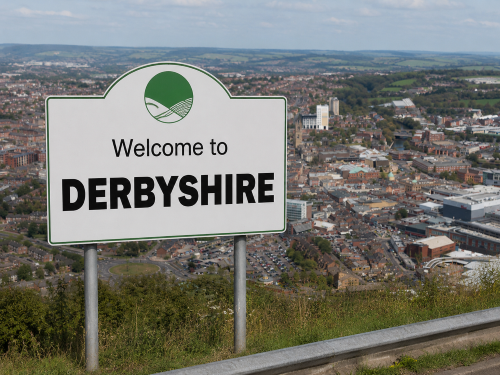
From Peak District Villages to Connected Towns: Choosing Your Derbyshire
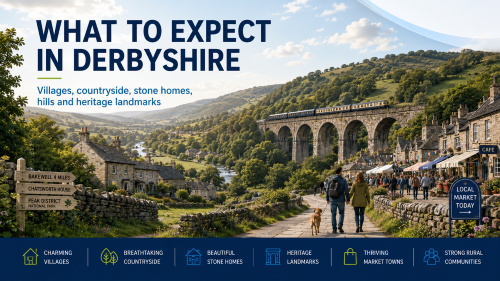
Derbyshire is hard to describe as a single type of place.
Its western and northern areas are strongly influenced by the Peak District, where places such as Bakewell, Buxton, Matlock, Hathersage and surrounding villages offer immediate access to hills, dales, moorland and traditional settlements.
Further east, Chesterfield combines a substantial town centre with access towards Sheffield and the M1.
Long Eaton and Ilkeston sit closer to Nottingham and the wider East Midlands employment area.
Belper combines industrial heritage with the Derwent Valley, while Ashbourne provides a market-town setting close to the southern Peak District.
Glossop looks in another direction, with connections to Greater Manchester as well as the Dark Peak.
That variety matters.
Someone asking why move to Derbyshire may be looking for a stone cottage with countryside outside the door. Another household may want a family home with practical motorway access. Someone else may want a market town while keeping links to Sheffield, Nottingham, Manchester or Derby.
The Peak District itself covers 555 square miles and was Britain’s first national park, designated in 1951. Much of it lies within Derbyshire, although its boundaries also extend into neighbouring counties. Peak District National Park facts show how close the landscape is to major urban areas.
Derbyshire House Prices Reveal Several Different Markets
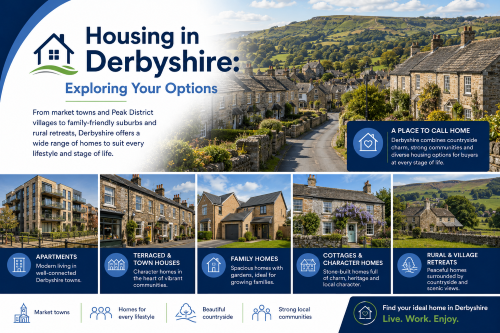
There is no single house price that accurately describes Derbyshire.
The contrast becomes clear when individual local-authority areas are compared.
In July 2026, the average house price in the Derbyshire Dales was £355,000, while first-time buyers paid an average of £287,000. Homes bought with a mortgage averaged £362,000. The Derbyshire Dales had the highest average house price in the East Midlands.
In North East Derbyshire, the average was £254,000, with first-time buyers paying £217,000 on average.
That difference can materially change what a household can buy and how much it may need to borrow.
A Derbyshire property search could include:
- a stone cottage near the Peak District;
- a period home in Buxton;
- a terrace in Chesterfield;
- a family house around Dronfield;
- a rural property near Ashbourne;
- a converted building in Belper;
- a newer home around Swadlincote;
- a property with land in the Derbyshire Dales.
Property character matters as well as price.
Older stone construction, listed buildings, converted mills, homes with acreage, rural access, private drainage and unusual outbuildings can all raise different questions during mortgage valuation or underwriting.
For first-time buyers, this makes it useful to compare the property as carefully as the mortgage rate. The cheapest home isn’t always the easiest to finance.
Schools, Travel and the Cost of Family Life

Moving with children can turn a property search into a much wider calculation.
Derbyshire offers state primary and secondary education, further education, apprenticeships and independent-school options. Established independent education includes Repton School, which is based in Repton, Derbyshire.
But choosing an area should not rest on a school name alone.
Families may also need to think about:
- admission arrangements and catchments;
- school journey times;
- childcare;
- public transport;
- after-school activities;
- whether both adults commute;
- independent-school fees where applicable;
- how education costs may change over time.
These considerations affect more than the morning routine.
Regular childcare or school expenditure can also influence disposable income and mortgage affordability.
Where independent education forms part of a longer-term household plan, Education Finance may be relevant.
A home can put a family closer to the life it wants. The financial question is whether the whole life around that home remains manageable.
Derbyshire Has an Economy of Its Own
Not everyone considering Derbyshire is moving there just to commute elsewhere.
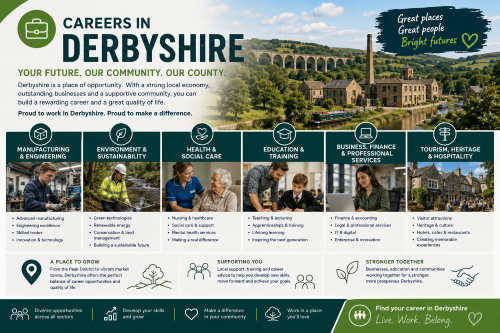
The county has a long industrial history, but its modern economy spans advanced manufacturing, engineering, logistics, construction, tourism, healthcare, education, and smaller rural enterprises.
Derbyshire County Council identifies manufacturing as a continuing major part of the county’s economy, with specialisms including transport, advanced materials, food production and engineering. Tourism is another distinctive economic strength.
Chesterfield provides employment and transport links in the county’s north-east.
Residents in the south and east can also access employment across Derby, Nottingham and the wider East Midlands.
Peak District locations have a different economic character, with accommodation, hospitality, attractions, outdoor businesses, agriculture, and countryside services playing a larger role.
Income can therefore arrive in different ways.
A Derbyshire mortgage applicant might receive:
- a regular salary;
- overtime or shift allowances;
- commission;
- bonuses;
- self-employed profit;
- company-director income;
- retained profits;
- seasonal tourism income;
- income from more than one source.
Mortgage lenders don’t necessarily assess every income type the same way.
Someone relocating for a better job may therefore find that the structure of their earnings matters almost as much as the role’s salary.
When the Property Search Becomes a Mortgage Decision
A house becomes affordable only when the property, borrowing and rest of the household finances work together.
That is particularly relevant in Derbyshire because different locations can create very different mortgage cases.
A conventional family home in Chesterfield may present a relatively straightforward property assessment.
A converted mill apartment around the Derwent Valley may involve leasehold or building-specific considerations.
A period stone cottage in the Peak District may prompt closer attention to construction, condition and valuation.
A rural home could include land, outbuildings or private access that a lender needs to understand.
Before applying, it can help to consider:
- deposit;
- loan-to-value;
- income structure;
- existing commitments;
- property construction;
- survey findings;
- tenure;
- borrowing term;
- commuting costs;
- future household plans.
If you are comparing several parts of Derbyshire, Find a Mortgage Adviser by Location lets you search by where you plan to buy and compare relevant adviser experience.
The philosophical question behind affordability isn’t simply: how much will a lender let me borrow?
It is how much borrowing still leaves enough room for everything else I want my move to achieve.

Higher-Value Homes in the Derbyshire Dales Need Their Own Context
Derbyshire should not be labelled as a uniformly high-net-worth county.
However, it has clear pockets of higher value.
The latest ONS figures show why. The average Derbyshire Dales property was £355,000 in July 2026, but detached homes averaged £493,000, while people moving home paid an average of £411,000. Office for National Statistics
Individual homes around Bakewell, Ashbourne and selected Peak District villages can sit well above local averages, particularly where the property includes significant land, period features or an unusual setting.
Higher-value borrowing can also coincide with more complicated finances.
Applicants may have:
- business ownership;
- partnership income;
- substantial bonuses;
- investment income;
- dividends;
- retained company profits;
- property portfolios;
- significant assets;
- several sources of income.
When borrowing requirements or financial circumstances fall outside conventional lender assessments, experience with High Net Worth Mortgage Brokers may help.
The point is not that an expensive property automatically requires specialist lending.
The adviser should understand the whole financial position, rather than treating a large mortgage as an ordinary case with a larger number attached.

Downsizing, Retirement and a Different Reason for Moving

Not every Derbyshire move is about getting a bigger house.
Some people move because they want less.
Less maintenance. A smaller garden. Fewer stairs. Lower running costs. More access to a town centre. Or simply a home that better reflects the next stage of life.
Derbyshire gives older homeowners several different options.
Someone may move from a large rural property towards Matlock or Ashbourne for local services.
Another household may prefer a smaller market town or village.
Others may want to stay close to the countryside while reducing the responsibilities that come with a larger family home.
At this stage, housing and retirement planning can become closely connected.
Questions may include:
- whether an existing mortgage needs repaying;
- how pension income affects borrowing;
- whether downsizing releases sufficient capital;
- how future care or accessibility could affect the choice of home;
- whether some property wealth should remain untouched;
- how inheritance plans fit with future borrowing.
Equity release should be considered separately from a standard residential mortgage and is not automatically suitable simply because someone owns a valuable home.
Homeowners exploring that route can read about Equity Release Advisers in Derbyshire and the issues that should be assessed before proceeding.
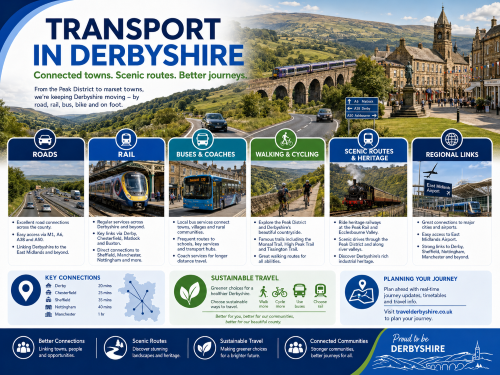
Derbyshire Connections Depend on Which Direction You Travel
Transport is another reason there is no single answer to why move to Derbyshire.
The county’s east has particularly strong north-south road links via the M1, while the A38 and A50 support journeys across other parts of Derbyshire and the wider Midlands.
Chesterfield has direct rail connections and is positioned for travel towards Sheffield, Derby, Nottingham and further afield.
Long Eaton gives residents access towards Derby and Nottingham.
Glossop and parts of the High Peak are more closely connected with Greater Manchester.
Buxton also has rail services towards Manchester.
Matlock follows the Derwent Valley toward Derby, while some rural and Peak District locations rely more on buses and private vehicles.
This is why a map can be misleading.
Two homes may be a similar distance from work but create very different daily journeys.
Before moving, compare:
- actual door-to-door travel time;
- railway station access;
- parking;
- bus frequency;
- peak-time road conditions;
- school runs;
- hybrid-working patterns;
- fuel and ticket costs.
A cheaper property further from work may not create a cheaper lifestyle once time and travel expenditure are included.
Weekends in Derbyshire Can Be Very Different From the Working Week
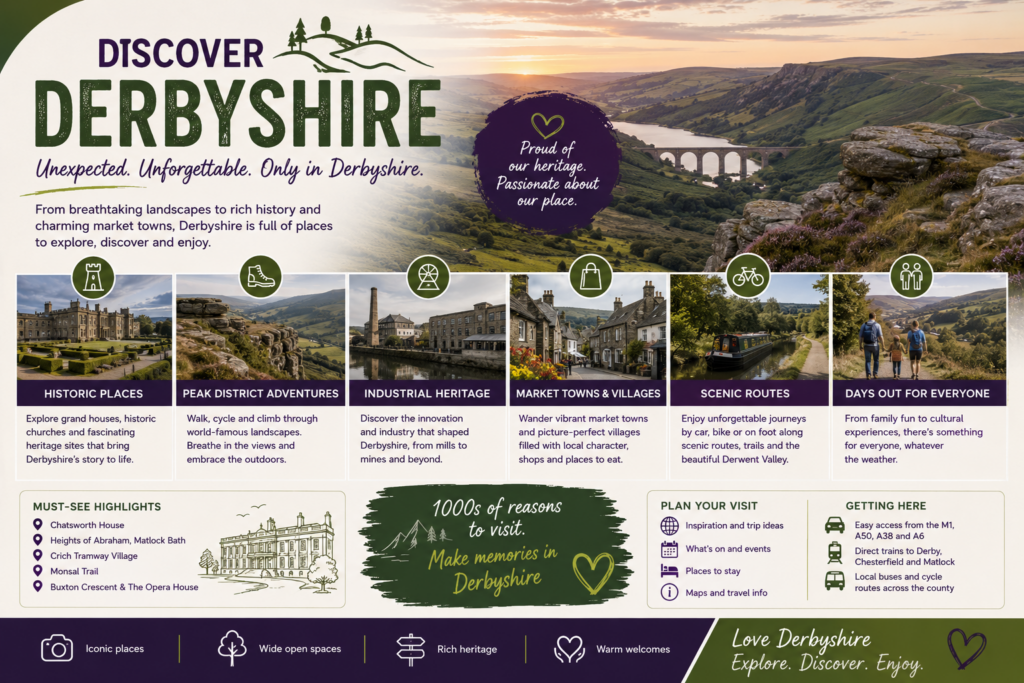
One of Derbyshire’s clearest attractions is the amount of outdoor life available without a long journey.
The Peak District offers contrasting landscapes, including the White Peak and Dark Peak, dales, gritstone edges, moorland, reservoirs, and established walking and cycling routes.
Residents can spend their time in very different ways.
That could mean:
- walking around Dovedale;
- cycling the Monsal Trail;
- visiting Chatsworth;
- exploring Castleton;
- climbing or walking around the Peak District edges;
- spending a day in Bakewell;
- visiting Buxton;
- exploring the Derwent Valley;
- walking around reservoirs;
- visiting historic market towns.
Derbyshire’s identity is also tied closely to its industrial and social history.
The Derwent Valley contains communities shaped by mills and manufacturing, while Chesterfield retains its market-town identity and distinctive crooked spire.
These things are easy to dismiss as attractions before moving.
Afterwards, they can become the places where weekends, hobbies and family time actually happen.
Food, Markets and Local Life Beyond the Tourist Trail
Living somewhere is different from visiting it.
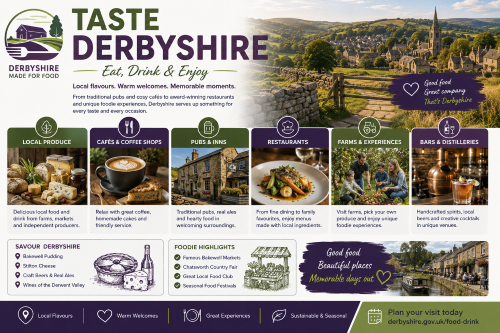
Derbyshire’s food and hospitality culture reflects both its rural economy and its towns for visitors.
Bakewell is best known for Bakewell pudding. Ashbourne has its own local food traditions, while Peak District villages offer a mix of country pubs, cafés, farm shops, and independent restaurants.
Chesterfield, Buxton, Matlock, Belper and other larger towns provide more everyday choices, from cafés and restaurants to markets and established high streets.
But the useful relocation question is not whether Derbyshire has good places to eat.
It is whether the area offers the type of everyday life you want.
That could mean:
- walking to a local café;
- having a market nearby;
- being able to meet friends without driving for an hour;
- buying locally produced food;
- reaching a supermarket easily;
- having pubs or restaurants within the community;
- being close to activities you will actually use.
A beautiful village may look perfect during a weekend visit.
Living there means thinking about a Tuesday evening in January as well as a summer Sunday afternoon.
Derbyshire Can Fit More Than One Stage of Life

One of the best reasons to move to Derbyshire is that the county doesn’t demand one particular lifestyle.
A first-time buyer may focus on Chesterfield, Ilkeston, Long Eaton, Ripley, or Swadlincote, depending on budget and work.
A family may value space, schools and transport around Dronfield, Belper or other established residential areas.
Someone working remotely may value access to the countryside more.
A higher-income household may consider a larger home in the Derbyshire Dales or selected Peak District villages.
A downsizer may prefer Matlock, Ashbourne, Buxton or another town where amenities can remain accessible.
Priorities differ, yet they can all exist within the same county.
That may ultimately be Derbyshire’s strongest argument.
The best place to move is not necessarily the one that looks most impressive on moving day. It is the place that continues to work after jobs change, children grow up, commuting patterns shift, and financial priorities evolve.
Browse Our Advisers in Derbyshire
Once you have narrowed down where you want to live, the next question is whether your mortgage fits the property and the circumstances behind the move.
Connect Experts lets you choose mortgage advisers by location and other relevant preferences.
Compare advisers based on the decision you need to make rather than simply choosing the closest postcode.
Connect Experts is a mortgage adviser directory and matching platform. It does not provide mortgage advice directly. Mortgage advice is provided by the adviser or firm you choose.



People who found this page helpful also explored these related topics:

Mortgage Broker in Matlock: Proven Local Adviser Search

Mortgage Broker in Shirebrook: Proven Mortgage Guidance

Mortgage Broker in Eckington for Confident Local Advice

Mortgage Broker in Bolsover: Proven Local Buyers Advice

Mortgage Broker in Heanor: Proven Local Mortgage Advice

Mortgage Broker in Glossop: Smart Local Mortgage Advice
Neighbouring Counties
FAQs: Why Move to Derbyshire?
Is Derbyshire mainly suitable for people who want rural living?
No. Rural and Peak District living are important parts of Derbyshire, but the county also includes substantial towns such as Chesterfield, Long Eaton, Ilkeston, Swadlincote, Belper and Ripley. The best area depends on whether you prioritise countryside, commuting, employment, schools, town-centre services, or a combination.
How different are house prices across Derbyshire?
They can differ significantly. In July 2026, the average property in the Derbyshire Dales was £355,000, compared with £254,000 in North East Derbyshire. Property type and individual location can create further differences, so use county averages as context rather than as a valuation.
What should I check before buying a rural Derbyshire property?
Consider the construction, condition, access, drainage, land, outbuildings and any unusual features alongside the purchase price. Some rural or older properties may require closer lender and valuation checks. A survey and appropriate legal enquiries can also be important before committing to the purchase.
Can Derbyshire work if members of the household commute to different cities?
Potentially. Different parts of Derbyshire connect towards Sheffield, Nottingham, Derby, Manchester and Birmingham. The practical answer depends heavily on the town or village, so compare rail connections, road access and actual door-to-door journey times for every regular commuter before deciding where to live.
Why can Peak District properties require different mortgage considerations?
Some Peak District homes are older, stone-built, listed, converted or include land and outbuildings. Those features don’t automatically prevent mortgage lending, but they can affect valuation and lender criteria. Therefore, assess the individual property rather than assuming every lender will treat it the same way.
Is Derbyshire suitable for someone planning to downsize later?
It can be. Towns such as Matlock, Ashbourne, and Buxton can offer access to shops, services, and countryside without the upkeep required for a large rural property. Anyone planning for later life should also consider accessibility, transport, healthcare, running costs and how future borrowing may change after retirement.