
Why move to Northamptonshire? Because where you live should do more than provide an address. It should make work, family life, travel, housing costs and the years ahead feel more manageable.
Northamptonshire sits between several major economic centres while maintaining its own identity. Northampton is the county’s largest urban centre, while Kettering, Corby and Wellingborough are established towns with strong transport links. Towcester and Brackley look south towards Buckinghamshire and Oxfordshire, while Oundle, Higham Ferrers and the Nene Valley provide a different market-town and rural character.
Since 2021, the county has been administered through North Northamptonshire and West Northamptonshire, and those two areas also show meaningful differences in housing costs.
For some households, the attraction is commuting. For others, it is finding more space, moving closer to work, choosing a market town or balancing access to several parts of England.
The useful question is therefore not simply why move to Northamptonshire?
It is which part of Northamptonshire works best for the life you want to build.
When the move becomes a mortgage decision, you can explore Mortgage Brokers in Northamptonshire and compare advisers covering different parts of the county.
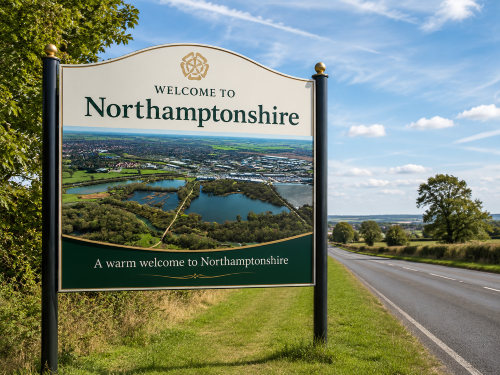
From Northampton to Oundle: Different Ways to Call the County Home

Northamptonshire cannot be summed up by Northampton alone.
Northampton provides the county’s largest concentration of shops, services, employment and university life. It also has a broad housing mix, from apartments and older terraces to suburban family homes and newer development.
Kettering and Wellingborough combine established residential areas with rail connections towards London.
Corby has expanded considerably over time, offering modern development alongside older neighbourhoods and employment areas.
Further south, Towcester and Brackley appeal to households wanting a market-town setting while keeping access to Milton Keynes, Oxfordshire, the M1, and the wider Midlands.
Oundle has a very different character, with historic streets, traditional buildings and a strong association with independent education.
Then there are the smaller towns and villages around the Nene Valley, south Northamptonshire, Rockingham Forest and the Grand Union Canal.
That range matters.
Someone searching why move to Northamptonshire might be looking for:
- easier access to London;
- a larger family home;
- a village property;
- proximity to Silverstone;
- a shorter journey to work;
- independent education;
- a first home with a different budget from surrounding counties;
- a quieter place for later life.
There is no single Northamptonshire lifestyle.
That is part of its appeal.
Two Housing Markets Tell a More Useful Story Than One County Average
Northamptonshire’s housing market is particularly useful to examine because the current administrative split gives buyers two distinct sets of local data.
The latest ONS figures show that in July 2026, the average house price in North Northamptonshire was £258,000. First-time buyers paid an average of £221,000, while mortgage-purchased homes averaged £257,000.
In West Northamptonshire, the average house price was £292,000. First-time buyers paid £242,000, while homes bought with a mortgage averaged £291,000.
That difference is more useful than presenting Northamptonshire as one uniform market.
Property type creates another layer of variation.
In North Northamptonshire, average July 2026 prices were:
- detached: £411,000
- semi-detached: £254,000
- terraced: £205,000
- flats and maisonettes: £119,000
In West Northamptonshire, they were:
- detached: £472,000
- semi-detached: £285,000
- terraced: £236,000
- flats and maisonettes: £140,000
That means the same household could be comparing very different decisions:
- a flat in Northampton;
- a family home in Wellingborough;
- a modern property in Corby;
- a detached house near Towcester;
- a period home in Oundle;
- a village property outside Brackley;
- a new-build around one of the county’s growth areas.
Property characteristics matter alongside price.
Leasehold flats, older stone homes, listed buildings, rural properties, barn conversions, modern estates and homes with larger plots may all raise different questions during valuation and underwriting.
First-time buyers who want to understand deposits, affordability and the application process can also read the First-Time Buyer Mortgage Guide.
For current local price data, see the ONS figures for North Northamptonshire and West Northamptonshire.
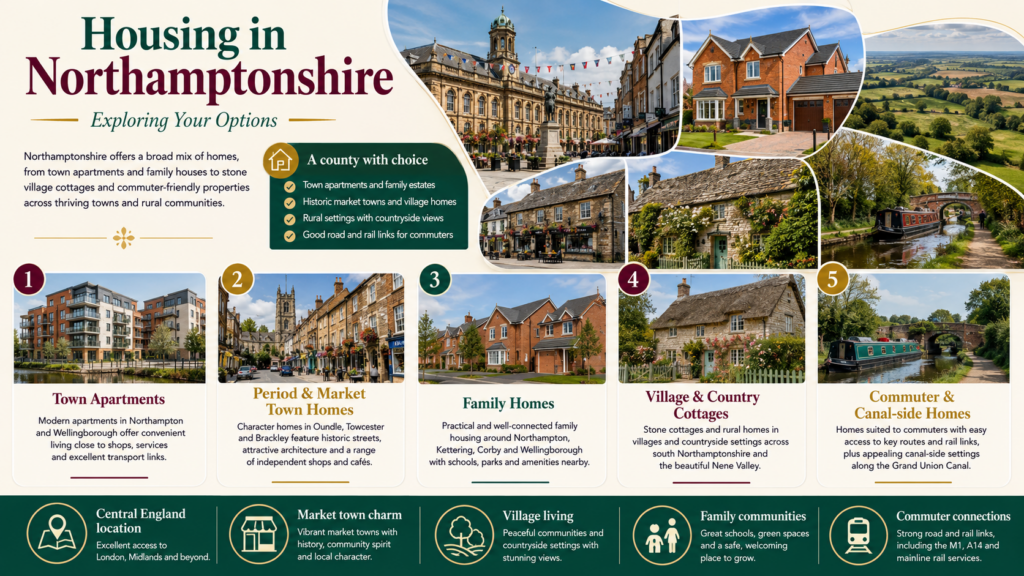
Education Can Change the Geography of a Move

For some households, the property search follows the school search.
Northamptonshire offers state education, further education, apprenticeships, university study and established independent education.
The University of Northampton operates from its Waterside Campus close to Northampton town centre. The university also provides more than 2,250 bed spaces across its university-owned halls, adding a distinct student element to the Northampton housing market.
Independent education is also a genuine consideration in parts of the county.
Oundle School accepts pupils through several entry points and offers both day and boarding education.
Northampton High School provides independent education from early years through to sixth form in Hardingstone.
A school decision can influence:
- where a family chooses to live;
- journey times;
- childcare arrangements;
- commuting patterns;
- household expenditure;
- the amount available for mortgage payments;
- whether one or both parents need easy road or rail access.
School fees sit outside the mortgage itself, but regular education expenditure can still affect affordability and longer-term household planning.
Where independent schooling forms part of that plan, Education Finance may be relevant.
The property and the life around it should be considered together.
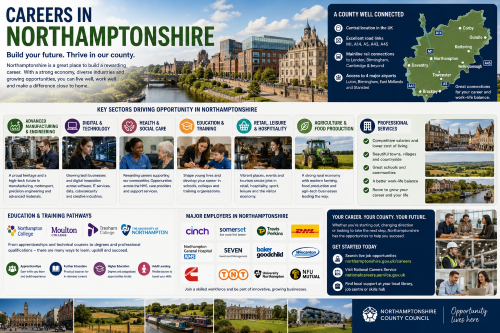
Work in Northamptonshire Is Not Defined by One Industry
A move to Northamptonshire does not necessarily mean commuting out of the county.
Its central position supports several important sectors, including logistics, engineering, manufacturing, construction, public services, healthcare, education and motorsport-related activity.
North Northamptonshire Council’s economic strategy highlights the area’s strategic road and rail connectivity and notes that job growth has outpaced working-age population growth over the past two decades.
Logistics is particularly visible along strategic road corridors such as the A14, and local planning policy recognises the importance of large-scale distribution and access to road and rail freight infrastructure.
Motorsport and high-performance engineering also give Northamptonshire an economic identity that few other counties can replicate.
The Silverstone area sits within a wider concentration of specialist automotive, engineering and technology activity.
Different industries also create different mortgage applicants.
One borrower may have a straightforward salary.
Another might receive:
- overtime;
- shift allowances;
- bonuses;
- commission;
- contract income;
- dividends;
- company-director income;
- retained profits;
- income from more than one employer or business.
That distinction matters because lender criteria vary.
Moving because of a new role can therefore change both where you want to live and how a lender assesses your income.
Northamptonshire's Position Changes How Far Away Places Feel
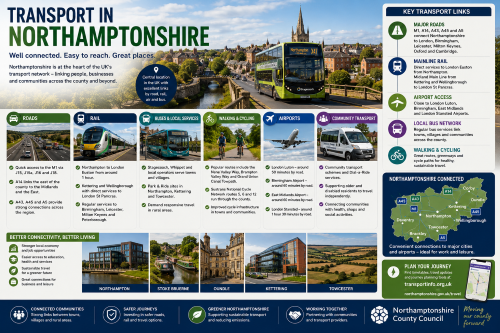
Transport is one of the strongest practical reasons to move to Northamptonshire.
The county sits close to several major routes, including:
- the M1;
- A14;
- A43;
- A45;
- A5.
These roads link to London, Birmingham, Milton Keynes, Leicester, Peterborough and Oxfordshire.
Rail connections create another option.
East Midlands Railway operates regular services between Corby, Kettering, Wellingborough and London St Pancras, with its Connect service running every 30 minutes in both directions.
Northampton also has rail connections towards London Euston and Birmingham.
That creates several different commuter patterns.
Someone living in Wellingborough may look south towards London.
A household in Brackley may have stronger links towards Oxfordshire, Buckinghamshire or the A43.
Towcester may suit someone working around Milton Keynes or Silverstone.
Kettering and Corby sit closer to the A14 and the wider East Midlands economy.
But assess transport as part of daily life, not by a headline journey time.
Before choosing an area, consider:
- station distance;
- parking;
- rail fares;
- school runs;
- peak traffic;
- hybrid working;
- road access;
- how often the journey will actually be made.
A cheaper property can still make household life more expensive if every working day requires more travel.
Motorsport, Heritage and Open Space Give Northamptonshire Its Own Identity
Northamptonshire’s central location could make it feel like somewhere between other places.
Its attractions prevent that from being the whole story.
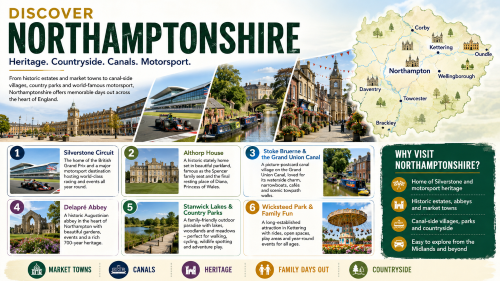
Silverstone Circuit is one of the county’s best-known names and reinforces Northamptonshire’s long association with motorsport and high-performance engineering.
Althorp adds a very different strand of heritage.
Delapré Abbey offers historic buildings and parkland near Northampton.
Wicksteed Park has shaped Kettering’s leisure landscape for more than a century.
Stanwick Lakes provides open space, walking, cycling and family activities within the Nene Valley.
The county also includes:
- Salcey Forest;
- Pitsford Water;
- Fineshade Wood;
- Stoke Bruerne;
- Grand Union Canal communities;
- market towns;
- historic churches and village centres.
This matters for relocation content because people do not only move towards an employer or away from a higher property price.
They move towards the kind of everyday life they want.
Dining Out: The Best Places to Dine in Northamptonshire
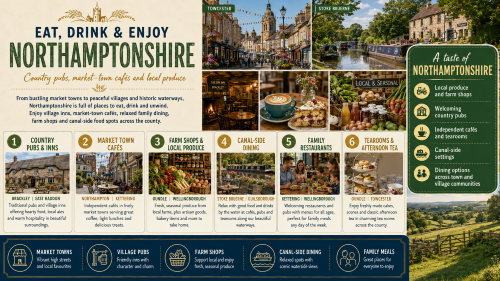
Northamptonshire has a varied food and drink scene. It includes country pubs, market-town cafés, farm shops, restaurants, tearooms and canal-side dining.
Northampton offers restaurants, cafés and bars for everyday dining. Kettering, Wellingborough, Corby, Daventry and Rushden also provide familiar favourites and local independents.
Market towns add more character. Oundle, Towcester, Brackley and Higham Ferrers offer cafés, pubs and relaxed places to eat. Many villages also have traditional inns and Sunday lunch spots.
The county works well for countryside dining. Rural pubs are common across south Northamptonshire, the Nene Valley and villages near Oundle. Canal-side pubs around Stoke Bruerne also suit walkers and weekend visitors.
Farm shops and local producers add to the appeal. Residents can find local meat, bakery goods, seasonal produce, cheeses, chutneys and gifts across the county. In addition, Northamptonshire’s event venues, heritage sites and country parks often support cafés and family-friendly food options.
For many movers, the dining scene is practical and relaxed. It offers choice without losing the county’s village and market-town feel.
The Mortgage Should Fit the Move, Not Dictate the Entire Move
A property budget matters, but it shouldn’t be the only measure of whether a move works.
Northamptonshire buyers may need to balance:
- deposit size;
- mortgage affordability;
- loan-to-value;
- childcare;
- commuting;
- school costs;
- other borrowing;
- council tax;
- household running costs;
- future changes to income.
Someone buying in Northampton may be making a different financial decision from a buyer choosing Oundle, Towcester, Brackley or a village in south Northamptonshire.
The property itself may also alter lender choice.
A newer Corby home may be straightforward from a construction perspective.
A listed or period property around Oundle could require a lender comfortable with older housing.
A rural home may include outbuildings, land, private drainage or non-standard access.
A Northampton apartment may involve lease length and service charges.
If you are comparing several parts of the county, Find a Mortgage Adviser by Location can help identify advisers covering the areas you are considering.
The useful question is not simply:
“What is the maximum I can borrow?”
It is:
“What level of borrowing still leaves enough room for everything else the move is meant to improve?”
That is where mortgage planning and relocation planning meet.

Larger Homes and More Complex Borrowing Need a Different Lens

Northamptonshire should not be described as a uniformly high-value county.
However, markets vary, and some parts of West Northamptonshire have substantially higher-value detached and rural homes.
ONS figures show that detached homes in West Northamptonshire averaged £472,000 in July 2026, compared with £411,000 in North Northamptonshire.
Higher-value housing can be found around parts of:
- Towcester;
- Brackley;
- Oundle;
- South Northamptonshire;
- selected villages close to the Buckinghamshire and Oxfordshire borders;
- rural locations surrounding Northampton.
Property value is only one part of the picture.
Applicants seeking larger mortgages may also have income from:
- bonuses;
- dividends;
- retained company profits;
- investment portfolios;
- partnership drawings;
- consultancy work;
- several businesses;
- multiple sources.
In these circumstances, the closest adviser may not necessarily have the most relevant experience.
High Net Worth Mortgage Brokers may be useful where borrowing size, assets or income structure require more specialist consideration.
That is a more natural reason to use HNW expertise than simply attaching the label to an expensive postcode.
A Northamptonshire Move Can Also Be About Having Less, Not More
Not every move is about adding bedrooms.
Some households move because their priorities have changed.
Later-life movers may be:
- downsizing;
- moving nearer children;
- looking for a smaller town;
- leaving a larger rural property;
- reducing maintenance;
- looking for easier transport access;
- moving after retirement;
- considering how property wealth fits into future finances.
Market towns such as Towcester, Oundle and Daventry can appeal for different reasons, while Northampton, Kettering and Wellingborough may provide easier access to larger services.
A later-life move also brings different financial questions.
These can include:
- whether an existing mortgage should be repaid;
- how pension income affects borrowing;
- whether selling releases enough capital;
- whether the next home should be owned outright;
- how inheritance plans influence the decision;
- whether housing wealth should form part of retirement planning.
Equity release is not the same as a standard residential mortgage and should be considered as a separate specialist decision.
Homeowners exploring that route can read about Equity Release Advisers in Northamptonshire.

Northamptonshire Can Make Sense at More Than One Stage of Life
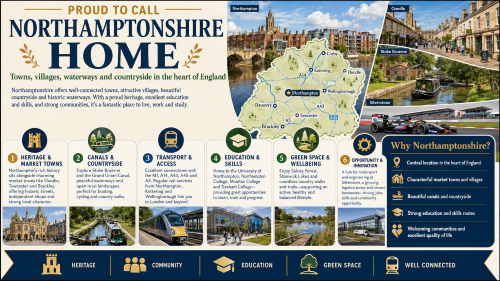
The answer to why move to Northamptonshire can change over time.
A graduate may choose Northampton for university or work. A first-time buyer may compare Northampton with Corby, Wellingborough, or Kettering. A family may look towards larger homes, schools and road connections.
Someone working in motorsport or engineering may focus on Towcester, Brackley or the Silverstone corridor.
A senior professional may prioritise rail links and motorway access.
Someone approaching retirement may prefer Oundle, Daventry, a village or a smaller market town. That flexibility is one of Northamptonshire’s practical strengths.
It is possible to move between urban, suburban, market-town and rural settings without necessarily moving far from the county’s major transport network.
A successful move should make sense when you collect the keys.
A better one should still make sense when work changes, children grow, commuting patterns shift or priorities become different.
Browse Our Advisers in Northamptonshire
Once you know where you want to live, the next decision is whether the mortgage fits the property and the household.
Connect Experts lets you compare advisers by location, mortgage expertise, and other useful preferences.
Local knowledge may help, but distance should not be the only consideration. Specialist experience matters more when the property, income, or borrowing requirement is less straightforward.
Find a Mortgage Adviser and compare advisers before deciding who you would like to contact.
Connect Experts is a mortgage adviser directory and matching platform. It does not provide mortgage advice directly. Advice is provided by the adviser or firm you choose.

People who found this page helpful also explored these related topics:

Mortgage Broker in Boughton: Practical Homebuyer Advice

Mortgage Broker in Guilsborough: Smart Advice That Fits

Mortgage Broker in Little Houghton: High Net Worth Advice

Mortgage Broker in Wootton: Trusted Proven Advice Guide

Mortgage Broker in Collingtree: Trusted Mortgage Advice

Mortgage Broker in West Haddon: Smart, Proven UK Advice
FAQs: Why Move to Northamptonshire?
Are house prices the same across North and West Northamptonshire?
No. ONS data for July 2026 shows the average house price in North Northamptonshire at £ 258,000, compared with £292,000 in West Northamptonshire. First-time buyers paid averages of £221,000 and £242,000, respectively. Individual towns and property types can differ substantially from those averages.
Which Northamptonshire locations suit market-town living?
Oundle, Towcester, Brackley and Higham Ferrers are among the locations where buyers can find a stronger market-town character. Daventry also provides a smaller-town alternative to Northampton. The right choice depends on transport, budget, schooling, and where household members need to travel.
Does Northamptonshire work for people employed in motorsport or engineering?
It can. The Silverstone area is strongly associated with motorsport and high-performance engineering, and the county’s road network also provides access to nearby automotive and technology centres. People relocating for specialist work should consider both the workplace location and how their income is structured when arranging a mortgage.
What should families compare before moving to Northamptonshire?
Compare the property alongside school journeys, childcare, commuting, household bills and access to local services. Families considering independent education may also want to look at established schools around Northampton and Oundle and assess how recurring education costs affect the wider household budget.
Is North Northamptonshire or West Northamptonshire better for first-time buyers?
Neither is automatically better. Average first-time buyer prices were lower in North Northamptonshire in July 2026, at £221,000 compared with £242,000 in West Northamptonshire. However, the right area depends on the individual property, deposit, income, commute, and lifestyle requirements, not the authority-wide average alone.