
Why move to Somerset? Because moving isn’t simply a decision about where to put your furniture. It is a decision about how much space you want around your life, how close you need to be to work, what you want weekends to feel like and whether the place you choose can still suit you years from now.
Somerset gives people unusually different ways to answer those questions.
Taunton provides county-town services and transport. Bridgwater sits close to major energy and industrial investment. Yeovil has an established employment base. Wells offers a much smaller cathedral-city setting. Frome has developed a strong, independent, creative identity, while Street and Glastonbury have their own distinct character.
Further west, Minehead, Watchet, Porlock, and the Exmoor coast offer a different relationship with the landscape and a different pace of life.
That range is central to why move to Somerset. The county is not one lifestyle or one housing market. The right location depends on what you want the move to change.
When the lifestyle decision becomes a mortgage decision, you can explore Mortgage Brokers in Somerset and compare advisers who cover different parts of the county.
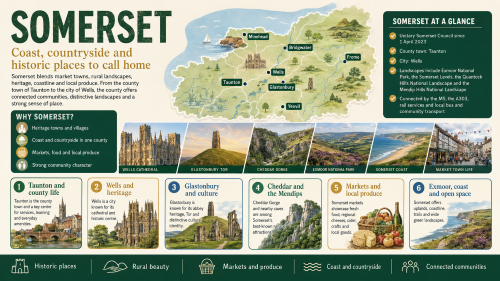
Market Towns, Moorland and Coast: Choosing Your Somerset
Somerset makes more sense as several local markets rather than one large rural county.
Taunton combines shopping, schools, employment and rail connections with access towards the Quantock Hills.
Bridgwater has a more industrial and commercial character and sits close to Hinkley Point C and the Gravity Enterprise Zone.
Yeovil serves much of south Somerset and has longstanding links with advanced engineering and aerospace.
Wells provides compact city living around a historic centre, while Frome combines period housing, independent businesses and cultural activity.
Street and Glastonbury sit close together geographically but offer very different town identities.
West Somerset changes again. Minehead, Watchet, Dunster, Porlock and communities towards Exmoor offer coastal or countryside living, but day-to-day travel can require more planning.
This is why two households asking why move to Somerset may reach completely different answers.
One may want a railway station.
Another may want a village on the edge of Exmoor. A third may be moving for work around Bridgwater. The county’s value lies in offering those choices without every location feeling the same.
Somerset Housing: The Property Can Change as Much as the Postcode
Somerset’s property market includes modern estates, terraced houses, stone cottages, Victorian and Georgian homes, rural properties, listed buildings, converted barns, coastal houses and new-build developments.
The latest ONS figures show that the average house price in Somerset was £282,000 in July 2026, up 3.1% from July 2025. First-time buyers paid an average of £232,000, while mortgage buyers paid an average of £278,000.
By property type, the July 2026 averages were:
- Detached: £460,000
- Semi-detached: £289,000
- Terraced: £234,000
- Flats and maisonettes: £136,000
Those numbers provide useful context, but they shouldn’t be mistaken for the price of a particular Somerset home.
A buyer might be comparing:
- a flat or terrace in Taunton;
- a family home around Bridgwater;
- a period property in Wells;
- an older home in Frome;
- a cottage outside Somerton or Langport;
- a coastal home around Minehead;
- a rural property with land or outbuildings.
Property characteristics can affect lender assessment as much as location.
Listed status, non-standard construction, acreage, private access, agricultural ties, holiday-use restrictions, flood considerations or substantial outbuildings may all require closer attention during valuation and underwriting.
For first-time purchasers who want to understand the borrowing process in more detail, the First-Time Buyer Mortgage Guide can provide useful supporting information.

Schools Can Become Part of the Moving Decision
For families, choosing a Somerset location may also mean deciding how education fits with housing, commuting, and household spending.
The county includes state schools, further education providers and established independent schools.
Millfield is based in Street, with its preparatory school in Glastonbury. The school describes itself as an independent school for pupils aged 2 to 18.
King’s College Taunton is another established independent school, offering day and boarding education in Taunton.
That matters because school decisions rarely exist in isolation from the move itself.
Families may need to compare:
- school journey times;
- school transport;
- childcare;
- whether both adults commute;
- termly fees where applicable;
- the cost of moving closer to a preferred school;
- how regular education costs affect mortgage affordability.
Millfield’s published 2026/27 fees, for example, show how significant independent education can become within long-term household expenditure.
Where independent education is part of the plan, Education Finance may be relevant.
A larger house near the right school may solve one problem, but the better decision is the one that keeps the wider household budget workable.
Somerset's Economy Is Changing Alongside Its Landscape
Moving to Somerset doesn’t necessarily mean leaving economic opportunity behind.
Somerset Council’s Economic Prosperity Strategy 2025-2045 identifies low-carbon energy, aerospace and defence, high-value manufacturing, and digital and data as important parts of the county’s future economy.
Two developments are particularly significant.
Hinkley Point C, on the West Somerset coast, is a nationally significant infrastructure project. Somerset Council says the development is intended to provide low-carbon electricity for around six million homes and has created employment, skills and local supply-chain opportunities.
Near Puriton, the Gravity Enterprise Zone is another major growth site. The Agratas battery manufacturing development represents around £4 billion of investment and is expected to create up to 4,000 direct jobs.
Elsewhere, Yeovil retains strong links with aerospace and advanced engineering, while Taunton supports public services, professional employment, healthcare and local business.
This creates a varied borrower profile.
A Somerset applicant may have:
- conventional PAYE income;
- overtime or shift payments;
- contractor income;
- company-director earnings;
- retained profits;
- self-employed income;
- seasonal or tourism-related income;
- more than one source of earnings.
Those differences matter because lenders don’t base criteria simply on where someone works. They depend on how reliable and assessable the income is.

Roads, Rail and Rural Distance All Matter in Somerset
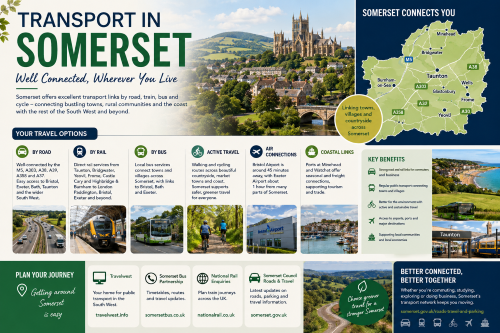
Transport is one area where Somerset demands realistic thinking.
Some locations are well connected. Others offer more space and scenery in exchange for longer journeys.
The M5 provides an important north-south route through the county, linking areas around Bridgwater and Taunton with Bristol, Gloucestershire and Devon.
The A303 is a major east-west route through south Somerset, while the A358, A38, A37 and A39 connect different parts of the county.
Rail stations include Taunton, Bridgwater, Castle Cary, Frome and Yeovil, among others.
For people considering Street or Glastonbury, road access may matter more because neither town has its own mainline railway station. Millfield’s own travel information, for example, identifies Castle Cary as one nearby rail option for Street.
This means transport should be judged by everyday routine rather than a map alone.
Consider:
- distance to the station;
- parking;
- school journeys;
- access to major roads;
- frequency of public transport;
- hybrid working;
- travel to Bristol, Exeter or other employment centres;
- whether living rurally means relying on a car.
A house may appear cheaper further from a town, but lower mortgage costs do not automatically mean lower total household costs.
From Glastonbury Tor to Exmoor: What Somerset Gives You Outside the Front Door
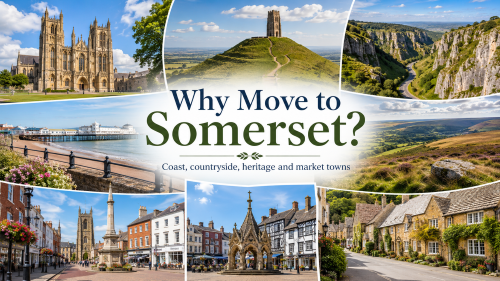
Somerset’s natural and cultural identity is one of the strongest reasons to move to Somerset.
The county includes landscapes and destinations that feel very different from one another.
Exmoor offers walking, cycling, dark skies, and dramatic countryside.
The Somerset coast includes communities from Minehead and Watchet towards Porlock, with access to coastal walking and the start of the South West Coast Path.
Further east, Somerset is associated with places such as:
- Glastonbury Tor;
- Wells Cathedral;
- Cheddar Gorge;
- the Mendip Hills;
- the Quantock Hills;
- Dunster;
- Somerset Levels;
- historic market towns and villages.
This matters because lifestyle shouldn’t be treated as decoration around the property decision.
The surroundings are part of what you’re buying, even if indirectly.
Someone choosing a home near Exmoor is making a different lifestyle decision from someone choosing Bridgwater for employment or Frome for its independent character.

Food, Markets and Everyday Somerset Life

A move becomes real through ordinary routines.
Where will you shop?
Where will you meet friends?
What does a Saturday look like?
Somerset has a particularly strong connection with local food and agriculture.
Its identity includes cider, Cheddar cheese, farm shops, local produce, markets, bakeries, village pubs and independent cafés.
Frome has a strong independent retail and market culture.
Wells combines a historic centre with cafés, restaurants and local shops.
Taunton and Yeovil provide broader town-centre choices.
In west Somerset, coastal communities such as Minehead and Watchet add seafood, harbour settings and tourism-based hospitality.
Rural areas offer a different rhythm again, with village pubs, local farms and seasonal produce forming part of everyday life.
These things may appear secondary during a property search.
Once somebody lives there, they often become central to whether the place feels right.
Planning the Mortgage Around the Somerset Move
The mortgage should support the move, not dictate every part of it. Someone buying in Taunton may be looking at a conventional family property. A purchaser in Wells may be considering an older or listed home.
A buyer near Exmoor may encounter land, outbuildings or private access. A coastal purchase can raise questions about construction, insurance, or flood information.
That can influence:
- deposit requirements;
- loan-to-value;
- valuation;
- affordability;
- lender selection;
- mortgage term;
- required documents;
- the amount of borrowing that remains comfortable.
If you are comparing several parts of the county, Find a Mortgage Adviser by Location can help you identify advisers serving the areas you are considering.
The more useful question is not always:
“What is the maximum I can borrow?”
It can be:
“What level of borrowing still allows the move to improve the life I am moving for?”
That distinction matters when a new home also changes travel costs, school costs, maintenance, energy use, or other household commitments.

Larger Homes, Rural Property and Complex Income in Somerset

Somerset should not be labelled a high-net-worth county overall.
However, parts of the county have larger rural homes, substantial period houses, and higher-value property, where borrowing requirements can become more specialist.
Areas such as Bruton, Frome, Wells, parts of the Mendips, selected villages around Taunton and some rural locations can include properties that sit well above the county average.
The ONS figure of £460,000 for the average detached Somerset property in July 2026 also shows how different the upper end of the market can be from flats or terraced housing.
The borrower may also be more complex than the property.
Income could include:
- partnership drawings;
- dividends;
- retained company profits;
- investment income;
- bonuses;
- multiple businesses;
- property income;
- overseas income.
In those circumstances, choosing an adviser solely because they are geographically closest may not be the best approach.
Experience with High-Net-Worth Mortgage Brokers may be relevant when the borrowing requirement, property, or income structure falls outside straightforward lender criteria.
A Somerset Move Can Also Be About the Next Stage of Life
Not every move is about gaining another bedroom.
For some households, why move to Somerset becomes a retirement question.
Someone may want to:
- leave a larger city;
- move closer to family;
- downsize;
- reduce household costs;
- exchange a larger property for a smaller town or coastal home;
- live closer to countryside;
- use property wealth differently in retirement.
West Somerset, parts of Exmoor, Wells, smaller market towns and coastal communities may appeal to people whose priorities have shifted away from commuting. But later-life moves create different financial questions.
Pension income may replace salary. An existing mortgage may still need to be repaid.
Downsizing may release capital, but moving costs still need to be considered.
Some homeowners may also begin exploring whether housing wealth should form part of wider retirement planning.
If you’re considering equity release, treat it as a separate specialist decision. Homeowners can explore Equity Release Advisers in Somerset for more information.
Eligibility alone does not make equity release suitable. The impact on inheritance, future options, interest and means-tested benefits also needs to be considered.

Why Somerset Can Suit More Than One Chapter of Life
A useful test of a location is whether it still makes sense when circumstances change. A first-time buyer might choose Taunton, Bridgwater or Yeovil because of budget, work and transport. A family may focus on school access, bedrooms and everyday services.
Someone working around Hinkley Point C or Gravity may prioritise road connections and commuting.
A self-employed household may choose a smaller town because hybrid working reduces the need to live close to a major employment centre.
A later-life mover may value Wells, the coast or access to Exmoor more than journey time to an office.
Somerset does not offer one universal version of a better life.
Its appeal is that it allows people to make different trade-offs between price, space, travel, countryside, coast and community.
That may ultimately be the strongest answer to why move to Somerset.
A successful move should still feel like the right decision after the boxes are unpacked, the commute has become routine, and the novelty of the new postcode has disappeared.
Browse Our Advisers in Somerset
Once you know which part of Somerset may suit you, the next step is to understand whether the mortgage works with the property and your circumstances.
Connect Experts allows users to compare advisers by location and other relevant preferences.
The aim is not simply to find the closest postcode. It is to find an adviser whose experience fits the decision you need to make.
Connect Experts is a mortgage adviser directory and matching platform. It does not provide mortgage advice directly. Mortgage advice is provided by the adviser or firm you choose.





People who found this page helpful also explored these related topics:

Mortgage Broker in Yeovil: Mortgage Advice BA20 & BA21

Wells Mortgage Broker: Advice for Buyers and Movers

Mortgage Advice in Wellington: Buyers, Movers & Owners

Taunton Mortgage Advisers: Search by Your Circumstances

Street BA16 Mortgage Adviser Search

Mortgage Broker in Shepton Mallet BA4: Mortgage Advice
Neighbouring Counties
FAQs: Why Move to Somerset?
Does living in rural Somerset usually mean relying on a car?
In many villages, a car can be important because public transport is less frequent than in larger towns. Buyers should check the practical journey to work, schools, shops and railway stations rather than judging distance from a map alone. Taunton and several other larger Somerset locations offer stronger rail and bus connections.
How different are house prices across Somerset property types?
The difference can be significant. ONS figures for July 2026 put the average Somerset detached property at £460,000, compared with £234,000 for a terraced home and £136,000 for a flat or maisonette. Location, condition, and the individual property can create further variation.
Which Somerset locations may suit someone relocating for work?
That depends on the employer and travel pattern. Bridgwater may be practical for employment linked to Hinkley Point C and the Gravity area, while Taunton has broader professional and public-sector employment. Yeovil has an established engineering and aerospace economy. Hybrid workers may have greater freedom to consider smaller market towns and rural locations.
What should I check before buying an older or rural Somerset property?
Consider construction, listed status where relevant, access, land and outbuildings, drainage, flood information, planning restrictions and whether the property meets normal lender criteria. Discussing unusual features with a mortgage adviser before applying can help identify whether specialist lender criteria may be needed.
Can Somerset work for families considering independent education?
Yes, depending on the preferred school and household budget. Somerset includes independent schools such as Millfield in Street and King’s College Taunton. Families should consider school fees, travel and childcare alongside mortgage affordability rather than treating education and housing as separate financial decisions.
Is Somerset only attractive to people looking for a quieter retirement?
No. Somerset also has substantial employment activity in energy, aerospace, advanced manufacturing, digital sectors and public services. Hinkley Point C and the Gravity Enterprise Zone are two major investment projects shaping the county’s economic geography.